

Last updated: August 3, 2026
Growing Hollyhocks in the Cottage Garden
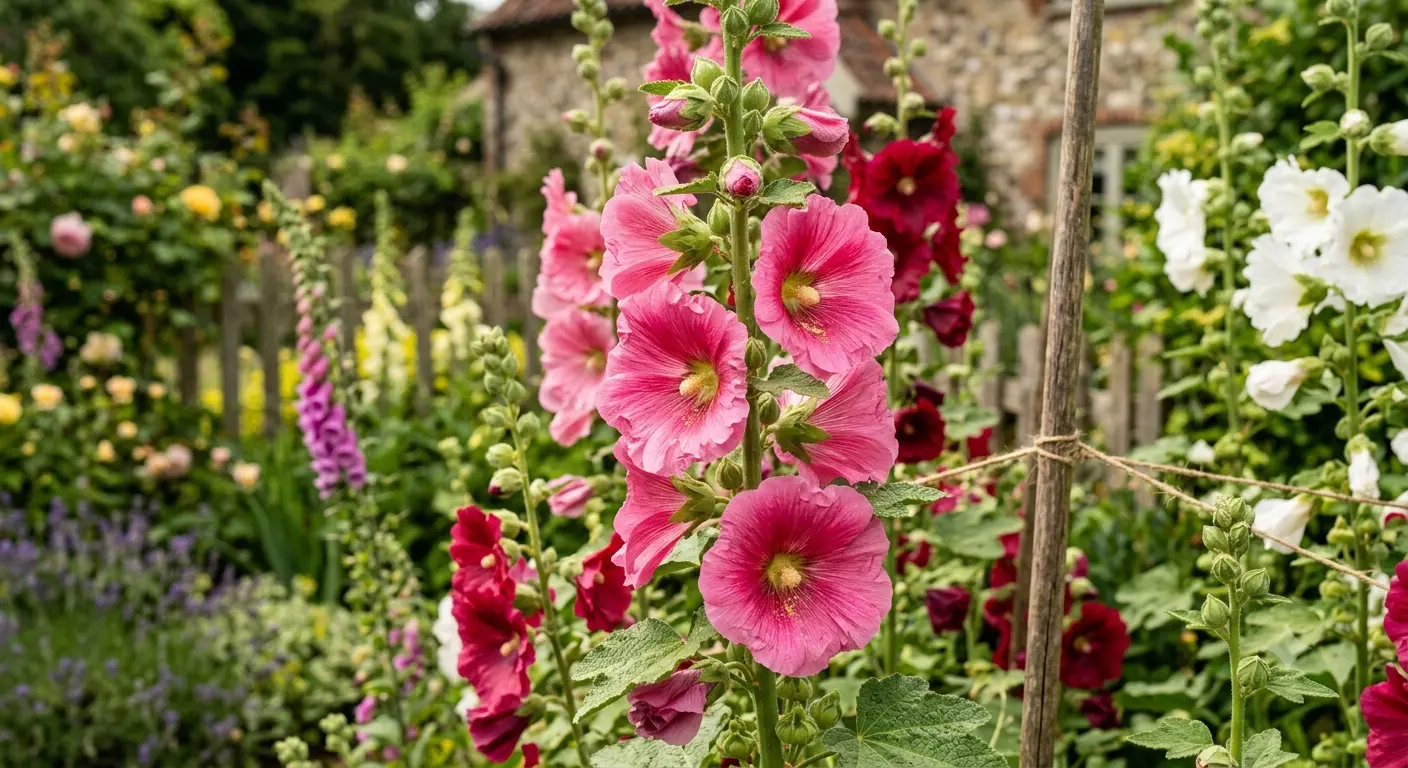
Hollyhocks (Alcea rosea) are the tall, old-fashioned flower that turns a plain fence line into a cottage garden — spires of saucer-shaped blooms rising 150–245 cm (5–8 ft) in pink, red, white, yellow, lavender, and near-black from midsummer into fall. They grow easily from seed, take hard winters in stride, and once planted they self-sow into a rolling colony that returns on its own year after year.
The two things every new hollyhock grower needs to understand are the clock and the rust. Most hollyhocks are biennial — leaves the first year, flowers the second — though a few strains bloom in year one, and rust is the single disease that dogs the plant. This guide covers both, plus choosing a variety, sowing for early or biennial bloom, climate and zone timing across North America, watering and staking, companions, deadheading, saving your own seed — including the weevil that eats it from inside the pod — and the plant’s long history and edible uses.
Hollyhock Varieties to Grow
Hollyhocks split first by flower form — single or double — and that choice matters more than colour. Singles show an open cup with the centre exposed, so single-flowered varieties feed pollinators; doubles pack extra petals into a frilly pom-pom that looks lush but buries the nectar. After form, it comes down to height and colour.
| Hollyhock Seed Variety | Flower Form | Height | Colour | Best For |
|---|---|---|---|---|
| Black Watchman | Single | 150–210 cm (5–7 ft) | Near-black maroon | Pollinators, dramatic contrast |
| Chater’s Double | Fully double | 180–245 cm (6–8 ft) | Mixed, scarlet to white | Showy borders, cut flowers |
| Indian Spring | Single & semi-double | 150–180 cm (5–6 ft) | Soft pink & white | First-year bloom, pastels |
| Mixed Colours | Single | 150–245 cm (5–8 ft) | Full colour range | All-round cottage colour |
For a first planting, a single mix or Indian Spring gives you height, pollinator value, and the quickest results. Add Black Watchman where you want the near-black flowers to punch against a pale wall, and grow Chater’s Double if you’re after cut flowers or a formal, full-petalled look — many gardeners plant both a single and a double, since they need identical care and bloom together.
Before You Grow Hollyhocks
Are Hollyhocks Annual, Biennial, or Perennial?
Hollyhocks are short-lived perennials that most gardeners grow as biennials: a leafy rosette the first year, flowers the second year, then decline. Because they drop seed so freely, a planting appears to come back forever; in reality it is a rolling succession of new plants, not the same crowns regrowing.
That distinction is worth getting right, because it explains the missing first-year flowers that frustrate most new growers. Illinois Extension’s guide to growing and caring for hollyhocks describes the plant as a biennial that grows as a rosette of leaves in year one and flowers in year two, occasionally behaving as a short-lived perennial and readily self-seeding to persist in the garden. Which way a given plant goes tracks the strain and whether you let it seed, not your winter: newer strains are bred as short-lived perennials, and a plant stopped from setting seed will often push a third season. No published source ties hollyhock longevity to a hardiness zone.
A few strains bloom their first year from an early indoor start, and Indian Spring is the best known of them. Be clear-eyed about that label, though: All-America Selections records only the 1939 flower award and the breeder for Indian Spring, and no extension service documents first-year bloom as a trait of that cultivar — it is seed-trade description, not tested performance. The trait itself is real and old. Toronto’s Steele, Briggs Seed Co. was selling an annual hollyhock strain that flowered from seed the first year in 1909, from a March or April indoor sowing set out in May. These strains are open-pollinated and come fairly true from saved seed, which is what lets a colony renew itself in roughly the same colours rather than drifting to muddy pinks in a couple of generations.
Choosing a Site for Hollyhocks
Plant hollyhocks in full sun — at least 6 hours a day — in deep, free-draining soil, and choose the spot carefully because the taproot resents being moved. Shade produces weak, leaning stalks that need staking and flower poorly, while soggy winter ground invites crown rot. A place against a fence, wall, or the back of a border is ideal: the height becomes a feature, the structure offers wind support, and taller plants screen the coarse lower leaves that hollyhocks always end up with.
Give each plant room for air to move around it, which is your first and cheapest defence against rust. NC State Extension’s Alcea rosea toolbox entry puts a mature plant’s ground width at 30–60 cm (12–24 in) and its spacing range anywhere from 30 to 90 cm (12 in to 3 ft); no extension service commits to a single number, only to the instruction to space for air movement. Settle at 45–60 cm (18–24 in) and you leave a real gap for foliage to dry after rain rather than a solid wall of wet leaves.
How to Grow Hollyhocks from Seed
Hollyhock seeds are large, flat, and easy to handle, and they germinate readily — provided you do not bury them. Cornell’s growing guide is blunt on the point: do not cover the seed, because light aids germination. That one instruction is where most failed hollyhock sowings go wrong. You can start seed indoors for earlier flowers or sow straight into the garden — indoor and outdoor sowing are two separate procedures, so here is each in turn.
Starting Hollyhock Seeds Indoors
Start hollyhock seeds indoors 6–8 weeks before your last frost, or 8–10 weeks for a first-year-blooming strain. No extension service publishes a sowing-to-transplant interval for hollyhock, so treat those as working numbers rather than a specification; the oldest written protocol is the 1909 Canadian one — sow March or April, plant out in May. An early start is the only way to get flowers the same season from most varieties.
- Press one seed onto the surface of each deep cell or pot and do not cover it — hollyhock germinates on light, so a skim of vermiculite is the most that should ever go over the seed. Deep containers matter more than wide ones, because they let the taproot run straight down.
- Keep the mix evenly moist and ordinary room-warm — published germination temperatures for hollyhock range from 13–16°C (55–60°F) to 25°C (77°F) depending on who you read, so no single figure is worth chasing. Seedlings break the surface in 10–14 days.
- Grow the seedlings under bright light as soon as they sprout so they stay short and sturdy instead of stretching into weak, leggy stems.
- Harden off over 7 days, then transplant after your last frost, disturbing the root ball as little as possible.
Because hollyhocks hate root disturbance, sowing into deep individual pots — or soil blocks — pays off at transplant time far more than it does with fibrous-rooted annuals. If you are new to indoor sowing, our walkthrough on starting seeds indoors covers lights, timing, and hardening off in detail.
Direct Sowing Hollyhock Seeds Outdoors
Direct-sow hollyhock seeds from spring through late summer in full sun. Cornell and the University of Maine both put the back end of that window two months before the first hard fall frost — late enough that the seedling is still a rosette going into winter, early enough that it hardens off. University of Maine Extension’s answer on fall hollyhock sowing adds a 12-hour warm-water soak first, then laying the seed on the surface for light. Sown outdoors, most varieties spend the first year as foliage and flower the next — the natural biennial rhythm, and the easiest way to grow them if you can wait a season.
- Rake the bed smooth and press the seeds firmly onto the surface, leaving them uncovered or under nothing more than a dusting of fine soil; burying them is the most common reason a direct sowing fails.
- Sow a little thicker than you need, then thin the seedlings to 45–60 cm (18–24 in) apart once they have a few true leaves.
- Keep the soil evenly moist until the seedlings are established — a dry spell at the two-leaf stage is what usually thins a sowing for you.
- For flowers next summer, sow at least two months before first hard frost so plants build a strong rosette and a real taproot before the ground freezes.
Germinating Hollyhock Seeds
Hollyhock seed sprouts in 10–14 days and needs no chilling, scarifying, or special treatment — but it does need light. Cornell’s hollyhock growing guide gives both the 10-to-14-day emergence figure and the instruction not to cover the seed at all, because light aids germination.
There is no dormancy to break either. A 2023 seed-morphometry study in Fronteiras germinated untreated hollyhock seed at over 93%, so the overnight soak the University of Maine recommends evens out emergence rather than softening a hard coat. Older seed, or a cold snap after sowing, stretches emergence toward three weeks.
Our pillar guide to germinating seeds successfully covers the moisture and light principles behind all of this.
Growing Hollyhocks Across North American Climates
Hollyhocks grow from the coldest Prairie gardens to the Gulf Coast, but the limiting factor shifts by region. Match your care to your climate; our North American planting calendar carries the frost dates behind every timing on this page.
Planting Hollyhocks by Zone
Timing decides whether you wait one season or two for bloom. Missouri Botanical Garden’s Alcea rosea profile rates hollyhock at 5–8 ft across Zones 2 to 10, the widest band any source gives it; Cornell stops at Zones 3 to 9 and NC State at 5 to 9b. What changes by region is not the hardiness rating but the sowing month.
This calendar sets sowing and flowering windows by zone across the US and Canada.
| Zone / Region | Start Indoors | Direct Sow / Transplant | Bloom Window | Key Adjustment |
|---|---|---|---|---|
| Zones 2–4 — AB, SK, MB, N. ON; MN, ND, MT, WY | Mid–late March (8–10 wks) | Late May–June | July–Aug (yr 2; yr 1 for early strains) | Grow first-year strains; mulch crowns for winter |
| Zones 5–6 — S. ON, QC, Maritimes; MI, NY, OH, PA | Late March–April | May | July–Sept (yr 2; yr 1 for early strains) | Stake against summer thunderstorms |
| Zones 7–8 — coastal BC; VA, TN, OR, WA | Optional (Feb–Mar) | Spring, or late summer for next-year bloom | June–Aug | Fall sowing works; watch rust in humidity |
| Zones 9–10 — FL, TX, CA, AZ Low Desert | Not needed | After last frost through June | Summer into fall | Grow as an annual; pull at the first frost; afternoon shade |
The far South runs on a different clock than the rest of the continent. University of Florida IFAS Extension’s note on growing hollyhock in North Florida plants from the last threat of frost through June and treats hollyhock as a summer-and-fall bloomer pulled at the first sign of frost — an annual, not the fall-sown cool-season crop it is often described as below Zone 9. Zone 11 is outside every published hardiness rating for the species.
Caring for Hollyhocks Through the Season
Watering Hollyhocks
Water hollyhocks at the base and never over the foliage — with this plant, how you water matters far more than how much. University of Minnesota Extension’s rust factsheet for the flower garden is specific about the method: use drip irrigation or a soaker hose to put water on the soil rather than the leaves, and if you have to use a sprinkler, run it early on a sunny day so the foliage dries fast.
Volume is the part nobody has pinned down. No extension service publishes a weekly water figure for hollyhock, and the plant profiles that do describe its needs put them at plain medium moisture in free-draining ground — so water deeply when the top few centimetres dry out and stop counting inches. Established plants ride out short dry spells; seedlings and first-year rosettes want steadier moisture. The moisture that kills hollyhock is winter wet: Missouri Botanical Garden warns the plant will not tolerate soggy winter soils, which is why drainage beats irrigation here.
Fertilizing Hollyhocks
Go light on the feed. No extension service publishes a fertilizer schedule for hollyhock, and Cornell’s growing guide points the opposite way from generosity — it warns that plants may need staking especially in rich soils. A spring topdressing of compost plus one balanced feed as spikes form is plenty, and compost-improved ground often carries them through with nothing more. Too much nitrogen produces soft, floppy growth and a mass of coarse leaves at the expense of flowers — the classic result of treating a hollyhock like a tomato.
Staking Hollyhocks
Tall, flower-laden spikes snap or lean in summer storms, and double varieties topple first because their heads carry the most weight. A little support at the right moment keeps them standing.
- Stake any plant over 180 cm (6 ft), or any plant in an exposed windy site, before the spike gets top-heavy with open bloom.
- Tie stems loosely to a bamboo cane or metal stake with soft twine, leaving room for the stalk to flex rather than lashing it rigid.
- Better still, plant against a fence or wall for built-in support and skip staking altogether.
There is also a way to need less support in the first place. Illinois Extension’s Hort Answers hollyhock entry recommends pinching the main stem early in the season to produce bushier, shorter plants less likely to need staking at all. You trade some spike height for a plant that holds itself up — a reasonable bargain in an exposed garden, and the only preventive on this list that costs nothing.
🍂 Managing Hollyhock Rust
Hollyhock rust is the plant’s signature disease and the one problem you will manage every season. It disfigures foliage badly but rarely kills an established plant, so the whole strategy is sanitation, airflow and timing rather than rescue.
Identifying Hollyhock Rust
Look on the undersides of the lowest leaves first. Wisconsin Horticulture’s hollyhock rust factsheet describes orange-to-yellow spots roughly 3–6 mm (⅛–¼ in) across on the lower leaves, with brown to dark-red raised pustules developing on the undersides beneath them. Those pustules are the diagnostic feature — a leaf spot without them is something else.
The pathogen is Puccinia malvacearum. Some extension pages, Wisconsin’s among them, call it Leptopuccinia malvacearum; that is an 1902 name for the lepto-form rusts that Index Fungorum and GBIF both list as a synonym, not a recent reclassification. Same fungus either way. Worth knowing too that hollyhock hosts a small complex of near-identical microcyclic rusts — USDA researchers list six Puccinia species on the plant — which is why you may find a different Latin name attached to the same orange pustules elsewhere.
Untreated, the damage goes well past a few spotted leaves. Iowa State’s hollyhock encyclopedia entry describes rust as making plants nearly leafless by late August — a defoliated lower stem with a spike still flowering on top is the classic late-summer hollyhock silhouette, and it is a disease, not a habit.
Preventing Hollyhock Rust Without Fungicide
Sanitation works on this disease better than on most rusts, and the biology explains why. The University of Illinois’ Report on Plant Disease 627 records that the fungus is microcyclic — it makes only teliospores and basidiospores, never the dry wind-borne urediniospores that let wheat rust blow across a county — and it has no alternate host. Every spore that lands on your hollyhock came from a hollyhock or another mallow-family plant nearby. That makes it a local, wet-foliage problem you can influence.
Two catches keep it from being a one-and-done fix. Illinois records that the fungus overseasons not only in dead debris but as mycelium inside tender young shoots and as teliospores on living tissue, and on the seeds or bracts — so a spotless autumn cleanup still leaves inoculum in the crown, and saved seed can carry it. And new crops of teliospores appear through the season and germinate immediately, so the disease cycles repeatedly rather than firing once. Sanitation lowers the pressure; it does not end it.
Then there is the weed step. Missouri Botanical Garden’s rust of hollyhock page tells growers to destroy common mallow in the vicinity because it hosts the same fungus, and Illinois goes further — the rust attacks about fifty species across ten genera of Malvaceae, so mallow, cheeseweed, lavatera and hardy hibiscus near the bed are all reservoirs. Pull the weeds; site the ornamentals apart.
| When | What to Do | Why It Works |
|---|---|---|
| Early spring, as growth starts | Pull common mallow and cheeseweed anywhere near the bed; thin crowded crowns and clear last year’s leaf litter | The fungus overwinters on mallow weeds and inside living hollyhock shoots, not just in dead debris |
| First pustules appear | Strip and bin the affected leaves that week — never compost them | Removing the first pustules cuts the inoculum before the teliospore crops multiply |
| Through summer | Water at the soil in the morning; keep the lowest foliage cleared so air moves at the crown | Basidiospores need a wet leaf surface to infect, so foliage that dries fast breaks the cycle |
| Late summer | Strip yellowed lower leaves and screen the bare stems with front-of-border plants | Plants can go nearly leafless by late August; the crown and the flower spike usually carry on regardless |
| After the first frost | Cut every stalk to the ground and remove all stems and leaves from the bed | Denies overwintering teliospores a place to sit through winter |
Strip and bin affected leaves rather than composting them, clear away the lowest foliage to open up airflow at the crown, and space plants generously so leaves dry fast after rain. Water the soil in the morning so foliage never stays wet overnight, and use a soaker or drip line rather than an overhead sprinkler. Starting fresh plants from seed every few years also helps, since young plants come into the season clean.
Fungicides for Hollyhock Rust in the US
Where rust runs heavy every year, a fungicide earns its place — on the right rotation. Wisconsin’s factsheet names chlorothalonil, mancozeb, myclobutanil, tebuconazole and triticonazole, then warns that myclobutanil, tebuconazole and triticonazole must not be alternated with one another: the three share a mode of action, so rotating among them is three applications of the same chemistry and does nothing for resistance. A real rotation pairs one of them with a protectant of different chemistry.
Timing decides more than product choice, and the sources disagree on it. Iowa State’s hollyhock rust entry says to begin applications when symptoms are first observed and reapply at roughly 7–10 day intervals. Missouri Botanical Garden starts earlier — before the first sign of disease — on the grounds that these are protective fungicides that prevent rather than eradicate.
Both positions are defensible and the difference is really about your plant’s history. On a bed that rusted last year, spray before symptoms show. On clean new plants, wait for the first pustules. Spraying a plant already covered in them accomplishes very little either way, because a protectant cannot undo an infection that has already taken.
Sulfur belongs on the list too. Missouri Botanical Garden’s rust page and the Connecticut Agricultural Experiment Station both name sulfur for hollyhock rust specifically, alongside the synthetics. It is a protectant, so it prevents new infection rather than curing existing pustules and wants to go on early — and in Canada it is one of the only options a home gardener has left.
Fungicides for Hollyhock Rust in Canada
Almost none of that US list is legally available to a Canadian home gardener, and two separate gates close on it. Federally, Health Canada’s mancozeb registration changes cancelled use on ornamental plants outright and prohibited use in residential areas, with last permitted sale in November 2022 and full implementation in November 2023.
Chlorothalonil is in the same territory: its outdoor uses were proposed for cancellation in Canada in 2022, leaving greenhouse ornamentals, and it has never been sold as a Canadian domestic-class product in the first place.
Provincial cosmetic-pesticide law closes the rest. Ontario’s rules on pesticides for home lawns and gardens cover ornamental gardens explicitly and permit only actives on a published allowable list — and not one of Wisconsin’s five appears on it. Sulphur and copper do, along with horticultural oil and Bacillus subtilis. Quebec’s domestic-use rules land in much the same place.
So for an Ontario or Quebec gardener the real answer to hollyhock rust is sulphur or copper applied early as a protectant, sitting on top of the spacing, base-watering, weed-clearing and autumn-cleanup work above. Registrations move in both countries, so shop by active ingredient rather than brand name and confirm the current label says ornamentals before you buy.
Rust-Resistant Hollyhock Varieties
Two species resist rust far better than common Alcea rosea. University of Minnesota Extension’s rust in the flower garden factsheet names Russian hollyhock and fig-leaf hollyhock — Alcea rugosa and Alcea ficifolia — as more resistant to hollyhock rust than Alcea rosea. Missouri Botanical Garden corroborates the rugosa half independently. Both grow bushier than a common hollyhock, throwing several stems from the base instead of one spire.
Resistance is not immunity, and it is worth knowing exactly how thin the evidence gets past the species level. There is no published cultivar-level rust screening for Alcea at all — Iowa State goes no further than saying named cultivars are often more resistant, though not entirely. The widely repeated claim that ficifolia × rosea hybrids give up their resistance for flower colour has no source behind it; treat it as grower lore rather than fact. Note also that ‘Las Vegas’, usually sold as a fig-leaf hollyhock, is a ficifolia hybrid, not the species — ‘Happy Lights’ is the strain more consistently traded as true A. ficifolia.
One name to ignore is the geography. Fig-leaf hollyhock is also sold as the Antwerp hollyhock, but Kew’s Alcea ficifolia record gives its native range as Iran; the Belgian nickname records where European gardeners first grew it, not where it came from. Starting with resistant stock does more than any spray — but it does not replace the airflow and base-watering habits above.
Troubleshooting Hollyhock Problems
Beyond rust, hollyhocks are troubled by less than most garden flowers — but the real list is longer than the usual three suspects. The Connecticut Agricultural Experiment Station’s hollyhock pest handbook entry runs to nine insects on the plant. This table pairs the symptom you will see with its cause and the immediate fix.
| Problem | Likely Cause | Fix |
|---|---|---|
| Orange-yellow spots 3–6 mm across on lower leaves, raised brown pustules underneath | Hollyhock rust, spread by wet foliage and overwintering in old debris | Strip infected leaves, water the soil not the leaves, space for airflow, clear every stalk in fall |
| Leaves peppered with many small round shot-holes; hollow or missing seed inside the pods | Hollyhock weevil — adults chew the leaves, larvae eat the seed from inside the pod | Shake stems over a cloth into soapy water during bloom; quarantine harvested pods before storing seed |
| Dark, sunken, round spots on upper leaves, no pustules underneath | Fourlined plant bug feeding — routinely mistaken for a leaf-spot disease or early rust | Tolerate it; damage stops when the nymphs mature in early summer and no spray is warranted |
| Leaves skeletonized to a lace-like tracery between the veins | Japanese beetles — established across the eastern and central US and, in Canada, Ontario, Quebec and the Maritimes; absent from the Prairies and most of the West | Handpick into soapy water in the cool of morning; skip beetle traps, which draw in more beetles than they catch |
| Ragged leaves bound into silk nests or tents, with frass inside | Painted lady or common checkered skipper caterpillars — hollyhock is a documented larval host for both | Leave them; this is a butterfly nursery, not an infestation, and the plant outgrows the damage |
| Clean, smooth semicircular notches cut from the leaf edge | Leafcutter bees taking leaf pieces to line their nest cells | Nothing — they are native pollinators, insecticides do not stop the cutting, and the damage is cosmetic |
| Fine pale stippling, then bronzed leaves with webbing on the undersides | Twospotted spider mites, worst in hot, dry, dusty spells | Hose the leaf undersides, then apply insecticidal soap; keep plants from drought-stressing |
| Ragged holes and slime trails on young rosettes | Slugs sheltering in mulch and debris near the crown | Hand-pick at dusk, pull mulch back from crowns, use iron-phosphate bait |
| No flowers at all the first year | Normal biennial habit — the plant is building a rosette and taproot | Wait for year two, or grow a first-year strain like Indian Spring from an early indoor start |
| Tall stalks leaning or snapped at mid-height | Wind, flower-heavy heads, too much shade, or excess nitrogen | Stake before the spike opens or plant against a fence; site in full sun and cut back on feed |
| Seedlings collapse at the soil line | Damping-off fungus in cold, wet, poorly drained mix | Sow in warm, free-draining mix; water from below and never let trays sit waterlogged |
| Lower leaves yellow and ragged by late summer | Late-season decline, usually rust-related | Strip the old foliage; screen the bare legs with front-of-border plantings |
| Irregular brown or tan blotches on leaves, sometimes with dark stem lesions | Leaf spot or anthracnose — both named alongside rust by Iowa State and NC State | Remove affected leaves, improve airflow, water at the base; the same sanitation that controls rust controls these |
One of those rows is regional rather than universal. The Canadian Food Inspection Agency’s Japanese beetle questions and answers lists Ontario, Quebec, Nova Scotia, New Brunswick and Prince Edward Island as infested, with British Columbia holding localised regulated areas under active eradication and the Prairie provinces uninfested. If you garden in Alberta, Saskatchewan, Manitoba or across most of the US Interior West, you can skip that row entirely.
Best Companion Plants for Hollyhocks
Hollyhocks earn their keep at the back of a border, but their bare lower stems and rust-prone leaves want company in front. The best partners share their sun-loving, well-drained conditions, screen those bare legs without crowding the crown, and either extend the pollinator season or add contrasting form.
| Companion Seeds | Good Match? | Why It Works |
|---|---|---|
| Cosmos | ✔ | Airy filler that hides bare hollyhock stems without blocking airflow at the crown |
| Zinnias | ✔ | Mid-height colour in front; wants the same heat, sun, and free drainage |
| Calendula | ✔ | Low front-of-border edging that pulls in hoverflies and other beneficials |
| Bee Balm | ✔ | Doubles the late-summer nectar draw at the same cottage-garden height class |
| Sunflowers | ✔ | Another tall back-of-border flower for a continuous cottage screen |
| Dense shade plantings & anything crowding the crown | ✘ | Poor airflow and low light worsen rust and produce weak, leaning stalks |
| Mallows, lavatera & hardy hibiscus | ✘ | Every mallow relative hosts the same rust fungus, which attacks about fifty species across the family — planting them together builds the inoculum |
If pollinators are your goal, lean on single-flowered hollyhocks and pair them with other nectar plants — our guide to planting a garden for pollinators shows how to keep forage going from spring through fall.
Deadheading Hollyhocks & Extending Bloom
Snap off spent flowers as the spike fades to push more bloom and delay seed set, but leave the last spikes to ripen if you want the colony to renew itself. Individual hollyhock flowers stay open only three to four days and a plant flowers for roughly four weeks, so deadheading buys real time rather than a token tidy-up. Removing faded blooms tidies the plant and can coax a few side shoots into flower; once the whole spike is finished, cutting it back to the basal rosette sometimes persuades the plant to persist another year rather than exhausting itself on seed. The University of Washington Miller Library’s Garden Tip 109 puts it plainly: hollyhocks can be encouraged to bloom for additional seasons if they are prevented from seeding. The trade-off is the whole decision, and it splits cleanly.
🌸 Other Uses for Hollyhocks
Cooking with Hollyhock Flowers
Hollyhock flowers are edible and the plant is not poisonous. Colorado State University Extension’s edible flowers fact sheet lists Alcea rosea among them and rates the flavour honestly — slight, and slightly bitter. Petals earn their place for looks rather than taste: floated in drinks, frozen into decorative ice cubes, scattered over salads and cakes, or, as both Colorado State and NC State suggest, used whole as a container for dip.
Be narrow about the rest of the plant. No extension service documents hollyhock leaves or immature pods as food, so the sourced claim stops at the flowers, and the hairy leaves are coarse enough that the point is academic. Carry Colorado State’s three general cautions for any edible flower: use only material that has not been sprayed, be certain of the identification, and try a small quantity first in case of an allergic reaction. Hollyhock and marshmallow (Althaea officinalis) are separate genera in one family, and hollyhock is mucilage-rich in its own right — but marshmallow’s herbal-medicine standing is marshmallow’s. The European and US monographs cover Althaea officinalis root and never mention Alcea rosea.
Treat hollyhock as a garnish crop rather than a bulk vegetable. If you want an edible flower that tastes of something, our guide to growing borage for its edible flowers covers one that does.
Making Hollyhock Dolls
Hollyhock dolls are a piece of garden folk craft worth passing on — nobody has documented where or when it started, and it is still going anyway. An upturned full bloom becomes the skirt, a bud pushed onto a toothpick makes the head and bodice, and a half-open flower serves as a bonnet — a whole flower fairy assembled in under a minute. It is a reliable way to get children interested in the garden, and part of why hollyhocks turn up in so many childhood memories of grandmothers’ yards. Single-flowered varieties, with their broad open skirts, make far better dolls than doubles.
How to Save Hollyhock Seeds
Hollyhock is one of the easiest flowers to collect seed from, and one of the few where an insect is actively competing with you for it. Our guide to saving seeds from your garden covers the general method; what follows is what is specific to hollyhock.
Harvesting Hollyhock Seed
Let the ring-shaped seed pods dry on the stalk and collect them once they are tan and crisp, before the pods split and scatter. Each spent flower leaves a disc-shaped pod packed with flat seeds stacked like coins, and one good spike yields more seed than most gardens need.
- Watch the lowest pods on the spike first — hollyhock opens from the base upward, so the bottom of the stalk ripens well ahead of the tip and you will make several passes rather than one harvest.
- Pick pods when the papery husk is brown and brittle and the seeds inside are hard and dark, close to black; green, soft seed will not store.
- Crumble the pods over a bowl and winnow out the chaff, then spread the seed in a single layer to finish drying indoors for about a week.
- Store in a labelled paper envelope somewhere cool, dark, and dry — a sealed jar in a warm room traps residual moisture and shortens viability.
Hollyhocks are open-pollinated, so saved seed grows into plants much like the parent — the reason a self-sown patch keeps its character for years. They are also almost entirely outcrossing: a 2012 paper in Plant Ecology and Evolution on the floral morphology and mating system of Alcea rosea measured multilocus outcrossing rates of 0.972 to 0.981 and traced it to flowers that shed their pollen before their own stigmas are receptive. Bees move nearly all of the pollen, so seed saved beside another colour drifts toward muddy pinks within a few generations.
Doubles are the one form that never comes fully true, throwing a share of singles every generation — unsurprising in a plant that outcrosses this heavily, though nobody has published a segregation ratio for it. Save from the plants closest to what you want and rogue out the rest.
Seed Savers Exchange’s flower seed saving profiles put hollyhock’s isolation distance at 400 m (¼ mile) and its stored viability at 9 years — far longer than the two or three years usually quoted for flower seed, and long enough that a forgotten packet is normally still worth sowing. Test an old batch by sprouting ten seeds on a damp paper towel and counting how many take; under half means sow thicker or start fresh.
Hollyhock Weevils in Saved Seed
If your hollyhock leaves are peppered with small round holes, you have hollyhock weevils, and they are after exactly what you are. Colorado State University’s hollyhock weevil fact sheet describes adults chewing the foliage into a shot-holed appearance, then the female using her very long snout to bore deep into a developing seed and lay an egg in the cavity — where the cream-coloured grub eats the seed and pupates inside it.
That is why a bad weevil year fills an envelope with hollow seed. Worse for a seed saver, larvae from late-season eggs overwinter inside the pods and pupate the following spring, so pods bagged in September can put live weevils into your seed jar months later.
The two published controls pull in opposite directions for anyone saving seed. NC State Extension’s hollyhock weevil publication notes the adults drop from the plant when disturbed, so laying a cloth underneath and shaking the stems into soapy water thins them through bloom. Colorado State’s other recommendation — remove and destroy the seed pods — is precisely what a seed saver cannot do. The workaround is quarantine: hold harvested pods sealed in a jar for a few weeks, discard any batch that produces emerging weevils, and only then move the seed into long-term storage.
🌍 A Short History of Hollyhocks
Hollyhocks have travelled with gardeners for roughly five centuries, from Eurasian gardens to North American dooryards, and nobody has ever found the wild original.


