

Last updated: July 18, 2026
Growing Sunflowers for Cut Flowers, Seeds & Birds
Sunflowers are one of those crops that look like they should be simple — and mostly they are — but the way most gardeners plant them produces exactly one outcome: a single enormous head on a 2-metre stalk that tips over in the first August thunderstorm. Whether that’s what you wanted depends entirely on which sunflower you chose and why. A Giant Mammoth planted for edible seeds, a Teddy Bear Dwarf grown in a container on a sunny patio, and an Organic Black Oil sunflower planted so goldfinches and chickadees have a feeding station come September are not the same crop in practice — even though they’re all Helianthus annuus. The variety shapes every decision that follows: spacing, staking, harvest timing, companion plant choices, and whether saving seeds is even worth doing.
Sunflowers also carry a quirk few guides mention: allelopathy. Their roots, decomposing leaves, and seed husks release compounds that suppress germination and growth in certain neighbours — plant a row of mammoth sunflowers along a cucumber or bean patch and yields quietly drop. This guide covers all of it: matching variety to purpose, getting germination and timing right across every North American climate zone, managing plants through a long growing season, harvesting for cut flowers or bird feed or edible seeds, and the companion-planting knowledge that protects the rest of your garden.
Sunflower Varieties
Single-Stem vs Branching Sunflowers
The most consequential distinction in sunflower growing is between single-stem and branching types: single-stem varieties put all their energy into one terminal flower head, while branching varieties redirect it into side shoots that each produce their own, smaller blooms. Giant Mammoth is the archetypal single-stem sunflower — one seed, one plant, one enormous head that can reach 30–50 cm (12–20 inches) across. It is spectacular, but it is a one-shot event. Once it blooms, the plant is finished.
Branching varieties work on a completely different timeline. The plant produces a central bloom first, then side shoots emerge and produce secondary and tertiary blooms over weeks. A single well-grown branching sunflower can produce 15–30 blooms from midsummer through to frost. For cut flowers, for pollinator support, or for any bed where you want continuous colour rather than a single dramatic statement, branching types are the correct choice. Spacing differs meaningfully too: single-stem types can be planted 30–45 cm (12–18 inches) apart; branching types need 60–90 cm (24–36 inches) per plant.
| Sunflower Seed Variety | Growth Type | Height | Days to Bloom | Pollen | Best For |
|---|---|---|---|---|---|
| Mixed Sunflower Seeds | Branching | 90–180 cm (3–6 ft) | 60–80 days | Yes | Cut flowers, pollinator gardens, extended-season colour, naturalized borders |
| Giant Mammoth Sunflower Seeds | Single-stem | 150–300 cm (5–10 ft) | 75–90 days | Yes | Edible seeds, bird feed, dramatic statement plant, seed saving |
| Teddy Bear Dwarf Sunflower Seeds | Branching — compact | 45–60 cm (18–24 in) | 50–60 days | No (pollenless) | Containers, cut arrangements (no pollen mess), kids’ gardens, front borders |
| Sunspot Dwarf Sunflower Seeds | Compact single-stem | 45–60 cm (18–24 in) | 55–65 days | Yes | Containers, small-space gardens, front-of-border impact without height |
| Organic Black Oil Sunflower Seeds | Single-stem | 120–180 cm (4–6 ft) | 80–100 days | Yes | Bird feed, wildlife gardens, microgreens, pressing for oil |
Giant Mammoth and Black Oil are both single-stem types, but serve completely different purposes. Giant Mammoth produces one enormous head — 30–50 cm (12–20 inches) across — packed with large striped seeds suited to roasting, snacking, or seed saving. Black Oil sunflowers grow more modestly at 120–180 cm (4–6 feet) and produce smaller heads dense with tiny, oil-rich black seeds that songbirds — goldfinches, chickadees, nuthatches — strongly prefer. They also germinate as microgreens in 7–10 days if you’re growing for sprouts rather than full plants. Neither type is right if your goal is months of continuous cut flowers.
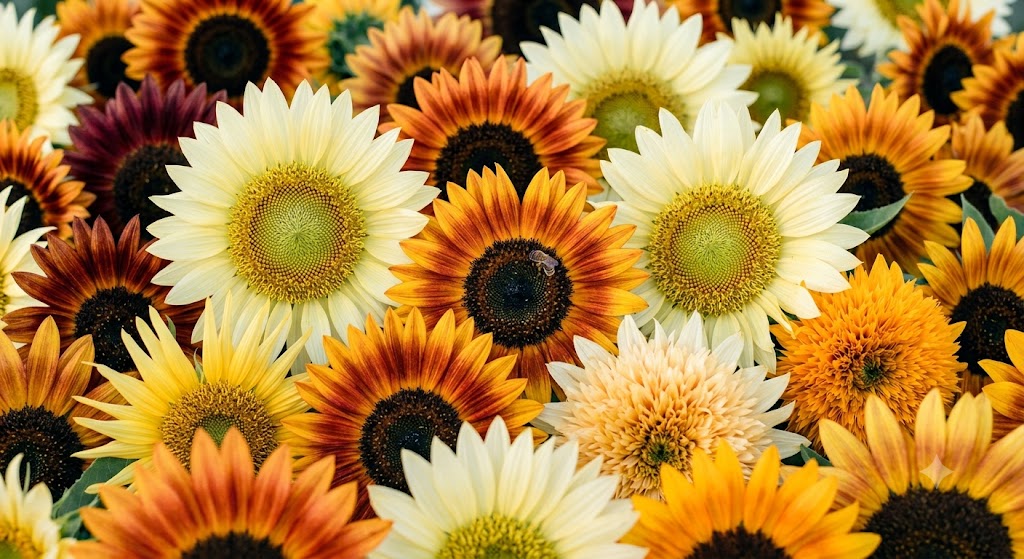
The Mixed Sunflowers collection, Teddy Bear, and Sunspot all produce more than one bloom per plant, making them far better choices for cutting gardens and season-long colour. The mix offers the widest range of heights, colours, and bloom times — classic gold, deep orange, burgundy, cream, and bi-colour — with staggered timing that extends your cutting window naturally. Teddy Bear produces fully double fluffy blooms with no pollen, ideal for interior arrangements but contributing nothing to pollinator support. Sunspot is the container gardener’s compact workhorse: short enough for a large pot but producing a bloom nearly as impressive as a full-sized variety.
Before You Grow Sunflowers
What Sunflowers Need to Thrive
Full sun is non-negotiable. Young sunflowers are genuinely heliotropic — the growing stem tracks the sun east to west throughout the day, straightening as the plant matures — and they need a minimum of 6 hours of direct light daily, with 8 hours producing meaningfully larger heads and stronger stems. Fewer than 6 hours means spindly stems, poor flowering, and susceptibility to every fungal disease that thrives in shade and poor airflow. Deep, loose soil matters as much as sun: the taproot drives 60–90 cm (2–3 feet) straight down in the first few weeks, and compacted subsoil stunts the plant before it’s even knee-high. Loosen soil to at least 30 cm (12 inches), work in compost, and most North American soils will support excellent growth.
The fertilizer warning is worth stating plainly: sunflowers in nitrogen-rich soil grow very tall and leafy, with disproportionately small heads and weak stems that can’t support their own weight. This is the single most common mistake in sunflower care. Standard vegetable fertilizer at tomato rates produces 3-metre (10-foot) plants that topple in July with a head the size of a coffee mug. What actually improves performance is phosphorus at bud formation — a single application of low-nitrogen, phosphorus-forward fertilizer (5-10-10 range) when the first bud becomes visible improves head size and seed density without driving excessive vegetative growth. In most soils with compost already worked in, no additional fertilizer is needed at all.
How to Grow Sunflowers from Seed
Direct Sowing vs Starting Sunflowers Indoors
Sunflowers strongly prefer direct sowing. The taproot develops rapidly from the moment of germination, and transplanting — even carefully done — causes enough root disturbance to stall growth for 1–2 weeks and sometimes permanently stunts the plant. In most of North America, direct sowing after the last frost date into soil that has warmed to at least 10°C (50°F) is the correct method. Germination is fast — 7–10 days at 21°C (70°F) — and a direct-sown sunflower in warm soil will frequently catch up to an indoor-started one well before midsummer.
The case for indoor starting is narrow but real. In Zones 2–4 with frost-free seasons under 100 days, a 2–3 week indoor head start provides genuine insurance for Giant Mammoth at 75–90 days — ensuring seeds fully fill before fall frost cuts the season short. Use individual deep biodegradable pots — at least 10 cm (4 inches) deep — and transplant at exactly 2–3 weeks of age, before the taproot reaches the container wall. A 4-week indoor seedling with a constrained root is a worse plant than a direct-sown one of the same age. Never start more than 3 weeks before your planned outdoor transplant date. For more on reliable germination, the complete seed germination guide covers soil temperature management and troubleshooting.
Direct Sowing Sunflowers Outdoors
Direct sow sunflowers after your last frost, once the soil has warmed to 10°C (50°F). This is the default for almost every garden — the taproot establishes without disturbance and the plant never loses momentum.
- Wait until the soil reaches 10°C (50°F) — cold ground stalls germination and invites rot, so a soil thermometer beats the calendar in a slow spring.
- Loosen the bed to at least 30 cm (12 inches) deep and rake it level; the taproot drives straight down in the first weeks.
- Sow seeds 1.5–2.5 cm (½–1 inch) deep, spacing by type — 30–45 cm (12–18 in) for single-stem, 60–90 cm (24–36 in) for branching.
- Firm the soil over each seed and water gently; keep the top few centimetres evenly moist until sprouts appear in 7–10 days.
- Thin to the strongest seedling at each station once plants reach 8–10 cm (3–4 in) — crowded sunflowers make small heads.
Starting Sunflowers Indoors
Start sunflowers indoors only in Zones 2–3, and no more than 2–3 weeks before transplanting. The taproot resents pots, so indoor starting is insurance for long-season Giant Mammoth in a short summer — not a head start worth chasing everywhere.
- Fill deep biodegradable pots — at least 10 cm (4 inches) deep — with sterile, soilless seed-starting mix so the whole root ball transplants intact.
- Sow one seed per pot at 2 cm (¾ inch) deep and water in.
- Hold the mix at 21–24°C (70–75°F) on a heat mat; seedlings emerge in 5–10 days.
- Give strong light the moment sprouts show — a bright south window or a grow light 5–8 cm above the seedlings prevents the stretch that makes floppy stems.
- Harden off over 5–7 days, then transplant pot-and-all at 2–3 weeks old, before the taproot reaches the pot wall.
The right starting gear makes indoor sowing reliable — deep biodegradable pots and steady bottom heat matter more than anything else on the bench.
| Item | What to Look For | Essential For | Shop |
|---|---|---|---|
| Biodegradable Pots | Deep individual cells, 10 cm (4 in) minimum; peat or coir; plant pot-and-all at transplant | Indoor starting — taproots must not be disturbed; biodegradable pots let you transplant the root ball completely intact | View on Amazon → |
| Seed Starting Mix | Fine, sterile, soilless; peat or coir base; low initial fertilizer; drains freely | Disease-free germination — garden soil compacts and causes damping-off in the warm, moist conditions sunflower seeds need | View on Amazon → |
| Seedling Heat Mat | Waterproof; consistent 21–24°C (70–75°F) bottom heat; sized to fit standard trays | Fast even germination in cool basements — floor temperature drops well below what sunflower seeds need for reliable sprouting | View on Amazon → |
| Tall Garden Stakes | 180–210 cm (6–7 ft) for Giant Mammoth; 90–120 cm (3–4 ft) for mid-size varieties; bamboo or metal; sold in bundles | Staking tall single-stem varieties before summer storms — a staked Giant Mammoth survives wind that topples an unsupported plant | View on Amazon → |
Sunflower Planting Calendar by Zone
When you sow matters as much as what you sow. The chart below maps direct-sow and indoor-start windows alongside bloom windows for all major North American climate zones. The table below has zone-by-zone timing notes and key adjustments.
| Zone / Region | Direct Sow | Opt. Indoor Start | Bloom / Harvest | Key Adjustment |
|---|---|---|---|---|
| Zones 2–4 AB, MB, SK, ND, MN, Mountain West | May 20 – Jun 10 | Apr 15 (2–3 wks before last frost) | Jul 15 – Sep 15 | Direct sow works for all varieties. Indoor start adds insurance for Giant Mammoth. Teddy Bear (50–60 days) and Sunspot (55–65 days) are the safest short-season choices. |
| Zones 5–6 S. ON, QC, NY, MI, OH, PA, NE | May 1 – Jun 15 | Apr 10 (optional) | Jul 1 – Oct 1 | Wide window; all varieties viable without indoor starting. Stagger successive sowings 3 weeks apart for an extended cut-flower season. |
| Zones 7–9 Spring NC, VA, TN, BC Coast, OR, WA | Mar 15 – May 1 | — | Jun 1 – Aug 20 | Succession sow every 3 weeks for extended bloom. Southeast: wide spacing and drip irrigation reduce fungal disease pressure in humid summer months. |
| Zones 7–9 Fall Same regions | Jul 20 – Aug 20 | — | Sep 1 – Nov 30 | Fall planting avoids peak summer disease pressure in the Southeast. Blooms into November in Zones 8–9; excellent for late-season pollinators and bird feed. |
| Desert / Low Desert Spring AZ, NV, SoCal, S. TX, BC Interior | Feb–Mar (★ low desert starts Feb) | — | May 1 – Jun 20 | Spring crop must bloom before June heat. Do not sow after April — plants flowering in July fail to set seed in extreme heat. Mulch heavily. |
| Desert / Low Desert Fall Same regions | Aug 5 – Sep 15 | — | Oct 1 – Nov 30 | Primary sunflower season in the low desert. Best seed production window. Black Oil sunflowers sown in late August provide peak seed fill in October–November. |
Spacing & Siting Sunflowers
Prepare the bed by loosening soil to at least 30 cm (12 inches) — sunflower taproots can reach 90 cm (3 feet) or more, and loose soil prevents the early compaction that stunts plants before they’re a foot tall. Work in 5–7 cm (2–3 inches) of compost but avoid nitrogen-heavy fertilizer before planting. Sow seeds 1.5–2.5 cm (½–1 inch) deep. For single-stem varieties like Giant Mammoth and Sunspot, space 30–45 cm (12–18 inches) apart. For branching types like Mixed Sunflowers, give each plant 60–90 cm (24–36 inches). Black Oil sunflowers planted for bird feed can be sown at 15–20 cm (6–8 inches) apart since head size matters less than seed volume per row.
Choose the sunniest, most sheltered site available. Tall varieties in exposed gardens will need staking regardless of soil quality — midsummer thunderstorms routinely topple well-rooted Giant Mammoth plants. The back of a fence or wall provides both support and reflected heat that accelerates growth in cooler climates. Avoid placing tall sunflowers directly north of sun-loving crops: a mature Giant Mammoth casts a significant shadow that can substantially reduce light on adjacent vegetables expecting full sun. Plan your layout with sunflowers as your northern or western border, not tucked alongside crops with high sun requirements.
Growing Sunflowers Across North American Climates
Caring for Sunflowers Through the Season
Watering Sunflowers
Sunflowers are more drought-tolerant than most annuals once established, but the first 3–4 weeks after germination require consistent moisture to support the rapid root development that defines the whole plant. Water deeply — to 20–30 cm (8–12 inches) — once or twice a week rather than with frequent shallow watering. Deep watering encourages the root system that makes sunflowers drought-resistant later in the season. Once plants are 30 cm (12 inches) tall, begin tapering frequency while maintaining depth. By midsummer, healthy established sunflowers in most climates need watering only during extended dry spells of more than 10 days without rain.
Fertilizing Sunflowers
Feeding is minimal and easily overdone. If your soil has compost, skip additional feeding entirely for the first half of the season. The one targeted feed that genuinely improves sunflower performance is a low-nitrogen, phosphorus-forward application (5-10-10 or similar) when the first bud becomes visible. Phosphorus at this stage improves head size and seed fill density — particularly important for Giant Mammoth if you’re growing for edible seeds or bird feed. Apply at half the label rate, water in thoroughly, and don’t repeat. More is not better, and high nitrogen at this stage will give you taller stems and a smaller head.
Staking Tall Sunflowers
Single-stem varieties over 120 cm (4 feet) should be staked as a matter of course in any garden with occasional wind. Drive a bamboo stake or metal post to within 30 cm (12 inches) of the plant’s base, going at least 30 cm (12 inches) deep to anchor solidly. Tie loosely in a figure-eight pattern — tight ties cut into the stem as it thickens. Add a second tie point when the plant reaches 150 cm (5 feet) and begins developing a bud. For Giant Mammoth reaching 2.5–3 m (8–10 feet), a 2-metre (6-foot) stake driven 30 cm into the ground is the minimum. Stake early — a plant already damaged by wind rarely recovers its full potential, and the enormous mass of a fully developed head on a weakened stem is an almost guaranteed collapse by August.
Deadheading Sunflowers to Extend Bloom
For branching varieties, removing spent blooms directs the plant’s energy toward pushing additional side shoots rather than setting seed on exhausted stems. Cut spent flowers at the base of each stem where it meets the lateral branch or main stalk — a clean cut with sharp scissors or pruners. This extends the continuous bloom window meaningfully in Mixed Sunflowers and Teddy Bear types that branch prolifically. Single-stem varieties like Giant Mammoth and Black Oil don’t benefit from deadheading — once the central head is spent, the plant is done. If your goal is bird feed or seed saving rather than continuous cutting, skip deadheading entirely on any variety and let all seed heads develop fully to maturity. The wildlife value of standing seed heads in autumn is substantial — leaving even two or three Giant Mammoth heads standing provides high-fat food for migrating and overwintering birds through October and November.
Best Companion Plants for Sunflowers
Sunflowers (Helianthus annuus) release allelopathic compounds — primarily through root exudates, decomposing leaves, and seed husks — that inhibit germination and suppress growth in a range of neighbouring plants. Research has documented suppression effects on cucumbers, potatoes, and some legumes when these crops are grown in direct contact with sunflower root zones or in soil recently turned with sunflower plant matter. The mechanism involves terpene and phenolic compounds that interfere with seed germination and early root development. The effect is proximity-dependent and strongest within 60–90 cm (2–3 feet) of the root zone — but it does mean the standard “tall annual at the back of the border” approach requires more forethought with sunflowers than with cosmos or zinnias.
The practical implication is straightforward: keep cucumbers, potatoes, and direct-sown beans away from sunflower root zones, and avoid incorporating sunflower stems and leaves directly back into beds where sensitive crops will follow next year — compost them instead. The companion plants that work excellently alongside sunflowers are allelopathy-tolerant and often benefit structurally from sunflowers’ height: corn, squash, marigolds, nasturtiums, and zinnias all pair well. Pairing sunflowers with other bee-friendly flowering plants extends your pollinator habitat from midsummer through frost — particularly valuable because sunflowers provide abundant late-summer pollen at exactly the moment many other flowers are winding down.
| Companion Plant | Relationship | Notes |
|---|---|---|
| Corn | ✔ Good | Compatible at similar heights; sunflowers attract pollinators that benefit corn; different nutrient profiles; classic pairing across Indigenous traditional agriculture |
| Squash / Pumpkins | ✔ Good | Different root depths; sunflowers provide light wind protection; squash ground cover helps retain soil moisture around sunflower bases in arid climates |
| Marigolds | ✔ Good | Excellent at the front of a sunflower border; nematode deterrent; attract beneficial insects; compatible sun requirements; no allelopathic conflict |
| Nasturtiums | ✔ Good | Trap crop for aphids — aphids strongly prefer nasturtiums over sunflowers; low-growing ground cover at sunflower bases; edible flowers and leaves as a bonus |
| Zinnias | ✔ Good | Same full-sun requirements; extend pollinator habitat at lower heights; compatible for cutting gardens; no known allelopathic conflict with sunflowers |
| Echinacea (Coneflower) | ✔ Good | Compatible late-season pollinator plant; both attract native bees and butterflies; echinacea’s fibrous root system tolerates proximity to sunflower taproots; excellent prairie-style pairing |
| Cucumbers | ✘ Avoid | Allelopathic suppression is well documented — sunflower root exudates and decomposing plant matter inhibit cucumber germination and early growth; keep at least 90 cm (3 ft) from sunflower root zones; do not follow sunflowers in the same bed without a season gap |
| Potatoes | ✘ Avoid | Allelopathic suppression documented; sunflowers and potatoes also compete heavily for soil nutrients; keep out of sunflower root zone entirely |
| Beans | ⚠ Caution | Research is mixed — some studies show suppression, others show compatibility; safe if planted 60 cm (2 ft) from sunflower roots; avoid planting beans directly in decomposing sunflower residue |
| Peppers | ⚠ Caution | Limited allelopathy evidence but peppers are sensitive to root competition and shade; tall sunflowers also block light peppers need; maintain 60 cm (2 ft) distance and site carefully |
| Tomatoes | ⚠ Caution | No strong allelopathy data, but tall sunflowers shade tomatoes needing full sun; the height conflict is the main practical issue; site sunflowers to the north of tomato beds |
| Fennel | ✘ Avoid | Fennel is itself broadly allelopathic; pairing two allelopathic plants compounds suppression effects on everything around them; keep fennel isolated in its own area |
Harvesting Sunflowers
Cutting Sunflowers for the Vase
Cut sunflowers for maximum vase life when the outer ring of petals is just beginning to open but the central disk is still tight, green to pale yellow, and has not yet started releasing pollen. This is typically 1–3 days before what most people picture as “full bloom.” At this stage the flower will continue opening fully in the vase and last 7–12 days rather than the 3–4 days of a flower cut at peak open. Cut in the early morning when stems are most hydrated. Use sharp, clean scissors or pruners — a crushed stem absorbs water poorly regardless of vase technique.
Cut at an angle and immediately stand in a deep bucket of cool water. Strip every leaf below the waterline before arranging — decomposing leaves breed bacteria that block water uptake faster than almost anything else. Change vase water every 1–2 days and recut the stem on a diagonal at each change. Sunflowers continue to face toward light sources indoors, so positioning in a well-lit spot and rotating occasionally keeps the display looking intentional. Teddy Bear’s pollenless blooms last slightly longer in arrangements than pollen-producing varieties and won’t shed yellow dust onto surfaces or tablecloths — a genuine practical advantage in interior settings.
Harvesting Sunflower Seeds for Eating
For Giant Mammoth and other large-headed varieties grown for edible seeds, the correct harvest cue is when the back of the head turns from green to yellow-brown, the petals have dropped, and 30–50% of the seed-bearing face shows visibly darkening seeds. Don’t wait for the entire head to look dry — at that point, birds will have been feeding on it for days and squirrels may have taken the rest. The scratch test: run a thumbnail across a seed. Firm, plump seeds with fully formed shells indicate mature seeds; soft or milky seeds need another week. Cover the ripening head with a paper bag tied loosely at the stem to deter bird competition while the final seeds mature. Cut with 30 cm (12 inches) of stem, hang head-down in a dry, well-ventilated space for 2–4 weeks until completely dry, then rub seeds free over a tray.
Harvesting Sunflower Seeds for Birds
For Black Oil sunflowers planted specifically for bird feed, the same back-of-head timing applies — harvest when the back turns brown-yellow. Black Oil seeds are smaller and dry faster once cut. If you’re leaving them standing for birds to self-harvest in the garden, simply allow the heads to remain on the stalk; birds will feed from September through November. Heads left standing through winter provide high-fat seed that supports songbirds through migration and cold weather more effectively than most commercial seed blends, because birds always prefer seeds in the shell over pre-shelled mixes.
Saving Sunflower Seeds
All five varieties in our collection are open-pollinated and save reliably to the next season — Giant Mammoth, Mixed Sunflower, Teddy Bear, Sunspot, and Black Oil all come true enough from saved seed to replant with confidence. The caveat is cross-pollination: sunflowers are largely insect-pollinated, and if you’re growing multiple varieties within 100–150 m (300–500 feet) of each other, saved seeds may drift from the parent type. For variety-true seed saving, grow only one variety per season in isolation, or accept cross-pollination as part of the process — particularly interesting with the mix packet, where variation is already the point. To save seeds, allow heads to mature fully on the stalk using the paper-bag method described above, then rub seeds free, spread on a screen for 1–2 weeks of additional air drying, and store in paper envelopes inside a sealed glass jar in a cool, dark location.
Sunflower seed viability is excellent — properly dried and stored seeds remain viable for 4–5 years. Test old seeds before devoting a whole bed: fold 10 seeds in a damp paper towel, seal in a plastic bag, and place in a warm spot for 5–7 days. Count how many sprout. Eight or more out of ten means viability is fine; fewer than five means using fresh seeds is worth the investment. Teddy Bear is pollenless and therefore cannot serve as a pollen donor in cross-pollination — it can only be the pollen recipient. This means saved Teddy Bear seeds in a garden with nearby pollen-producing varieties may produce offspring with some pollen. For seed savers who want to maintain the pollenless trait: isolate Teddy Bear completely, or grow it in a location with no other sunflowers within 150 m (500 feet).
Common Sunflower Problems and How to Fix Them
| Problem | Likely Cause | Fix |
|---|---|---|
| Leggy, floppy seedlings | Insufficient light; nitrogen-rich soil encouraging excessive stem growth | Move to 8+ hours direct sun; reduce nitrogen; stake early before the stem can’t support itself |
| Head smaller than expected | Excess nitrogen pushed vegetative growth over flowering; overcrowding | Apply phosphorus (5-10-10) at bud stage next season; avoid high-N fertilizer; thin seedlings to correct spacing |
| Stem rot at base — white mold | Sclerotinia sclerotiorum — thrives in damp, crowded, humid conditions | Improve plant spacing; switch to drip irrigation; remove and bin affected plants; do not compost |
| Plant collapses or leans severely | Wind damage / stem lodging; head weight exceeding stem strength | Stake before stems reach 1 m (3 ft); use figure-eight ties; add second stake point at 150 cm (5 ft) |
| Aphid colonies on stems | Common in late summer; worse in humid or overcrowded plantings | Strong water spray from hose; allow ladybugs and lacewings to control naturally; neem oil if severe |
| Head produces no filled seeds | Pollination failure — pollenless variety isolated from pollen sources; extreme heat during bloom | Plant pollenless varieties near pollen-producing varieties; avoid scheduling peak bloom during heat waves |
| Seeds not maturing before frost | Variety’s days-to-maturity too long for available frost-free season | Switch to shorter-season varieties (Teddy Bear 50–60 days, Sunspot 55–65 days) in Zones 2–4; start Giant Mammoth indoors in Zone 3 |
| Brown-orange powdery spots on leaves | Puccinia helianthi (sunflower rust) — fungal; spreads in humid conditions | Remove affected leaves promptly; improve air circulation with wider spacing; drip irrigate; usually cosmetic late in season |
| Birds eating seeds before harvest | Normal wildlife behaviour; birds start before seeds are fully dry | Cover developing heads with paper bags tied at the stem; harvest when 30–40% of seeds are visibly darkening |
| White powdery coating on leaves | Powdery mildew — common in dry/humid contrast conditions; usually late-season | Improve airflow with proper spacing; remove severely affected leaves; rarely fatal to the plant if caught mid-season |
🧪 Can Sunflowers Clean Up Polluted Soil?
Sunflowers are one of the classic plants used to pull heavy metals and other contaminants out of polluted soil. The same deep, aggressive roots that make them drought-tolerant also draw dissolved metals up into the stems and leaves, where the plant stores them — sunflowers were famously planted after the Chernobyl and Fukushima disasters to help strip radioactive isotopes from soil and water. Scientists are now testing that same metal-gathering trait for using plants to mine rare-earth metals from ground too poor for a conventional mine.
🌍 A Short History of Sunflowers
The sunflower is one of the very few major crops domesticated in North America — its whole story starts here, travels the world, and comes home again.


