

Last updated: July 11, 2026
🌼 Why Grow Marigolds from Seed
Marigolds bloom from midsummer to hard frost, cost almost nothing to start from seed, and are the only common garden flower with peer-reviewed evidence behind their pest reputation. French marigold roots release alpha-terthienyl, a compound that suppresses root-knot nematodes in the soil — the same soil-dwelling parasites that gall tomato, pepper, and eggplant roots. That is a real, measurable effect, and it is the reason marigolds have held a place in vegetable gardens for generations rather than only in ornamental borders.
Seed is also where the flexibility lives. Garden centres sell a narrow slice of the genus — usually a hybrid French series in orange and yellow. Grown from seed you can choose an open-pollinated variety, save seed from it every autumn, and pick the type that matches the job: a compact French marigold for interplanting between tomatoes, a tall African for cutting, a Signet for the salad bowl. This guide covers all three Tagetes types, sowing and transplant timing across US and Canadian zones, care through the season, what the pest research does and does not support, companion pairings, edible and dye uses, and seed saving.
Choosing a Marigold Type: French, African & Signet
The three marigold species sold as seed behave differently enough that the choice changes what you get out of the plant. Compare them before you sow.
| Marigold Seed Variety | Height | Flower | Seed to Bloom | Best For |
|---|---|---|---|---|
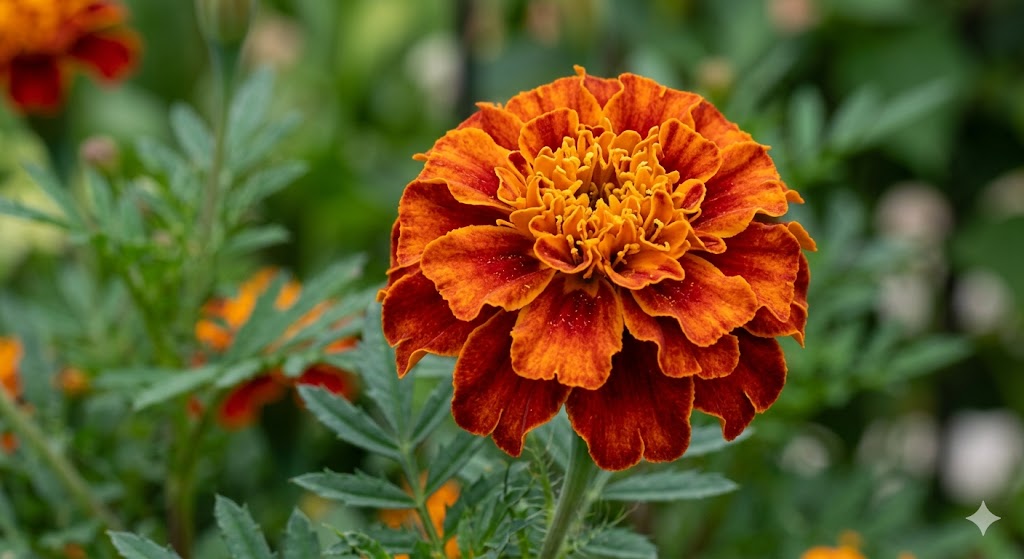
| French Marigold (Tagetes patula) | 15–45 cm (6–18 in) | 2.5–5 cm (1–2 in), single or double; yellow, orange, red, bicolour | 45–55 days | Nematode suppression, vegetable-bed interplanting, containers, short seasons |
| African Marigold (Tagetes erecta) | 30–90 cm (12–36 in) | 5–12 cm (2–5 in) pompom; yellow to deep orange | 60–80 days | Cut flowers, back-of-border colour, petals for dye and dried colouring |
| Signet Marigold (Tagetes tenuifolia) | 20–30 cm (8–12 in) | Tiny single blooms, lacy foliage; citrus-spice flavour | 50–60 days | Edible petals, herb gardens, edging, part-shade tolerance |
For most vegetable gardeners, French marigolds are the default. They germinate fastest, stay compact enough to sit between crop rows without shading them, tolerate humid summers better than the big African pompoms, and carry the strongest nematode evidence. African types are worth a row of their own when you want cut stems or a mass of petals for dye — but they take an extra three to four weeks to bloom, which matters in a short season, and their heavy heads flop in wind and rain. Signets sit quietly between the two: small, tidy, heavy-blooming, and the only type most people actually enjoy eating.
One point of confusion worth clearing up before you buy seed: pot marigold is not a marigold at all. Calendula officinalis belongs to a different genus, has soft petals with a completely different flavour and skin-salve tradition, and does nothing for nematodes — if that plant is what you’re after, the guide to growing calendula from seed covers it properly. Everything below refers to true Tagetes marigolds.
Before You Grow Marigolds
How Much Sun Marigolds Need
Marigolds need at least 6 hours of direct sun a day to bloom heavily, and 8 hours is better. Below that threshold the plants still grow — they simply stretch, thin out, and set a fraction of the flowers, which is the single most common reason a healthy-looking marigold underperforms. Signet marigolds are the most forgiving of the three and will still bloom respectably in 4–5 hours of morning sun.
The one exception is the low desert. Where summer highs run above 38°C (100°F), unbroken afternoon sun scorches foliage and stalls flowering entirely, and plants sited for morning sun with afternoon shade bloom far longer. That is a climate adjustment, not a change to the general rule.
Soil & pH for Marigolds
Marigolds want free-draining soil at a pH of 6.0–7.5 and very little else. They are among the few garden annuals that flower better in lean ground than in rich ground — a bed heavily amended with fresh manure or fed with high-nitrogen fertiliser produces knee-high foliage and almost no flowers. Compost worked in before planting is plenty for the whole season.
Drainage matters more than fertility. Marigolds sitting in cold, waterlogged soil are the ones that collapse from root rot and botrytis in a wet summer. In heavy clay, plant on a slight mound or in a raised bed and skip the mulch until the soil has warmed through.
How to Grow Marigolds from Seed
Marigold seeds germinate in 5–7 days at 18–24°C (65–75°F), sown 6 mm (¼ in) deep, and French varieties bloom 45–55 days after sowing. The seeds are large, dark, and easy to handle, and germination is reliable enough that one or two seeds per cell is sufficient — there is no need to overseed and thin heavily as you would with a fussier flower.
Starting Marigold Seeds Indoors
Start marigold seeds indoors 6–8 weeks before your last frost date. Indoor starting is what buys a short-season gardener a long bloom window, and it is the only way to get the 8+ weeks of root growth that the nematode effect depends on before the vegetable crop goes in.
- Fill cell trays or 7 cm (3 in) pots with a sterile seed-starting mix — not garden soil or standard potting mix, both of which pack down and carry damping-off fungi.
- Sow one or two seeds per cell at a depth of 6 mm (¼ in), laying the long thin seeds flat and covering lightly.
- Water from the bottom until the surface darkens, then cover the tray with a humidity dome or loose plastic until the first sprouts appear.
- Hold the tray at 18–24°C (65–75°F); a heat mat brings emergence forward by several days in a cool room. Expect sprouts in 5–7 days.
- Remove the dome the day sprouts appear and move the tray under a grow light positioned 5–8 cm (2–3 in) above the seedlings, run 14–16 hours a day. Leggy marigold seedlings are a light problem, not a heat or water problem.
- Thin to the strongest seedling per cell once the first true leaves open, snipping the weaker one at soil level rather than pulling it.
- Harden off over 7–10 days, starting with an hour outdoors in a sheltered spot and building to a full night out before transplanting.
Transplant out once night temperatures hold above 4°C (40°F). Marigolds are not killed by a light chill the way a tomato is — they simply sit and sulk — but a plant set out into cold soil stalls for two weeks and never fully catches up to one planted a fortnight later into warm ground. Plant at the same depth the seedling was growing in its cell; burying the stem base invites collar rot, and marigolds gain nothing from the deep planting that suits tomatoes.
Direct Sowing Marigold Seeds Outdoors
Direct sowing works well from Zone 6 south, where the season is long enough that a mid-May sowing still gives months of bloom. Direct-sown marigolds skip transplant shock and often catch up to transplanted plants within a few weeks.
- Wait until soil temperature at 5 cm (2 in) depth reaches 18°C (65°F) — cold soil is the main cause of slow, patchy marigold germination outdoors.
- Rake the bed to a fine tilth and level it; large clods leave the flat seeds sitting in air pockets where they dry out.
- Sow seeds 2.5 cm (1 in) apart in rows or scattered in a block, then cover with 6 mm (¼ in) of fine soil and firm gently.
- Keep the surface evenly moist until emergence, watering with a fine rose so the seed is not washed out of place.
- Thin French seedlings to 20–25 cm (8–10 in) apart once they reach 5 cm (2 in) tall — 25–30 cm (10–12 in) in humid regions, and 30–40 cm (12–16 in) for African types.
- Pinch the growing tip of each plant at 10–15 cm (4–6 in) tall to force branching; a pinched marigold carries noticeably more flowers than an unpinched one.
A seedling heat mat and a modest grow light change the outcome of indoor sowing more than any other purchase. Marigolds started on a windowsill in a Canadian March stretch toward the glass and arrive at transplant date thin and floppy; the same seed under a light 5–8 cm (2–3 in) overhead produces stocky plants that flower a week or two earlier.
| Item | What to Look For | Essential For | Shop |
|---|---|---|---|
| Seed starting mix | Sterile, fine-textured, free-draining — not potting soil | Preventing damping-off in seedlings | View on Amazon → |
| Seedling heat mat | Thermostat-controlled, sized to your tray | Holding 18–24°C (65–75°F) in a cool room | View on Amazon → |
| Grow light | Full-spectrum LED or T5, adjustable height | Compact, stocky seedlings instead of leggy ones | View on Amazon → |
| Cell trays with humidity dome | 72-cell trays; clear vented dome | Even moisture through the 5–7 day germination window | View on Amazon → |
Growing Marigolds by Climate Across North America
Marigolds grow across almost every North American zone, but the limiting factor changes completely depending on where you garden: frost date in the north, humidity and air circulation in the east and southeast, and heat load in the southwest. Find your climate below before you fix your planting dates.
Challenge: a direct sowing after last frost leaves only 8–10 weeks of bloom before a September freeze, and too little root time for nematode suppression.
Start seeds indoors 6–8 weeks before last frost, transplant in late May once nights hold above 4°C (40°F), and choose fast French varieties at 45–50 days rather than African types, which may not bloom before frost.
Challenge: dense planting plus humid air gives poor circulation, which drives botrytis on spent blooms, powdery mildew, and spider mite flare-ups. African pompoms rot fastest.
Space French marigolds at 25–30 cm (10–12 in) instead of 15 cm, water at the base only, and deadhead every 3–4 days through July and August so wet petals never sit on the plant.
Challenge: above 38°C (100°F) marigolds hold their leaves but stop setting flowers, and full afternoon sun scorches both foliage and open blooms.
Site plants for morning sun with afternoon shade, mulch to hold soil temperature down, and run drip at the root zone. Expect a spring flush (February–May) and a second in autumn, with a quiet midsummer.
When to Plant Marigolds by Zone
Marigold seeds are started indoors 6–8 weeks before the last frost across Zones 3–6, and direct sown outdoors from Zone 6 south once soil reaches 18°C (65°F). The table below sets both windows against the regions they apply to. Timing for every other crop in the bed is covered in the complete planting calendar by zone.
| Zone / Region | Start Seeds Indoors | Transplant or Direct Sow | Bloom Window | Key Adjustment |
|---|---|---|---|---|
| Zones 3–4 — Manitoba, Saskatchewan, northern Alberta, northern Ontario & Quebec; Minnesota, Wisconsin, North Dakota, Montana, upstate New York | Late March – mid April | Transplant late May – early June; direct sowing rarely finishes in time | Mid July – first hard frost (mid-late September) | Choose French varieties at 45–50 days; skip African types |
| Zones 5–6 — southern Ontario, Quebec, Nova Scotia, coastal BC; Michigan, Pennsylvania, Ohio, New England, Colorado Front Range | Late March – mid April | Transplant mid–late May; direct sow late May in Zone 6 | Early July – frost (early-mid October) | Space at 25–30 cm (10–12 in) where summers are humid |
| Zones 7–8 — Virginia, Tennessee, Oklahoma, Oregon, Washington, northern California | Late February – mid March (optional) | Direct sow or transplant April; a second sowing in July for autumn colour | June – November | Deadhead hard through humid August to hold off botrytis |
| Zones 9–11 — Florida, Gulf Coast, south Texas, Arizona, southern California | Not needed — sow direct | Direct sow February–March, then again September for a winter display | March–June and October–January; a pause at peak heat | Afternoon shade and mulch above 38°C (100°F) |
Caring for Marigolds Through the Growing Season
Watering Marigolds
Marigolds want the top 2.5 cm (1 in) of soil to dry between waterings, and roughly 2.5 cm (1 in) of water per week in the ground. Established plants are drought-tolerant, and consistent overwatering is the leading cause of root rot and botrytis in home gardens — far more marigolds are lost to a generous hose than to a dry week.
Water at the base, never overhead. Wet petals hold water in their tightly packed centres, and in a humid August that is exactly where grey mould starts. Container plants are the exception to the drying rule: a 25 cm (10 in) pot in July heat can need water daily, and a wilting container marigold recovers within hours once soaked.
Feeding Marigolds
Marigolds are light feeders and flower best in lean soil. Compost worked into the bed before planting carries them through the season; if you fertilise at all, use a balanced granular feed such as 10-10-10 at planting only. High nitrogen through the summer produces lush dark foliage and very few flowers, which is the second most common reason a marigold refuses to bloom.
Container marigolds are the exception, because nutrients leach out with every watering. Feed potted plants a balanced liquid fertiliser every 3–4 weeks, at half the label rate, and stop if the plant starts pushing leaf at the expense of buds.
Deadheading Marigolds to Extend Bloom
Deadhead marigolds every 3–4 days through peak summer to keep them flowering until frost. A spent flower left on the plant sets seed, and seed set is the signal that ends the flowering cycle — the plant redirects energy from new buds into ripening what it already has.
Pinch or snip the spent head back to the first set of leaves rather than pulling the petals off, which leaves a stub that browns and invites mould. French marigolds need this more often than African types but reward it faster, often pushing new buds within a week. Late in the season, deliberately leave a few of the best heads on the plant to ripen for seed.
Growing Marigolds in Containers
French and Signet marigolds are excellent container plants; African types get tall and top-heavy without the wind-stiffened stems they develop in open ground. Use a pot at least 20–25 cm (8–10 in) across with real drainage holes, fill it with potting mix rather than garden soil, and set 2–3 plants per 25 cm (10 in) pot for a full look by midsummer.
Containers also make the interplanting easy where beds are full: a pot of French marigolds parked beside a tomato container puts the same volatile foliage in the same airspace as the crop you are trying to protect, without giving up bed space.
Using Marigolds for Pest Control
How French Marigolds Suppress Root-Knot Nematodes
French marigold roots release alpha-terthienyl, which suppresses root-knot nematodes (Meloidogyne spp.) when the plants grow as a dense stand for at least 8 continuous weeks. The compound disrupts nematode development in the soil around the roots, and the effect is well documented in the research literature — but it is dose- and time-dependent, and that is where most garden applications fall short.
Scattering three marigolds through a bed does very little. What has shown measurable nematode reduction is a solid planting of Tagetes patula grown for 8–12 weeks and then turned into the soil before the vegetable crop goes in, or a close, continuous interplanting maintained alongside it through the season. In nematode-prone soils — common through the US Southeast, the Gulf Coast, and parts of the Pacific Northwest — that pre-season cover crop is the single highest-value use of a marigold packet.
Which Pests Marigolds Deter
Above ground, the picture is more modest. The strong volatiles in marigold foliage appear to confuse whiteflies, and the effect is proximity-based: a marigold border immediately around the tomatoes does something, a marigold at the far end of the garden does not. The flowers also pull in hoverflies and parasitic wasps, which then prey on aphids — an indirect benefit that is real but easy to overstate.
What marigolds will not do is clear a garden of aphids, caterpillars, flea beetles, or cucumber beetles, and they are actively a host plant for Japanese beetles, which chew the blooms. Treat marigolds as one component of an integrated approach rather than a substitute for it; the organic pest control guide for vegetable gardens covers the rest of the toolkit.
| Pest / Problem | Evidence Level | Best Approach |
|---|---|---|
| Root-knot nematodes | Strong — peer-reviewed field and greenhouse studies | Dense French marigold stand for 8+ weeks, ideally as a cover crop turned in before planting |
| Whiteflies | Moderate — deterrence, not elimination | Interplant closely with tomatoes, peppers, and brassicas |
| Aphids (indirect) | Weak — works by attracting predators | Let some blooms open fully to feed hoverflies and parasitic wasps |
| Mexican bean beetle | Anecdotal — mixed reports | Worth a border row at bean beds; results vary by region |
| Japanese beetles | None — marigolds are a host plant | Hand-pick in the morning; do not rely on marigolds here |
Companion Planting with Marigolds
French marigolds planted 30–45 cm (12–18 in) from tomatoes, peppers, and eggplant suppress root-knot nematodes and deter whiteflies without any measurable effect on crop growth. The warnings circulating online about keeping marigolds away from nightshades trace back to allelopathy experiments run at alpha-terthienyl concentrations far above anything that occurs at garden spacing — in a real bed, the pairing is one of the most useful in the garden.
Border planting and interplanting do different jobs. A continuous marigold border around a bed gives the nematode-suppressing root mass and puts the volatile foliage on every approach to the crop; individual plants tucked between crop rows put that foliage right in among the leaves where whiteflies land. The table below covers the pairings worth making and the two worth spacing out, and the vegetable companion planting chart sets them in the context of the whole garden.
| Companion Seeds | Relationship | Notes |
|---|---|---|
| Tomatoes | ✔ Good companion | Nematode suppression at the roots, whitefly deterrence above ground. Plant 30–45 cm (12–18 in) from the stem. |
| Peppers | ✔ Good companion | Same benefits as tomatoes, and particularly valuable in hot regions where nematode pressure runs high. |
| Eggplant | ✔ Good companion | Eggplant is highly nematode-susceptible — one of the best uses of a French marigold interplanting. |
| Cucumbers | ✔ Good companion | Marigold blooms pull in pollinators that improve cucumber fruit set. No negative interactions documented. |
| Cabbage & Brassicas | ✔ Good companion | Marigold scent appears to confuse cabbage moths. A border row works as well as interplanting here. |
| Basil | ✔ Good companion | Both draw pollinators; basil fills the gaps between marigolds in a raised bed neatly. |
| Beans | ⚠ Space them out | Reports of growth inhibition at very close spacing. Keep marigolds to the bean-bed border rather than between plants. |
| Radishes | ⚠ Neutral | Anecdotal reports of slowed radish germination near marigold roots. Radishes mature so fast the effect is minor either way. |
| Strawberries | ⚠ Use caution in dry heat | Marigolds can harbour spider mites in hot, dry conditions, and mites move readily to strawberries. |
Using Marigold Flowers in the Kitchen & Dye Pot
Which Marigold Petals Are Edible
All three Tagetes types produce edible petals, but they are not equally worth eating. Signet marigolds — Lemon Gem and Tangerine Gem above all — have a clean citrus-spice flavour that holds up fresh in salads and lightly cooked in butter or rice. French marigold petals are mildly spicy with a bitter edge, pleasant scattered on a plate in small quantities. African petals are the least palatable fresh and the most useful dried.
Use only the petals. Pull them free of the green calyx at the base of the flower, which is bitter and can upset a sensitive stomach, and harvest fully open flowers in the morning when the oils are strongest. Dried African petals are the classic saffron substitute of Georgian, Armenian, and Iranian cooking — they lend a deep gold colour to rice, soups, and broths without the price tag, which is where the old name “poor man’s saffron” comes from.
Using Marigold Petals as a Natural Dye
African marigold petals give a rich yellow-to-orange dye, and the tradition is old: weavers across Mexico and Guatemala used Tagetes for textile dye long before European contact, and the plant remains a dye staple across South Asia. French petals dye too, giving a paler, greener yellow.
Harvest fully open flowers, strip the petals from the calyx, and simmer them in water for 30–45 minutes to draw out the pigment. Strain the petals out, add fibre that has been mordanted with alum, and simmer until the colour takes. Dried petals keep for months in a jar, so a surplus at the end of the season is worth putting by rather than composting.
Harvesting & Saving Marigold Seeds
Marigold seed is ready when the petals have browned on the plant and the base of the flower head feels dry and papery — each head holds 20–50 seeds and stays viable for 2–3 years. Open-pollinated French marigolds come true from saved seed, which is the whole argument for choosing them over a hybrid series.
- Leave your best flower heads on the plant from late summer and stop deadheading those stems — a head picked green will not have ripe seed inside it.
- Wait until the petals have browned completely and the calyx at the base feels dry and papery, then snap the head off cleanly at the stem.
- Pull the dried calyx apart over a bowl to release the long black seeds with pale straw-coloured tips; discard the petal remnants and any soft, pale seed.
- Spread the seed in a single layer on a plate or screen and dry it in a ventilated spot out of direct sun for 1–2 weeks before it goes anywhere sealed.
- Store the dried seed in a labelled paper envelope inside an airtight jar in a cool, dark place — a fridge shelf is ideal, a hot shed is not.
- Before sowing saved seed a year or more later, test 10 seeds on a damp paper towel at room temperature for a week: 7 or more sprouts means good viability, fewer than 5 means sow thickly or start fresh.
Two things govern whether saved marigold seed comes true. First, hybrid seed will not: a packet marked F1 produces plants whose seedlings scatter back into their parent traits, so save only from open-pollinated or heirloom varieties. Second, Tagetes types cross readily by insect, so if you grow French, African, and Signet marigolds side by side, expect saved seed to give unpredictable heights and flower forms. To keep a variety true, grow one Tagetes type per season, or separate types by at least 150 m (500 ft) — the same isolation logic that governs every insect-pollinated crop, laid out in the complete guide to saving seeds.
Troubleshooting Marigold Problems
| Problem | Likely Cause | Fix |
|---|---|---|
| Seedlings stretched, pale, falling over at 5–8 cm | Not enough light indoors — a windowsill in March is rarely enough | Move under a grow light 5–8 cm (2–3 in) above the leaves, 14–16 hours a day. Lower the light; do not raise the plants. |
| Slow, patchy, or no germination | Soil below 15°C (60°F), or seed buried deeper than 1 cm | Use a heat mat indoors; wait for 18°C (65°F) soil outdoors. Sow at 6 mm (¼ in) and expect sprouts in 5–7 days. |
| Tall, dark, leafy plants with almost no flowers | Excess nitrogen from fertiliser or fresh manure | Stop feeding entirely. Growth slows and buds follow within 2–3 weeks; next season, plant in lean soil with compost only. |
| Blooming stops mid-summer | Deadheading skipped, or heat above 38°C (100°F) | Deadhead every 3–4 days. In extreme heat, shade through the afternoon and expect flowering to resume as nights cool. |
| White powdery coating on upper leaf surfaces | Powdery mildew — crowded plants, humid air, still conditions | Widen spacing to 25–30 cm (10–12 in), water at the base only, remove affected growth, and treat with diluted neem oil. |
| Brown, mushy, collapsing flower heads | Botrytis (grey mould) — spent blooms left on the plant in wet weather | Remove every spent head and any mouldy debris; improve airflow; never water overhead. |
| Stippled, dull, pale leaves with fine webbing underneath | Spider mites — hot, dry, dusty conditions | Blast the undersides with water, then apply insecticidal soap or neem oil. Keep plants watered; drought-stressed marigolds attract mites. |
| Petals chewed, flowers full of holes | Japanese beetles (they feed on marigold blooms) or earwigs at night | Hand-pick beetles into soapy water in the early morning; use diatomaceous earth at the base for earwigs. |
| Lower leaves yellow, plant wilts despite wet soil | Root rot from overwatering or poor drainage | Stop watering and let the soil dry well down. Check roots — brown and mushy means rot. Replant survivors on a mound or in a raised bed. |
🌍 A Short History of Marigolds
Marigolds are a New World genus that travelled the globe under a badly misleading set of names.
Tagetes marigolds are native to Mexico and Central America, where Indigenous Peoples cultivated them long before European contact. The Aztec name cempōhualxōchitl — “twenty flower” — survives today as cempasúchil, the marigold carried in armfuls to graves and altars for Día de los Muertos, its scent believed to guide the dead home. Nahua healers also used the plant medicinally, and weavers across Mexico and Guatemala boiled the petals for a gold textile dye. Spanish ships carried seed to Europe in the 1500s, where it picked up the “French” and “African” labels that still confuse gardeners: neither continent is its home.
Marigolds returned to North America as European garden plants and became a fixture of the American cottage garden and, later, the bedding trade. Seedsman David Burpee ran a decades-long campaign from the 1950s to have the marigold named the US national flower, breeding white varieties and lobbying Congress — the rose eventually won in 1986, but the marigold’s place in US gardens was cemented. American agricultural research is also where the nematode work was done: USDA and land-grant university trials through the late twentieth century established Tagetes patula as a cover crop for nematode-infested soils in the Southeast and Gulf states.
Marigolds became one of Canada’s standard annual bedding plants precisely because they suit the country’s constraint: a short season. A French variety sown indoors in late March flowers by mid-July even in Zone 3 Manitoba, and keeps flowering through the light autumn frosts that finish tender annuals. They are a staple of municipal plantings from Halifax to Victoria, and Canadian market gardeners increasingly plant French marigold as a nematode cover crop in tunnel soils where tomatoes are grown year after year in the same ground.
Hello.
Great guide on how to grow French marigolds from seed! The step-by-step instructions are easy to follow and the tips for caring for the plants are very helpful.
Thanks for sharing.