
Published: July 11, 2026
Growing Roses from Seed: Which Roses Actually Come True
Roses grow from seed perfectly well. The reason so many people fail is that they treat rose seed like tomato seed, and rose seed is nothing like tomato seed. It carries two separate dormancy mechanisms stacked on top of each other, and the standard advice — clean the seeds, put them in the fridge for ten weeks, sow them — only unlocks one of the two.
There is a second decision that matters just as much, and it comes before the fridge. If you cut open a hip from a hybrid tea or a Knock Out in your front bed, the seeds inside are a genetic lottery ticket. Modern roses are complex hybrids, and their seedlings scatter across the parental gene pool: muddy colours, single petals where the parent was double, weak growth. You may get something lovely. You will not get the parent plant back.
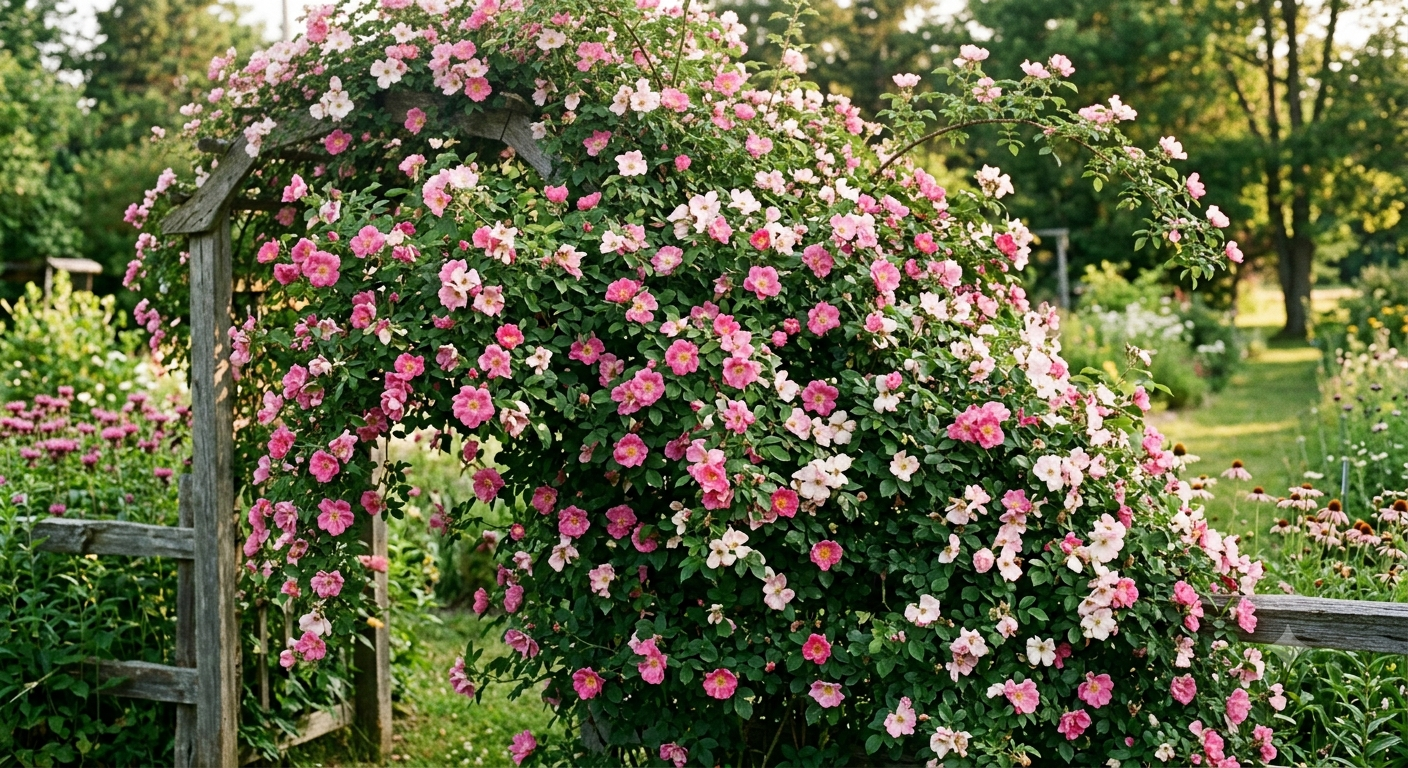
Species roses — the wild roses — are the opposite. They are unhybridized, self-fertile, and they breed true. A seed from Rosa blanda grows into Rosa blanda: same flower, same hardiness, same enormous crop of hips. That reliability is why nearly every rose seed packet you can actually buy is a wild species, and why this guide is built around them.
Choosing a Wild Rose Species to Grow from Seed
Pick the species by the problem your site has, not by the flower — all the wild roses carry the same simple five-petalled bloom in pink or white, and they all set hips. What separates them is height, hardiness, and which soil they will tolerate. The species below are the ones sold as seed across North America.
| Wild Rose Seed Variety | Height | Hardiness | The Site It Solves |
|---|---|---|---|
| Smooth Rose (Rosa blanda) | 0.6–1.5 m (2–5 ft) | Zones 3–7 | Thornless new growth — the one to plant along a path, near kids or dogs |
| Pasture Rose (Rosa carolina) | 0.6–0.9 m (2–3 ft) | Zones 3–9 | Small yards, low borders, and shade — the only native rose that stays genuinely short |
| Prairie Rose (Rosa arkansana) | 0.3–1.2 m (1–4 ft) | Zones 3–8 | Dry open prairie, poor soil, drought — it came through the Dust Bowl |
| Woods’ Rose (Rosa woodsii) | 0.6–2 m (2–6 ft) | Zones 3–9 | Dry slopes, cut banks, and streambanks — a fibrous root mesh that holds loose soil |
| Swamp Rose (Rosa palustris) | 1.5–2.5 m (5–8 ft) | Zones 4–9 | Wet clay, rain gardens, pond edges, ditches that hold water for days |
| Virginia Rose (Rosa virginiana) | 1.2–1.8 m (4–6 ft) | Zones 3–8 | Coastal and roadside sites — tolerates salt spray, and the best fall colour of the group |
| Shining Rose (Rosa nitida) | Up to 1 m (3 ft) | Zones 3–7 | Acidic, boggy, peaty ground — and the only native rose that works as a groundcover |
| Prickly Rose (Rosa acicularis) | 0.9–2.1 m (3–7 ft) | Zones 2–6 | The far north — the hardiest of them all, and Alberta’s floral emblem |
| Beach Rose (Rosa rugosa) | 1.5–2.5 m (5–8 ft) | Zones 2–7 | Pure sand, salt spray, total neglect — and the largest, best hips for eating |
Two of these deserve a note before you buy. Rosa rugosa is the easiest rose in the world to grow and the most generous with hips, but it is not a North American native — it came from the coastal dunes of northeastern Asia, and it has naturalized so successfully on some Atlantic shorelines that a few New England states now discourage planting it near the coast. Inland, it is simply a tough, beautiful, productive shrub. And Rosa multiflora, which you will occasionally see offered cheaply as “wild rose seed,” is a genuinely invasive species across much of eastern North America. Read the Latin name on the packet, every time.
The rest are true North American natives, and they all sucker. That is worth knowing rather than fearing: a wild rose spreads by rhizome into a thicket over several years, which is exactly what you want on a slope or along a fence line, and exactly what you do not want in a 2 m border. Give them room, or choose Pasture Rose, Prairie Rose, or Shining Rose, which stay under a metre and remain manageable.
Before You Grow Roses from Seed
Where Rose Seeds Come From
Rose seeds live inside the hip — the swollen red or orange fruit left behind after the petals drop. A hip needs to stay on the plant and ripen fully, which takes roughly four months from bloom, before the seeds inside are mature enough to germinate. Pick it green and the embryos are unfinished; the seed will never sprout no matter what you do to it afterwards.
This is also why cut roses can never give you seed. The flower has to be pollinated and then left on the living plant to develop its fruit. If you want seed from your own garden, stop deadheading in late summer and let the last flush of blooms go to hip.
How Long Roses Take to Grow from Seed
Growing roses from seed is a two-to-three-year project, and knowing that upfront is the difference between success and a discarded pot. Stratification alone runs four to six months. Germination is slow and staggered — one commercial seed house lists the window for Rosa rugosa as anywhere from 20 to 450 days. Seedlings then need a full season to build a root system, and most species do not flower until year three, sometimes year five.
Nothing about that timeline is a problem if you plan for it. It is only a problem when a gardener expects seedlings in three weeks, sees bare soil, and throws the tray on the compost — with perfectly good seed still dormant inside it.
Rose Seed Dormancy: Why the Fridge Alone Is Not Enough
Rose seeds carry two independent dormancy locks — a physiologically dormant embryo and a hard, water-resistant endocarp — and cold stratification only opens the first one. This is the single most useful fact in rose propagation, and it explains almost every failed batch.
The mechanism has been measured. In a controlled study of Rosa rugosa, seeds given cold and warm stratification broke their physiological dormancy successfully — the embryos woke up, respiration rose, hormone ratios shifted — and still only about 10% germinated. The embryos were alive and ready; they simply could not break out. The stony endocarp surrounding each seed was holding them in. When researchers then abraded that endocarp mechanically, water uptake jumped from 21% to 64%, and germination more than doubled.
In the wild, birds do that abrading. A waxwing or a grouse eats the hip, and the grit in its gizzard scours the seed coat before the seed is deposited. That is not a charming aside — it is the missing step. When you rub rose seeds between two sheets of medium-grit sandpaper, you are standing in for the bird.
The second lock is deeper than one winter. North American native roses are classed by seed growers as needing a cold period, then a warm period, then a second cold period — the pattern a seed experiences lying in the duff through winter, summer, and the following winter. Prairie Moon Nursery assigns exactly this code to Rosa blanda, Rosa carolina, Rosa arkansana and Rosa palustris, alongside a scarification code. The same double-dormancy pattern shows up in many slow native perennials; if you have worked through how to grow echinacea from seed, the logic will feel familiar, though roses take it a step further.
The practical consequence: a single ten-week stint in the fridge will germinate some of your seed — the fraction whose dormancy happened to be shallow. The rest is not dead. It is waiting for the second winter, and it will come up next year if you keep the pot.
Stratification Requirements by Rose Species
Match the protocol to the species before you start, because the treatments differ enough to matter — and note that four of them, Swamp, Woods’, Virginia, and Prickly Rose, want their warm phase first, which reverses the order most rose instructions give. Cold means a refrigerator at 1–4°C (34–40°F); warm means room temperature to slightly above, around 18–20°C (65–68°F).
| Rose Species | Scarify First? | Stratification Protocol | Notes |
|---|---|---|---|
| Smooth Rose (R. blanda) | Yes — sandpaper | Cold 60–90 days → warm 60–90 days → cold again | Full double dormancy. Expect germination spread over two springs. |
| Pasture Rose (R. carolina) | Yes — sandpaper | Cold 60–90 days → warm 60–90 days → cold again | Same protocol as Smooth Rose; slow but reliable. |
| Prairie Rose (R. arkansana) | Yes — sandpaper | Cold 60–90 days → warm 60–90 days → cold again | Hard seed coat. Some growers substitute a hot-water soak for sanding. |
| Swamp Rose (R. palustris) | Yes — sandpaper | Warm 60–90 days → cold 60–90 days | Never let the seed or the medium dry out at any stage — this is a wetland seed, and it loses viability in dry storage. |
| Woods’ Rose (R. woodsii) | Yes — sandpaper | Warm 90–120 days → cold 90–120 days | The USDA plant guide states the warm phase must precede the cold. Germinates in 30–40 days after treatment; seed stays viable 2–5 years. |
| Virginia Rose (R. virginiana) | Yes — sandpaper or 24 h soak | Warm 60 days → cold 60 days | The shortest protocol of any native rose here — the easiest species for a first attempt. |
| Prickly Rose (R. acicularis) | Yes — sandpaper | Warm 60 days → cold 90 days | Deep dormancy; germinate cool at 15–18°C (59–68°F). Most seed comes up in the second spring. |
| Shining Rose (R. nitida) | Yes — sandpaper | Cold 60–90 days → warm 60–90 days → cold again | No separate published code; use the native Rosa default. The RHS notes germination may take two seasons. |
| Beach Rose (R. rugosa) | Yes — sandpaper or 24 h soak | Cold 90–120 days (single cycle usually sufficient) | The easiest species from seed. A warm phase before the cold speeds it further. |
| Hybrid garden roses | Optional | Cold 10–12 weeks | Will germinate, but seedlings will not resemble the parent plant. |
One number is worth holding onto: in a trial on a related species, seed stratified for 10 weeks germinated at 8%, while seed stratified for 12 weeks germinated at 30.6%. Two extra weeks in the fridge nearly quadrupled the result. Do not cut the cold period short.
How to Grow Roses from Seed
Harvesting & Cleaning Rose Seeds from Hips
Harvest hips in mid to late fall, once they have turned deep red or orange but before they shrivel — roughly four months after the flower opened. Many growers wait until after the first hard frost, which softens the flesh and makes extraction easier.
- Cut the ripe hips from the plant with snips, wearing gloves. Take only plump hips still attached to the shrub — hips that have already dropped to the ground are usually spent, and leave plenty behind for the birds.
- Slice each hip open and scoop the seeds out with a knife tip or fork. A single hip holds anywhere from 1 to 22 seeds, with around 7 on average.
- Scrub every trace of pulp off the seeds under running water, working them against a fine mesh sieve. Residual fruit flesh is the number one cause of mould, and mould in the stratification bag will destroy the batch.
- Float-test the cleaned seed in a glass of water for a few minutes. Seeds that sink are generally viable; most of the floaters are empty. Discard the floaters — but do not agonise, because the test is a rough guide, not a verdict.
- Soak the sinkers for one hour in a dilute hydrogen peroxide solution — 1.5 tsp of 3% peroxide per cup of water — to suppress fungal spores before they go into the bag.
Cleaned seed can wait a few days in the fridge if you cannot start treatment immediately, but do not let it dry out hard. Rose seed handles best while still slightly moist from cleaning, and swamp rose in particular loses viability quickly once it dries.
Scarifying & Stratifying Rose Seeds
Scarification comes first, then the temperature cycle — sanding a seed after it has been chilled and imbibed water risks damaging a swollen embryo. This is the sequence that opens both locks.
- Rub the seeds between two sheets of medium-grit sandpaper, a few at a time, with light pressure. The goal is to scuff and dull the shiny coat, not to crack it — stop the moment any seed looks crushed.
- Mix the scarified seed with a damp medium — vermiculite, horticultural sand, or a folded coffee filter. Moisten it slowly until it is damp but yields no water when squeezed. Soggy medium rots seed as surely as dry medium kills it.
- Seal the mixture in a labelled zip bag with the species and the start date, then run the first phase your species calls for — cold at 1–4°C (34–40°F) for Smooth, Pasture, Prairie, and Shining Rose, warm at 18–20°C (65–68°F) for Swamp, Woods’, Virginia, and Prickly Rose. Check weekly for mould, and sow any seed that sprouts early.
- Move the bag to the opposite temperature for the second phase, 60–120 days depending on the species table above. Keep it damp throughout. Nothing visible happens in a warm phase — the embryo is completing its after-ripening, and skipping it is why most batches stall.
- For the four cold–warm–cold species, return the bag to the fridge for a second cold period of 60–90 days. For Rosa rugosa, a single 90–120 day cold cycle takes you straight to sowing.
Start counting backwards from your sowing date. A full cold–warm–cold run takes six to nine months, which means hips collected in October are ready to sow the following summer or the spring after. That is why so many growers simply hand the job to winter instead, which is the next section.
Sowing & Germinating Rose Seeds
Sow stratified rose seeds 6 mm (¼ in) deep in a sterile seed-starting mix and hold them at 15–21°C (60–70°F); germination runs anywhere from 3 weeks to well over a year. Roses germinate best in cool soil, so resist the urge to put the tray on a heat mat — high heat suppresses rose germination rather than speeding it.
- Fill shallow trays or pots, 8–10 cm (3–4 in) deep, with a sterile seed-starting mix. A 50/50 blend of potting mix and vermiculite or perlite drains well and resists the fungal problems that kill rose seedlings.
- Sow the seed 6 mm (¼ in) deep and firm the surface lightly. Label every tray with the species and date — seedlings that emerge a year apart from the same batch are impossible to identify otherwise.
- Water thoroughly, then keep the mix evenly moist but never saturated. Bottom-watering avoids disturbing the seed and keeps the surface drier, which discourages damping-off.
- Hold the trays at 15–21°C (60–70°F) in bright light. A cool bright room or an unheated porch suits roses better than a warm windowsill.
- Prick out seedlings once they have three to four true leaves — the ones that look like miniature rose leaves, not the two rounded seed leaves. Lift each one with a spoon, taking the whole root ball, and never handle the roots directly.
Expect a germination rate of 20–30% even when everything is done right, and expect it to arrive in waves rather than all at once. Keep every tray for a second full year before you give up on it. The seed that did not come up this spring is, more often than not, simply waiting out its second winter.
Fall Dormant Sowing: Letting Winter Stratify Rose Seeds Outdoors
Sowing cleaned rose seed outdoors in late fall lets natural freeze-thaw cycles handle stratification, and for multi-year dormancy it outperforms the refrigerator. It is also, by a distance, the least work.
The reasoning is simple. A cold–warm–cold protocol asks you to manage a bag of damp seed through three temperature phases across most of a year, checking weekly for mould. Winter, spring, summer, and the following winter do that for free, in the correct order, at the correct durations, with no mould risk and no forgotten bags at the back of the fridge. This is precisely how a wild rose reproduces without any help at all.
Sow cleaned, unscarified seed into a weed-free nursery bed or a deep pot after the first hard frost, 6 mm (¼ in) deep. Skip the sandpaper for fall sowing — an abraded seed coat can trigger premature germination in a warm spell, and the seedling will be killed by the next freeze. Sink the pot into the ground or against a north wall, cover it with hardware cloth to keep mice out, and leave it alone. Some seed will come up in the first spring; the rest will appear in the second. Both are normal.
Growing Roses from Seed in Your Climate
Canada Zones 2–5, US Upper Midwest, Northern Plains, Mountain West.
Rose seedlings emerging in their first spring are tiny and shallow-rooted going into a hard winter, and frost heave lifts them straight out of the ground.
Overwinter first-year seedlings in pots in an unheated garage or cold frame, and set them out only in their second spring. Prickly Rose and Prairie Rose are the species to pick here — both are hardy to Zone 2–3.
Southeast US, Gulf Coast, Mid-Atlantic, Southern Ontario, Pacific Northwest.
Damping-off is the main killer of rose seedlings, and warm humid air with still conditions is exactly what the fungus wants. Black spot follows on the young foliage.
Use a sterile mix, bottom-water only, and run a small fan over the trays. Space seedlings generously once potted on, and site mature plants in full sun with open air on all sides. Pasture Rose is the species that shrugs this climate off best.
Southwest US, Southern Plains, Texas, Low Desert, BC Interior.
Rose seed germinates in cool soil and shuts down as it warms, so a spring sowing that runs into early heat simply stops producing seedlings.
Sow in fall or very early spring and keep germinating trays below 21°C (70°F) — a shaded north patio beats a sunny windowsill. Woods’ Rose and Prairie Rose handle the summers best once established.
When to Start Rose Seeds by Zone
| Zone / Region | Collect Hips | Begin Stratification | Sow | Key Adjustment |
|---|---|---|---|---|
| Zones 2–3 Alberta, Saskatchewan, Manitoba, northern Ontario & Quebec; North Dakota, Minnesota, Montana | Late Sept – Oct | October | Late May – June | Pot up rather than direct-sow; overwinter first-year seedlings under cover. |
| Zones 4–5 Southern Ontario & Quebec, Maritimes; New England, New York, Michigan, Wisconsin, Iowa, Colorado | October | October – November | May | Fall dormant sowing works reliably here — winter does the whole cold cycle. |
| Zones 6–7 Niagara & Windsor Ontario; Pennsylvania, Ohio Valley, Virginia, Missouri, Pacific Northwest | Oct – early Nov | November | April | Winters may be too mild for full outdoor stratification — use the fridge for the cold phases. |
| Zones 8–9 Coastal BC; coastal Carolinas, Georgia, Texas, coastal California, Oregon & Washington | November | November (fridge only) | Feb – March | Outdoor winter is too warm to stratify. Sow early so seedlings size up before summer heat. |
Caring for Rose Seedlings Through the First Year
Watering & Feeding Rose Seedlings
Overwatering kills more rose seedlings than any pest. The roots are fine and easily suffocated, and constantly wet mix invites the same fungi that cause damping-off. Water when the top centimetre of mix has dried, water from below where you can, and let the surface dry between waterings.
Wait until seedlings have their true leaves before feeding, then use a half-strength balanced liquid fertilizer every second or third watering. Full-strength feed scorches roots this young. A gentle, steady supply is what builds the root system that carries the plant through its first winter.
Hardening Off & Planting Out Rose Seedlings
Young roses go outside gradually over 10–14 days, starting in full shade for an hour or two and building up exposure and duration. Plants raised indoors have soft tissue and no wax cuticle to speak of, and a single unshielded afternoon in direct sun will bleach and kill them.
Plant out when seedlings reach roughly 15 cm (6 in) and have several sets of true leaves, choosing a site with at least six hours of direct sun. In Zones 2–5, hold them in pots through their first winter instead and plant in the second spring — an established root system handles frost heave that a first-year seedling cannot.
Growing Wild Roses in the Garden
Siting & Pruning Wild Roses
Wild roses flower and resist disease best in full sun with open air movement around them; they will grow in partial shade, but you will trade blooms for foliage and invite black spot. They are genuinely unfussy about soil, which is the point of them — Prairie Rose thrives in the sand, clay, and rock that would kill a hybrid tea.
Prune in late winter, and prune lightly. Wild roses bloom on both old and new wood and need no annual hard cutback; take out dead and crossing canes to open the centre, and cut a few of the oldest canes to the ground every few years to renew the shrub. Heavy pruning simply costs you flowers. Once they are in, wild roses ask for almost nothing at all, which puts them in the same class as the tough, plant-once perennials in our guide to low-maintenance perennial flowers.
Wild Roses as Pollinator Plants
A wild rose is a pollen station rather than a nectar bar — the open single flowers give bees direct access to a mass of stamens, which is why native bee traffic on Rosa is so heavy compared with the tight double blooms of garden hybrids. Hollow rose stems are also winter nesting habitat for stem-nesting solitary bees.
Leave a few canes standing at 30–60 cm (12–24 in) over winter rather than cutting everything to the ground, and the bees will use them. Pair the roses with other long-season native forage — how to grow bee balm covers a native perennial that picks up the pollinator baton just as the roses finish blooming in July.
Harvesting Rose Hips
Rose hips are ready when they are fully coloured, deep red or orange, and give slightly under gentle pressure — usually early to mid-fall. A light frost softens them and noticeably improves the flavour, so there is no rush.
Wild roses produce far better hips than garden hybrids, and Rosa rugosa produces the best of all: hips the size of cherry tomatoes, exceptionally high in vitamin C. Split them, scrape out the seeds and the irritating fine hairs surrounding them, and use the flesh for tea, jelly, syrup, or drying. The hairs are the part that matters — they are a genuine irritant and must be removed before eating. Leave plenty of hips on the shrub regardless; they are a critical winter food for songbirds, and they are how the plant seeds itself.
Companion Planting for Roses
Roses pair well with aromatic herbs and alliums, which mask the scent that draws aphids and pull in the predatory insects that eat them. The classics below all sow easily from seed alongside a young rose planting.
| Companion Seeds | Relationship | What It Does for Roses |
|---|---|---|
| Lavender | ✔ Excellent | Shares the same full-sun, sharp-drainage brief; the scent confuses aphids and deer. |
| Chives | ✔ Excellent | The classic rose underplanting — allium scent repels aphids and is said to reduce black spot. |
| Catnip | ✔ Excellent | Long bloom, heavy bee draw, and a documented deterrent to aphids and flea beetles. |
| Marigold | ✔ Excellent | Suppresses root nematodes and draws hoverflies, whose larvae eat aphids by the hundred. |
| Borage | ✔ Good | A magnet for bees and predatory wasps; self-sows happily around a shrub base. |
| Thyme | ✔ Good | Low aromatic groundcover that shades the root zone without competing for light. |
| Sage | ⚠ Fine, with room | Good pest confusion, but it bulks up — keep it 60 cm (24 in) clear of the rose’s crown. |
| Fennel | ✘ Avoid | Allelopathic and competitive; it suppresses growth in most of its neighbours. |
For a fuller picture of which aromatic herbs work together and which quietly sabotage each other, our herb companion planting chart maps the whole set.
Troubleshooting Rose Seeds & Seedlings
| Problem | Likely Cause | Fix |
|---|---|---|
| No germination at all after a full cold cycle | Only one dormancy lock was opened — seed was chilled but never scarified, or never got the warm phase. | Do not discard the tray. Give it a warm period at 18–20°C (65–68°F), then a second cold period, and keep it a full extra year. |
| Fuzzy white or grey growth in the stratification bag | Fruit pulp left on the seed, or medium too wet. | Rinse the seed, soak 1 hour in dilute hydrogen peroxide, repack in fresh barely-damp medium, and resume the count. |
| Seedlings topple at soil level, stem pinched and dark | Damping-off — a fungal collapse caused by wet surface, still air, and reused mix. | Remove affected seedlings immediately. Bottom-water only, add airflow with a fan, and never reuse potting mix for rose seed. |
| Seed sprouted inside the fridge bag | Dormancy broke early — common and harmless. | Pot up the sprouted seed immediately, 6 mm (¼ in) deep, and return the rest of the bag to the cold. |
| Seedlings stall at 2–3 cm and sit there for weeks | Too warm, too dark, or no nutrients after the seed leaves were exhausted. | Move to 15–21°C (60–70°F) in bright light and begin half-strength feed once true leaves appear. |
| Black spots ringed with yellow on young leaves | Black spot fungus, spread by water splashing off the soil surface. | Remove infected leaves, water at the base only, and open up spacing. Wild species shrug this off far better than hybrids. |
| Clusters of green or black insects on new shoot tips | Aphids, drawn to the soft flush of spring growth. | Blast them off with a hose, then underplant with chives or catnip. A full run of options is in our organic pest control guide. |
| Three-year-old plant is healthy but has never flowered | Simply not old enough, or not getting enough sun. | Wild roses from seed commonly first bloom in year 3–5. Confirm it gets 6+ hours of direct sun, then wait. |
| Item | What to Look For | Essential For | Shop |
|---|---|---|---|
| Medium-grit sandpaper | 120–180 grit sheets, not a sanding block | Scarifying the endocarp — the step that doubles germination | View on Amazon → |
| Horticultural vermiculite | Fine or medium grade, sterile, bagged | Holding even moisture through months of stratification | View on Amazon → |
| Sterile seed-starting mix | Fine-textured, peat or coir based, never reused garden soil | Preventing damping-off, the top killer of rose seedlings | View on Amazon → |
| Seed trays with humidity dome | Shallow 8–10 cm depth with drainage and a vented lid | Sowing out, with vents to cut the humidity that breeds fungus | View on Amazon → |
| Soil thermometer | Probe style, reading down to 0°C (32°F) | Confirming the fridge and the warm phase are actually in range | View on Amazon → |
🌍 A Short History of Roses
Wild roses have grown across the northern hemisphere for some 35 million years, and every continental culture that met them put them to use long before anyone bred them for the florist’s trade.
Wild roses grow natively from the Arctic treeline to the Gulf, and Indigenous Peoples across that entire range used them. Rose hips were a dependable late-winter food when little else remained — eaten fresh, dried into cakes, or boiled into a thick syrup — and their vitamin C content made them a practical hedge against scurvy long before the vitamin had a name. Petals were infused for tea, the roots and inner bark prepared as washes for wounds and sore eyes, and the thorny thickets used as living fencing. Nations of the northern plains and boreal forest knew Rosa acicularis and Rosa woodsii intimately; eastern nations relied on Rosa carolina and Rosa virginiana. That knowledge is unbroken — rose hip harvesting continues in Indigenous communities across the continent today.
The rose is the national floral emblem of the United States, signed into law in 1986, and four states claim a wild rose of their own — Iowa and North Dakota both honour the prairie rose, and New York and Georgia name the rose in general. Prairie Rose earned a particular reputation in the 1930s, when it was one of the few flowering plants that came through the Dust Bowl droughts unharmed, its deep stout roots reaching moisture that had abandoned the topsoil. US rose breeding took off in the twentieth century around hybrid teas, but the native species stayed in the ground, and the current native-plant movement has brought them squarely back into American gardens.
The prickly rose, Rosa acicularis, has been Alberta’s floral emblem since 1930, chosen by the province’s schoolchildren, and it grows wild from the Yukon to Newfoundland — one of the hardiest roses on earth, flowering happily where winters reach −40°C. Canadian breeders later turned that native cold-hardiness into an export: the Explorer and Parkland series, developed by Agriculture Canada from the 1960s onward, crossed rugged species roses with garden types to produce shrubs that survive prairie winters without protection. Those programs are the reason cold-climate gardeners worldwide can grow roses at all.
Growing Roses from Seed FAQ
Related Growing Guides
Another native perennial that needs cold stratification before it will sprout — how to grow echinacea from seed.
The native pollinator perennial that blooms as the wild roses finish — how to grow bee balm.
Nine hardy species compared side by side — browse all rose seed varieties.
Which aromatic herbs protect roses and which compete — herb companion planting chart.