

Last updated: August 20, 2026
Mumm’s Sprouting Seeds Review
After more than a decade ordering sprouting seed from Mumm’s, it’s the seed I recommend to anyone who wants clean, reliable sprouts at home. This review covers who Mumm’s is, what their seed is actually like to grow with, which varieties are worth starting with, and the SEEDBANK discount code that takes 10% off at checkout.
Mumm’s is a family-run organic seed farm in Saskatchewan that has specialized in seed for sprouting and microgreens since the 1970s. That focus is the whole story here — this is seed grown and tested specifically to sprout and be eaten raw, not repackaged garden seed, and over years of ordering it that difference showed up batch after batch.
Who Is Mumm’s Sprouting Seeds?
Mumm’s Sprouting Seeds is a family-run organic seed farm near Shellbrook, Saskatchewan that has sold dedicated sprouting seed for over 35 years — one of North America’s original sprouting-seed growers. What began as the Mumm family’s back-to-the-land homestead, with a sideline in organic alfalfa and radish seed for sprouting, grew into a full operation that moved off the farm and into a converted curling rink in nearby Parkside in 2000.
Today the business is run by Lisa Mumm, a fifth-generation farmer who returned to the family operation in 2009 and is a past vice-president of the Canada Organic Trade Association board. Most of the seed is grown by organic farmers across Saskatchewan, with varieties that don’t suit the Prairie climate sourced from other certified-organic growers. Mumm’s grows and sells its own seed rather than reselling someone else’s, which is a big part of why the quality stays consistent from order to order.
Mumm’s Sprouting Seeds Discount Code (SEEDBANK)
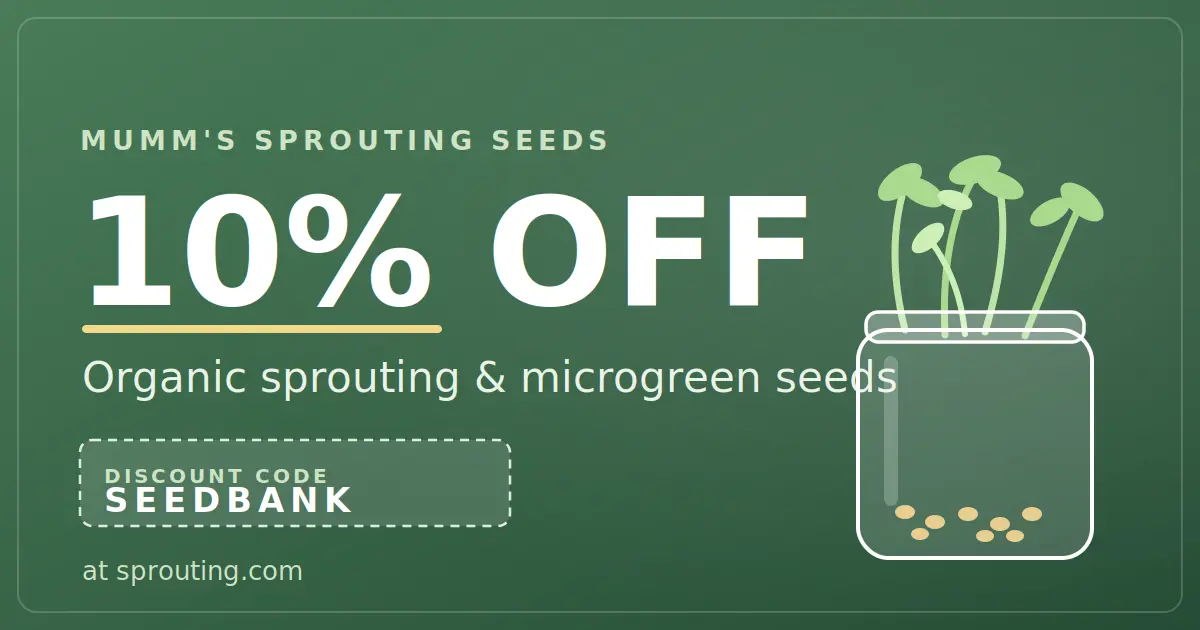
The Mumm’s Sprouting Seeds discount code is SEEDBANK, and it takes 10% off your order at sprouting.com. Enter it in the coupon code field at checkout — the same box some stores label the promo code or the discount code — and the saving comes off your total before you pay. The code works for customers in both the United States and Canada.
How to Apply Mumm’s Discount Code at Checkout
Applying the SEEDBANK code takes about ten seconds on Mumm’s checkout page.
- Add your sprouting or microgreen seeds to the cart at sprouting.com, then open the cart and click through to checkout.
- Find the discount box on the checkout page — on desktop it sits in the order-summary column on the right, and on mobile it appears under the collapsed order summary.
- Type SEEDBANK into that box exactly as shown, in capitals.
- Click Apply, then confirm the discount line appears in the order summary before you pay.
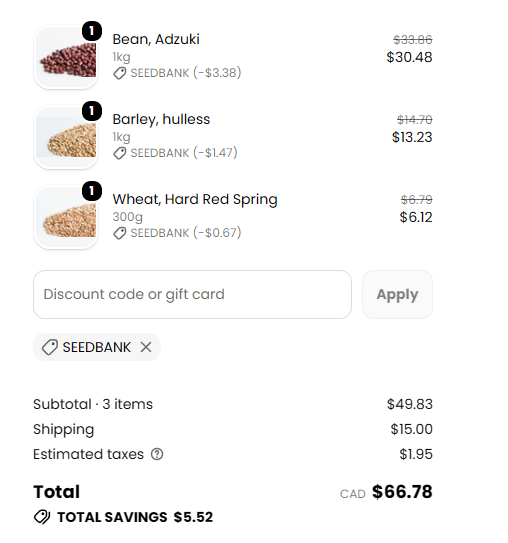
Here is how the discount-code box usually appears at checkout — on desktop screens it’s typically in the right-hand column:
Mumm’s Sprouting Seed Quality
Three things separate dedicated sprouting seed from a packet of garden seed: what the seed is tested for, how it’s certified, and whether it performs the same way twice.
How Mumm’s Sprouting Seed Is Germination-Tested
Mumm’s sells seed selected and germination-tested for sprouting and eating raw, screened to a standard that garden seed sold for planting is never held to. That screening is the single biggest factor in a clean, mould-free jar, and it’s the real reason to buy dedicated sprouting seed rather than repackage a bag meant for the garden.
The reason the standard is stricter comes down to where contamination starts. Colorado State University’s sprout food-safety review reports that seeds are almost always the primary source of contamination in sprout-associated outbreaks, and that a few salmonellae on or inside a single seed can raise contamination by 3–5 orders of magnitude per gram once the warm, humid sprouting cycle begins. No home rinse routine reverses that, which is why the seed you start with decides the outcome.
Organic Certification on Mumm’s Seed
Every variety Mumm’s sells is certified organic, which matters more on a sprouting seed than on a garden packet: you eat the seed itself, raw, a few days after it leaves the bag. Certification also rules out the synthetic fungicide seed treatments that are routine on some conventional planting seed and have no business in a sprouting jar.
Mumm’s Seed Consistency Batch to Batch
What stood out across the years was consistency. Different varieties, different order sizes, different seasons — germination held up and the sprouts came clean. That reliability is what turns sprouting into a habit you keep rather than a project you abandon, and it’s why Mumm’s earned the repeat orders.
Mumm’s seed outlasted anything I picked up at a grocery store. Over the years I went through many kilograms of their sprouting seed, storing it right through the winter in large pails with airtight lids — and not once did I open a pail months later to find a bug or a critter in the seed. Bulk seed off a grocery shelf can’t always say the same.
What sold me on ordering in bulk was how well it travels. Mumm’s ships out of Saskatchewan and I’m in Southern Ontario — a long haul across the country — yet every bulk bag arrived intact. Their packaging is genuinely tough: across all those years I never had a ripped bag or a damaged order turn up at my door. I ordered year round, too — summer heat or the dead of winter — and the cold never harmed a batch.
For true bulk, they were the best I found. I ordered bags all the way up to 10 kg (22 lb) when they carried them, and the big multi-kilo sizes since — the hard red spring wheat especially, which is incredibly durable and tough — held up just as well. If you only want to try a variety, they also do smaller packs from around 100 g (3.5 oz), so you’re never forced into a big commitment.
The mung beans sprout clean and evenly batch after batch. I leaned on their bulk seed for years — Kamut and hard red spring wheat by the bagful, red and crimson clover that I used as a cover crop on the property, black oil sunflower for my bird feeders, and bulk Thai basil and garlic chives for the kitchen garden. Every bag arrived clean and smelled fresh.
Over ten years and a lot of kilograms, it earned its place as the only sprouting seed I bothered to reorder.
Where to Buy Mumm’s Sprouting Seeds
Buy Mumm’s sprouting seeds direct from sprouting.com. That is the only place the full catalogue exists and the only place the SEEDBANK code works. A handful of Canadian retailers stock a small selection and Amazon lists a few best-sellers, but every one of them carries a fraction of the range at a higher price per gram.
Buying Mumm’s Sprouting Seed Direct
Ordering direct gets you the whole catalogue — over a hundred single seeds, fourteen ready-mixed blends, and the jars, lids and trays — in sizes from small trial packs up to multi-kilo bags. Direct is also the only route where SEEDBANK applies, which puts the price under the retail listings before shipping is counted.
Canadian Retailers That Stock Mumm’s Seed
Several Canadian health-food and hydroponics retailers carry Mumm’s — Well.ca, Vegan Supply and Indoor Farmer among them, alongside marketplace listings on Walmart.ca and Amazon.ca. What they stock is the same seed in small retail packs, usually the six or eight best-known varieties, at retail pricing with no discount code. They are worth knowing about if you want one small bag today rather than a bulk order next week.
Buying Mumm’s Sprouting Seed in the United States
US buyers order the same way Canadians do. Mumm’s ships across the border, prices show in your own currency at checkout, and the SEEDBANK code applies identically. There is no separate US storefront and no US distributor carrying the range, so ordering direct is the practical route rather than one option among several.
| Where to Buy | Range Stocked | SEEDBANK Code | Ships To |
|---|---|---|---|
| Direct from Mumm’s (sprouting.com) | Full catalogue — 100+ single seeds, blends, jars, lids and trays, trial packs through multi-kilo bags | Yes — 10% off | Canada and the United States |
| Amazon.ca and Amazon.com | A few best-selling varieties in small packs | No | Canada and the United States |
| Canadian health-food and hydroponics retailers | Small selection of popular sprouting varieties in retail pack sizes | No | Canada |
| Walmart.ca marketplace | Limited third-party listings, availability changes | No | Canada |
| Local health-food stores | Varies by store; mostly alfalfa, broccoli and mung in small packs | No | In-store only |
Buying & Storing Mumm’s Sprouting Seed
Buying Mumm’s Sprouting Seed in Bulk
Bulk is where Mumm’s makes the most sense. Sprouting and grain seed keeps for years when it’s stored properly, so one larger order works out far cheaper per jar than buying small bags a few at a time. Mumm’s also sells packs from around 100 g (3.5 oz), so trying a variety before committing to a multi-kilo bag is straightforward.
Grain is where the bulk maths bites hardest. A multi-kilo bag of hard red spring wheat costs little more than a couple of small packets and covers months of growing wheatgrass at home, and whole grain holds its viability longer in storage than the small brassica seeds do.
Storing Mumm’s Sprouting Seed
Store sprouting seed cool, dry, and dark in an airtight container, sealed against both air and moisture. Food-grade pails with gasketed lids are the practical choice for multi-kilo bags, and glass jars with tight lids handle smaller amounts.
How long the seed stays viable depends on the crop more than the container. Oregon State Extension’s garden seed longevity guide puts brassica seed such as broccoli, kale and cabbage at 3–5 years, radish at 4 years, and beans and peas at about 2 years, with dry, cool storage pushing each of those toward the top of its range. Seed past its window usually germinates unevenly rather than not at all, so a sparse, straggly jar is the first symptom you’ll notice.
| Seed Type | Typical Viability in Dry, Cool Storage | What Fading Viability Looks Like |
|---|---|---|
| Broccoli, kale, cabbage, kohlrabi | 3–5 years | Patchy jar with a layer of ungerminated seed at the bottom |
| Radish, including daikon | 4 years | Slower start, then uneven root-hair development |
| Lettuce | 3 years | Thin, weak stands that stall before the leaves open |
| Onion, leek | 2–3 years | Sharp drop-off rather than a gradual decline |
| Beans, peas, lentils | About 2 years | Seeds that swell on the soak but never split |
Best Mumm’s Sprouting Seeds to Try
New to sprouting? Broccoli, mung bean, and a mild ready-made blend are the most forgiving starting points — fast, crunchy, and mild enough to eat every day. Broccoli is the one with the most research behind it: Fahey, Zhang and Talalay’s 1997 broccoli sprouts paper found 3-day-old sprouts carry 10–100 times the glucoraphanin of mature heads — glucoraphanin being the compound the body converts to sulforaphane.
The table below covers the varieties worth starting with, what each is best for, and how long each takes on the counter. The timings are Mumm’s own published jar-method figures rather than general estimates.
| Sprouting Seed | Best For | Days to Harvest |
|---|---|---|
| Broccoli | Daily salad sprouts; mild peppery bite and the highest glucoraphanin of the brassicas | 4–5 days |
| Broccoli Brassica Blend | Broccoli, clover, radish, mustard and arugula in one jar for more flavour range | 4–5 days |
| Mung Bean | Classic thick, crunchy bean sprouts for stir-fries and salads | 2–3 days |
| Daikon Radish | A sharp, spicy kick on sandwiches, tacos and grain bowls | 4–5 days |
| Red Clover | Mild, alfalfa-like sprouts for everyday salads, and easier than alfalfa to get right | 4–5 days |
| Alfalfa | The fine-threaded sandwich and salad sprout most people picture first | About 5 days |
| Fenugreek | Nutty, mildly bitter sprouts with a distinct curry note | 2–3 days |
| Salad Bowl Blend | Mung, lentil and black quinoa mix, with sesame added for flavour rather than sprouting | 2–3 days |
| Green Kale | Tray microgreens — Mumm’s advises against jar-sprouting this one | 10–14 days as a microgreen |
Every timing in that table assumes the standard countertop jar method: soak, drain fully, then rinse and drain three times a day until the jar fills. Beans and lentils finish fastest at 2–3 days; the small brassica and clover seeds take a day or two longer to size up. Two of those timings need a footnote: mung and fenugreek at 2–3 days are Mumm’s own published figures and run faster than the university sources. Oregon State puts mung at 4–5 days, which is the figure our own mung guide uses, so treat the vendor timings as the earliest a jar is usable rather than the point of best yield.
Green kale is the exception in the table. Mumm’s advises against sprouting it in a jar and recommends growing it as a microgreen instead, which means a shallow tray of medium and 10–14 days rather than a rinse cycle. It’s the same seed either way — only the method changes.
Raw Sprout Safety at Home
Clean seed is where safety starts, but the rinse routine finishes the job. Sprouts grow in exactly the conditions bacteria prefer — warm, humid, nutrient-rich, and undisturbed — so rinse and drain three times a day, or every six hours for anything you plan to eat raw, tip the jar so it drains completely between rinses, and keep it out of direct sun. A jar that smells sour or turns slimy goes in the compost, not the salad bowl.
Risk isn’t the same for everyone. The FDA’s produce safety guidance advises that children, older adults, pregnant women and anyone with a weakened immune system avoid sprouts raw or lightly cooked. Cooking is a reduction, not an eraser: Health Canada’s wording is that it kills most harmful bacteria and reduces your risk, and the FDA says reduces as well. No agency says removes or eliminates, and none of them endorses a quick pass through a hot pan — the published instruction is to cook sprouts until steaming hot throughout.


