Wild Strawberry (Fragaria vesca): The Original Woodland Strawberry
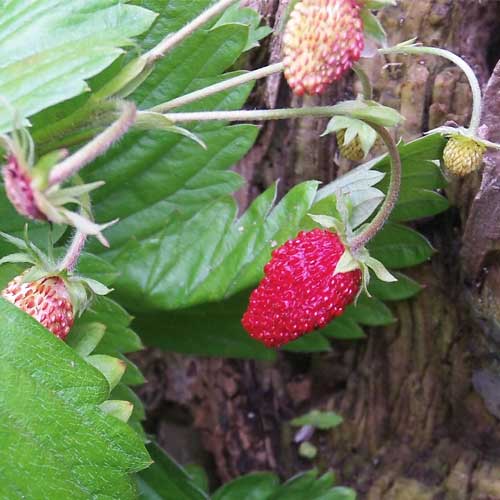
Wild strawberry is the woodland species that every cultivated strawberry descends from, and in pure aroma and depth of flavour it still outclasses the supermarket berry. The fruit is small — fingernail-sized — but carries a concentrated, faintly rose-scented sweetness that gardeners across Europe and Asia have prized for centuries. In France the berries are gathered as fraises des bois, “strawberries of the woods,” and treated as a delicacy. Each berry ripens to a vivid red with a clean, bright taste that no grocery strawberry manages to reach.
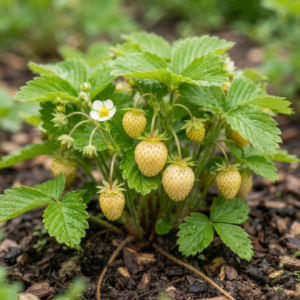
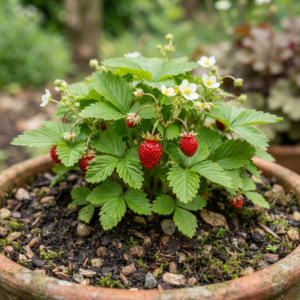
This is a low, ground-hugging perennial that sends out runners to knit itself into a living mat — the trait that makes it such a useful edible groundcover under trees and along shaded edges. Few fruiting plants tolerate as much shade, and few are as hardy: established plants fruit in modest flushes from late spring through early autumn and shrug off winters down to Zone 3. Grown from seed, it is one of the most resilient small fruits you can start yourself.
🇺🇸 US: Perennial in Zones 3–10, coast to coast. Across the Upper Midwest and Northeast it thrives in dappled woodland light; in the Deep South and Zones 9–10 it performs best as a cool-season plant, fruiting fall through spring and resting over the hottest weeks.
Best for: Woodland gardens, shaded borders, naturalized edible groundcover, and cottage-garden edging.
🌱 How to Grow Wild Strawberry Seeds
Wild strawberry seeds germinate best after 3–4 weeks of cold stratification, then surface-sown in light at 18–21°C (65–70°F). Cold stratification mimics the winter the seed would meet on the forest floor and sharply lifts germination rates: mix the seeds with moist vermiculite or a damp paper towel, seal in a small bag, and refrigerate for 3–4 weeks. After chilling, surface-sow onto a moist seed-starting mix and leave them uncovered — light is required for germination — then hold the tray at 18–21°C (65–70°F) and keep it evenly moist. Sprouting takes 2–4 weeks. As an alternative, sow outdoors in autumn and let the season do the chilling; the seed germinates on its own in spring.
Start indoors 8–10 weeks before your last frost. Once seedlings show 2–3 true leaves, pot them on individually and grow them under bright light. Transplant outdoors after frost at 25–30cm (10–12 in) spacing. This species genuinely prefers a spot with dappled light or 4–5 hours of direct sun, in moist, humus-rich, slightly acidic soil (pH 5.5–6.5), though it adapts to most ground. Let the runners roam for groundcover, or trim them back to hold the plants in tidy clumps.
🍓 Harvesting & Using Wild Strawberries
Wild strawberries ripen a few berries at a time from late spring into autumn, so harvest is a steady trickle rather than one big flush. Pick each berry only when it is fully, deeply red and pulls away with the lightest tug — under-ripe fruit is tart and misses the aromatic top note the plant is grown for. Because the fruit is soft and tiny, gather it into a shallow container and use it within a day or two; it does not keep or ship like a commercial berry.
Eaten straight from the plant is the classic use, and the flavour is intense enough to lift a bowl of cream, a summer tart, or a spoon of yoghurt. The berries also cook down into a fragrant jam, though you will need patience to gather enough. Beyond the fruit, the young leaves have a long European history as a mild herbal tea: harvest them in late spring, dry them flat in a warm airy spot, and steep a small handful per cup for 5–7 minutes for a gentle, grassy-sweet infusion.
🌿 Growing Wild Strawberry as Edible Groundcover
Wild strawberry seeds are the low-cost route to an edible groundcover that few other fruiting plants can match, because the running habit that needs managing in a formal bed becomes an asset in the right spot. Set young plants 25–30cm (10–12 in) apart under trees, along a shaded path, or on a bank, and within a season or two the runners knit into a continuous mat that suppresses weeds, holds soil, and hands you berries as a bonus. Unlike a purely ornamental groundcover, every square foot is productive.
The species earns this role through its shade tolerance: a north-facing border or dappled woodland edge that would starve conventional strawberries keeps wild plants fruiting modestly and covering ground reliably. Give the planting a spring feed of compost, keep it watered through its first summer, and let it spread. Where you want a clean edge, simply shear the outermost runners once or twice a season — the mat stays exactly as wide as you choose.
🫙 Saving Wild Strawberry Seeds
Wild strawberry seeds are easy to save because Fragaria vesca is an open-pollinated species that comes true from seed. Let a few of the ripest, softest berries go slightly past eating stage, then mash each one into a small dish of water, swirl to separate the pulp, and pour off the floating debris. The tiny viable seeds sink; lift them out, dry them flat on a paper towel for 1–2 weeks, and store them in a sealed envelope somewhere cool and dark.
As a true species rather than an F1 hybrid, saved seed reproduces the parent’s flavour and habit faithfully, with only minor natural variation. Cross-pollination between different Fragaria vesca selections is possible if they flower side by side, so keep a little distance if you grow more than one type for seed. Before the next sowing, run a quick viability check — cold-stratify the saved seed as you would a purchased packet, since properly dried seed stays viable for roughly 2–3 years.