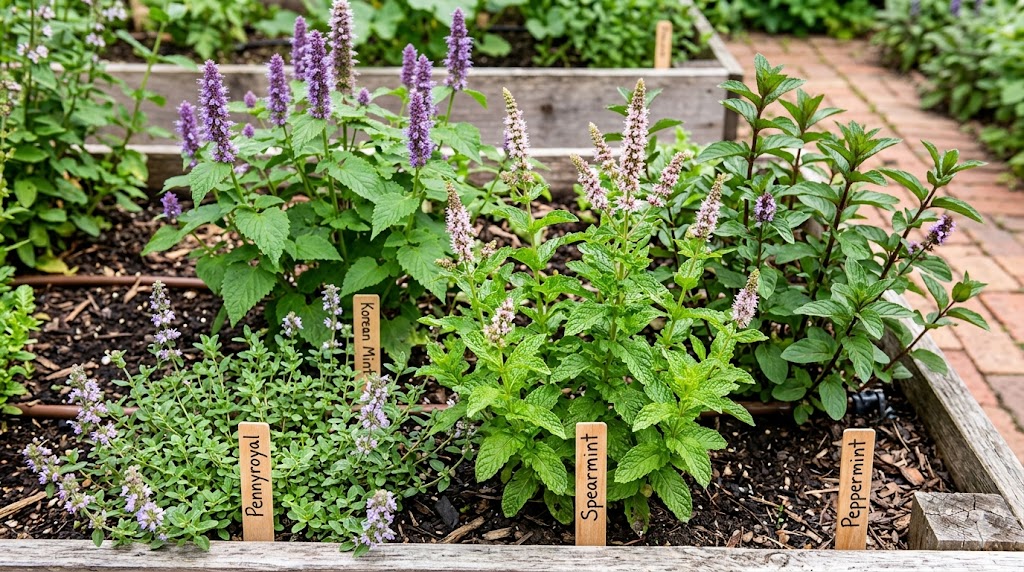

Mint earns its reputation from both sides of the argument. Grow it well and you have one of the most productive, fragrant, and genuinely useful herbs in the garden — a plant that harvests all season, returns vigorously every spring, and pulls double duty as a pest deterrent near brassicas, tomatoes, and roses. Grow it carelessly and you will spend years pulling runners out of whatever happens to grow nearby. The difference is not luck. It is understanding what mint actually wants, and what it will take if you let it.
This guide covers five distinct varieties available from the mint seeds collection, each with a different flavour profile, growth habit, and garden personality. Two of them — mountain mint and Korean mint — are not true Mentha at all, despite the name, and that distinction matters for how you grow them. Whether you’re starting seeds in a Zone 3 Prairie garden with four frost-free months to work with, or managing a Zone 9 California bed where mint grows year-round, the advice here goes beyond the generic “plant in sun, water regularly” instructions that fill most growing guides.
Mint spreads by underground rhizomes — horizontal roots that shoot out in every direction, surfacing as new plants well beyond the original crown. A single spearmint or peppermint plant left unchecked can colonise an entire raised bed within two growing seasons and is extremely difficult to fully eradicate once established.
The fix is straightforward: grow mint in containers, or plant it in-ground inside a physical root barrier at least 30 cm (12 inches) deep. A nursery pot sunk flush with the soil surface works well. Check periodically for rhizomes escaping through drainage holes. Mountain mint and Korean mint are significantly less aggressive spreaders, but the container rule is still the safest practice for any bed you care about.
Spearmint, peppermint, pennyroyal, mountain mint, and Korean mint — open-pollinated varieties for Canadian and US gardens.
As an Amazon Associate, I earn from qualifying purchases — at no extra cost to you. Shop Mint Seeds on Amazon →Which Mint Should You Grow?
The five varieties on this site cover most of what a home gardener would want from mint — culinary use, pest deterrence, pollinator value, and ornamental appeal. Two important notes before the table: peppermint (Mentha × piperita) is a natural hybrid between spearmint and watermint, and may produce variable seedlings from seed — flavour and menthol content will vary more than with spearmint. Mountain mint (Pycnanthemum virginianum) and Korean mint (Agastache rugosa) are in the broader mint family but are different genera entirely, with their own distinct growing requirements.
| Variety | Species | Flavour | Best Use | Hardiness | Shop |
|---|---|---|---|---|---|
| Spearmint | Mentha spicata | Sweet, mild, classic mint | Cooking, tea, cocktails, fresh use | Zones 3–11 | Buy Seeds → |
| Peppermint | Mentha × piperita | Strong, menthol-forward, cooling | Tea, baking, aromatherapy, pest deterrence | Zones 3–11 | Buy Seeds → |
| Pennyroyal | Mentha pulegium | Sharp, medicinal, pungent | Ground cover, insect repellent, borders | Zones 5–9 | Buy Seeds → |
| Mountain Mint | Pycnanthemum virginianum | Earthy, herbal, mild mint | Pollinator gardens, native plantings | Zones 3–8 | Buy Seeds → |
| Korean Mint | Agastache rugosa | Anise-like, bold, complex | Asian cuisine, ornamental, pollinators | Zones 4–10 | Buy Seeds → |
Spearmint is the default culinary choice and the variety most home gardeners picture when they think of mint. It’s mild enough to use in quantity, grows vigorously in almost any climate, and handles regular harvesting better than peppermint without losing flavour. Peppermint’s stronger menthol content makes it better suited to tea, baking, and aromatherapy use — fresh in salads or cocktails it can be overpowering. Pennyroyal is more specialist: primarily a ground cover and insect repellent. While its leaves are technically edible, it should not be consumed in large amounts — its essential oil is toxic and should never be taken internally.
Mountain mint and Korean mint are the surprise performers. Mountain mint is a native North American wildflower with exceptional pollinator value — its small white flowers draw an extraordinary range of native bees, wasps, and butterflies from midsummer through fall. Korean mint grows taller and more upright, with striking blue-purple flower spikes and a complex anise-forward flavour used across Korean and Chinese cuisines. Neither spreads by aggressive rhizomes the way true Mentha species do, making them much better-behaved garden plants.
Before You Grow — Site, Sun, and the Containment Rule
Getting the setup right matters more for mint than almost any other herb. The decisions you make before planting — container versus in-ground, pot depth, sun exposure — determine whether mint becomes a garden asset or a multi-year problem.
- Containers (recommended for true Mentha): Use pots at least 30 cm (12 inches) deep and wide. Spearmint, peppermint, and pennyroyal will fill a container rapidly — plan to divide or repot every 1–2 years. Check drainage holes seasonally for escaping rhizomes.
- Sunk containers: For a planted look, sink a container flush with the soil surface. This gives the visual effect of an in-ground plant while blocking underground spread. Any solid container works; nursery pots are ideal.
- In-ground with root barrier: Install solid plastic edging or slate tiles 30–35 cm (12–14 inches) deep forming a closed loop around the planting. Check the boundary each spring and cut back any escaping runners immediately.
- Mountain mint and Korean mint: Clumping habit, not rhizomatous — safe to plant directly in-ground. Deadhead flowers to prevent self-seeding if you want to limit spread.
- Sunlight: Spearmint and peppermint prefer full sun (6+ hours) but tolerate partial shade — afternoon shade in Zone 7+ climates actually improves flavour by slowing essential oil volatilisation in intense heat. Mountain mint and Korean mint both prefer full sun.
- Soil: Rich, moist, well-draining soil with a pH between 6.0 and 7.0. Mint is not fussy about fertility — average garden soil with compost worked in is sufficient. Avoid heavy clay that stays waterlogged; root rot is the most common serious problem.
- Moisture: Consistent moisture, but never standing water. Mint in containers dries out faster than in-ground — daily checking in summer is not unusual in warm climates.
- Spacing: 30–45 cm (12–18 inches) between plants for true Mentha types in-ground; 45–60 cm (18–24 inches) for mountain mint and Korean mint, which grow substantially larger at maturity.
Growing Mint from Seed
Most commercially grown mint is propagated by cuttings or division rather than seed — mint seeds are small, slow to germinate, and in peppermint’s case produce variable offspring due to its hybrid parentage. That said, growing from seed is entirely practical for home gardeners. It requires more patience than most herb seeds, and close attention to a few specific requirements, but it works reliably when done correctly.
- No cold stratification required: Unlike many perennial seeds, mint germinates without pre-chilling. Start directly into warm conditions.
- Surface sow only: Press seeds lightly onto the surface of moist, sterile seed-starting mix — do not cover. Mint seeds need light to germinate. Even a thin layer of soil significantly reduces germination rates.
- Temperature: 18–21°C (65–70°F). Bottom heat from a seedling mat improves germination speed noticeably.
- Germination time: 10–16 days under good conditions; allow up to 21 days before assuming failure.
- Humidity dome: Cover the tray with a clear dome until seeds germinate; prop open for airflow once seedlings appear to prevent damping-off.
- Timing: Start indoors 8–10 weeks before your last expected frost date. In Canada: late February (Zones 5–6) to late March (Zones 3–4). In the US northern tier: late February to early March.
- Pot up: Once seedlings have 3–4 true leaves, move to individual 5–7 cm (2–3 inch) cells. Harden off over 7–10 days before transplanting outdoors after last frost.
One practical note on peppermint from seed: because Mentha × piperita is a natural hybrid, seedling flavour varies more than with spearmint. You may get plants with stronger or weaker menthol content than expected — this is normal, not a germination failure. If you need consistent, strong peppermint flavour, propagating from cuttings taken from a plant with the profile you want is more reliable. For home gardeners happy with some variation, seed-grown peppermint is perfectly fine.
🌍 Climate Realities — Growing Mint Across North America
Mint adapts to a wide range of North American climates, but the challenges shift considerably by zone. The three situations below reflect where standard growing advice most reliably leads gardeners astray.
- Where: Canada Zones 3–5 (AB, SK, MB, northern ON, QC); US Upper Midwest (MN, ND, WI, MT); Mountain West high elevation
- Standard advice gets wrong: Treating mint as tender. True Mentha types are cold-hardy to Zone 3 — crowns survive Prairie winters and return vigorously in spring. The real challenge is the short window for establishing transplants before fall frost.
- The adjustment: Start seeds indoors by late January to early February — not March. Apply 10–15 cm (4–6 inches) of straw mulch over crowns before ground freeze. Move container plants to an unheated garage once temperatures drop consistently below –5°C (23°F); their roots cannot survive repeated hard freezes without insulation. Expect aggressive regrowth by late May; begin harvesting early to prevent bolting in the short season.
- Where: Pacific Northwest coast (BC, WA, OR); Southern Ontario; Great Lakes; Southeast US (GA, NC, SC, AL); Gulf Coast; Mid-Atlantic (VA, MD)
- Standard advice gets wrong: Dense planting for a lush look. In humid conditions, tight mint plantings are the primary driver of mint rust and powdery mildew — both fungal problems that spread rapidly through poor airflow.
- The adjustment: Space plants at 45 cm (18 inches) minimum, even in containers. Water at the base only, never overhead. Remove and destroy any stems showing rust pustules (orange spots on leaf undersides) at first sign — they don’t recover and will infect the rest of the plant. In the Pacific Northwest, mint rust pressure is high from June onward; preventive neem oil applications before wet periods make a significant difference.
- Where: Southwest US (AZ, NV, Southern CA low desert); Southern Plains (TX, OK); BC Interior (Okanagan); Utah; New Mexico
- Standard advice gets wrong: Full sun placement year-round. Soil surface temperatures above 40°C (104°F) in midsummer cause leaf scorch, essential oil loss, and premature bolting. Mint in full southwest sun in a Zone 9–10 summer will look and taste poor.
- The adjustment: East-facing placement or afternoon shade from a structure or taller plant. 7–10 cm (3–4 inches) of mulch to buffer root zone temperature. Deep watering daily in peak heat; containers can be moved to shade during heat waves. Mountain mint and Korean mint handle dry conditions better than true Mentha types and are better choices for the drier end of these climates.
🗺️ Planting by Zone — North American Calendar
The tables below give specific timing across Canadian provinces and US states. Mint behaves as a perennial in Zones 3–9 — once established, it returns each spring without replanting. Use these timings for the first planting year, or whenever starting a new planting from seed.
| Zone / Region | Start Seeds Indoors | Transplant Outdoors | First Harvest | Recommended Varieties | Key Adjustment |
|---|---|---|---|---|---|
| Zone 3 — AB, SK, MB, N. Ontario; ND, MN, MT | Late Jan – early Feb | Late May – early June | July | Spearmint, Peppermint, Mountain Mint | Heavy straw mulch before ground freeze; move containers indoors; vigorous regrowth expected by late May |
| Zone 4 — S. Ontario, Quebec; WI, MI, upstate NY, ME | Early to mid-February | Early to mid-May | June – July | All varieties | Mulch crowns in late October; divide every 2–3 years to maintain vigour and flavour |
| Zone 5 — S. Ontario lowlands, Nova Scotia; OH, IN, IL, PA | Mid to late February | Late April – early May | June | All varieties | Container growing strongly recommended; harvest regularly to prevent bolting; divide in spring or fall |
| Zone 6 — BC coast, Vancouver Island; lower WA/OR; KY, VA, MO | Late February | Early to mid-April | May – June | All varieties; Korean Mint excellent | Afternoon shade in hot summers improves flavour; harvest before flowering to maintain essential oil content |
| Zone / Region | Start Seeds Indoors | Transplant Outdoors | First Harvest | Recommended Varieties | Key Adjustment |
|---|---|---|---|---|---|
| Zone 7 — Pacific NW coast (OR, WA); NC, TN, AR, N. TX | February – March | March – April | April – May | All varieties | Watch for mint rust in wet Pacific NW springs; widen spacing to 45 cm and apply preventive neem oil before wet periods |
| Zone 8 — Pacific NW lowlands; GA, SC, AL; TX Hill Country | January – February | February – March | April | Spearmint, Peppermint, Korean Mint | May go semi-dormant in peak summer heat; cut back hard and water deeply to revive in late August |
| Zones 9–10 — S. California, AZ lowlands, Gulf Coast, TX Valley | September – October | October – November | January – March | Spearmint, Pennyroyal, Korean Mint | Grow as cool-season perennial; afternoon shade essential; expect summer dormancy in true desert zones |
Harvest, Pruning, and Care
- Keep soil consistently moist — mint wilts quickly and loses flavour under drought stress
- Water at the base, not overhead, to reduce fungal disease risk
- Containers need daily checking in summer; in-ground plants are more forgiving
- In winter, dormant in-ground plants need no irrigation; containerised plants in cold storage need minimal watering to prevent the root ball desiccating
- Begin once plants reach 15–20 cm (6–8 inches) tall — typically 60–90 days from transplant
- Harvest in the morning after dew dries for peak essential oil content
- Cut stems back to just above a leaf node; never remove more than one-third of the plant at once
- Regular harvesting delays flowering (bolting) and keeps leaves tender and flavourful
- Flavour is most concentrated just before the plant flowers — watch for bud formation
- Cut plants back hard (to 5–8 cm above soil) after flowering to trigger a fresh flush of new growth
- Divide true Mentha types every 2–3 years in spring or fall — congested crowns produce smaller leaves and weaker flavour
- To divide: lift the container, pull apart root sections by hand, discard old woody central growth, replant vigorous outer sections in fresh compost
- Mountain mint and Korean mint: divide every 3–4 years only; they don’t need it as often
- In-ground (Zones 3–6): Cut stems to the ground in late autumn; apply 10–15 cm of straw mulch after first hard frost
- Containers (Zones 3–5): Move to an unheated garage or cold room once overnight temps drop below –5°C (23°F); water minimally through winter
- Zone 6+: Container plants can stay outdoors with a light straw covering; in-ground plants need no special treatment
- Plants emerge slowly in spring — do not assume crown death until late May in cold zones
🍵 Making Mint Tea from Your Harvest
The most common reason people grow spearmint and peppermint is for tea — and homegrown mint tea is genuinely different from anything in a box. The essential oils responsible for flavour and aroma are most concentrated in freshly harvested leaves, and the difference between a cup made with fresh garden spearmint and a commercial tea bag is significant enough that most people notice it immediately.
- Fresh mint tea: Use 8–10 large leaves (or a generous handful of smaller leaves) per cup. Bruise lightly by folding before steeping. Pour water at 85–90°C (185–194°F) — not a full rolling boil, which destroys delicate volatile oils. Steep 4–5 minutes. Spearmint is mild enough to use generously; use peppermint more sparingly.
- Dried mint tea: Use 1–2 teaspoons of crumbled dried leaves per cup. Steep 5–7 minutes at the same temperature. Dried mint has a more concentrated, earthier character — excellent for the winter months when the plant is dormant.
- Drying your harvest: Bundle stems and hang upside-down in a warm, dark, well-ventilated spot for 1–2 weeks, or use a food dehydrator at 35°C (95°F) for 2–4 hours. Dehydrators preserve colour and essential oil content better than air-drying. Store in an airtight jar away from light — properly dried mint keeps its flavour for up to a year.
- Best varieties for tea: Spearmint for mild, everyday drinking. Peppermint for a strong menthol-forward cup. Korean mint for an unusual anise-flavoured herbal tea. Mountain mint leaves can be used but are more herbal and less sweet than true Mentha types.
- Blending: Spearmint and chamomile is the classic pairing — mild, floral, and calming. Peppermint and lemon verbena works well for a brighter, more aromatic cup. Once you’re growing both, you can recreate most commercial herbal blends from your own garden.
As an Amazon Associate, I earn from qualifying purchases — at no extra cost to you.
| Product | Best For | Notes | Shop |
|---|---|---|---|
| Loose Leaf Tea Infuser | Fresh or dried mint leaves | Reusable and easy to clean — the simplest way to brew fresh-cut mint without leaves floating in your cup | Shop on Amazon → |
| Food Dehydrator | Drying mint for year-round tea | Preserves essential oil content and colour far better than air-drying; useful for all herbs, not just mint | Shop on Amazon → |
| Loose Leaf Spearmint Tea | Flavour reference | Useful benchmark while your plants establish — shows what well-dried spearmint should taste and smell like | Shop on Amazon → |
| Peppermint Tea Bags | Everyday drinking while plants establish | A reliable baseline — and a direct comparison once your homegrown peppermint is ready to harvest | Shop on Amazon → |
| Mint Chamomile Tea Blend | Classic herbal blend | The most popular mint-herb pairing — once you’re growing both, you can recreate this entirely from your own garden | Shop on Amazon → |
Spearmint, peppermint, pennyroyal, mountain mint, and Korean mint — all open-pollinated and ready for Canadian and US gardens.
As an Amazon Associate, I earn from qualifying purchases — at no extra cost to you. Shop Mint Seeds on Amazon →Companion Planting for Mint
Mint’s volatile oils make it genuinely useful as a pest deterrent near a range of vegetables and flowers — but always grown in a container placed nearby, never planted directly in the bed. The pest-deterring effect works at a distance; you never need rhizome contact with the target plant to get the benefit. For a deeper look at herb pairings across the garden, see the Herb Companion Planting Chart and Vegetable Companion Planting Chart.
| Plant | Relationship | How It Helps | Notes |
|---|---|---|---|
| Tomatoes | ✅ Beneficial | Deters aphids, spider mites, and flea beetles near tomato plants | Always in a container placed at the bed edge — never planted directly in the tomato bed |
| Brassicas (cabbage, kale, broccoli) | ✅ Beneficial | Repels cabbage moths, white butterflies, and aphids with volatile oils | Place a container at each corner of a brassica bed; spearmint most effective |
| Roses | ✅ Beneficial | Deters aphids and rose chafers; improves overall pest balance | One container at the base of each rose; spearmint works best for this use |
| Peas | ✅ Beneficial | Deters aphids and thrips; grows well in similar cool, moist conditions | Container nearby — mint’s rhizomes will invade pea beds if planted directly |
| Chamomile | ✅ Beneficial | Traditional pairing — said to improve essential oil concentration in neighbouring mint | Plant chamomile at ground level beside contained mint; both prefer similar moisture levels |
| Marigolds | ✅ Beneficial | Both deter aphids and nematodes; combined planting at bed borders maximises effect | Plant marigolds directly in the bed; keep mint in a container at the border |
| Mountain Mint | ✅ Beneficial | Outstanding pollinator plant drawing native bees, wasps, and butterflies from midsummer through fall | Plant directly in-ground in pollinator beds; does not spread aggressively by rhizomes |
| Fennel | ⚠️ Use with caution | — | Fennel is allelopathic to most surrounding plants including mint; keep at least 60 cm apart |
| Other herbs (basil, thyme, sage) | ⚠️ Use with caution | — | Mint won’t harm other herbs chemically, but rhizomes will crowd them out of shared beds; always use separate containers |
| Strawberries | ❌ Avoid | — | Mint rhizomes will invade and overwhelm strawberry crowns within a single season; never plant in the same bed |
| Parsley | ❌ Avoid | — | Mint root exudates inhibit parsley germination and early establishment; keep in separate containers or beds |
| Lavender | ❌ Avoid | — | Lavender needs dry, low-fertility, alkaline soil — the opposite of mint’s preferences; mint’s moisture requirements cause crown rot in lavender |
Pests and Diseases
Mint is generally robust, but a handful of pests and fungal problems are common enough to know in advance. Mint rust is the most serious — once established in a plant it spreads quickly and affected stems cannot recover. Early identification and removal is the only reliable control. For product recommendations and purchasing options, see the Organic Pest Control Guide.
| Problem | Symptoms | Treatment | Safe to Use |
|---|---|---|---|
| Mint aphids (Ovatus crataegarius) | Curled leaf tips, sticky honeydew, yellowing new growth; worst in spring flush | Safer’s Insecticidal Soap — spray leaf undersides; repeat every 7 days until clear | ✅ Early and late season; ⚠️ avoid during bloom when pollinators are present |
| Spider mites | Fine webbing on stems and undersides; stippled, dull leaves; worst in hot, dry conditions | PUROLEO Neem Oil — thorough coverage including leaf undersides; repeat every 7 days | ⚠️ Avoid during flowering; apply in cool morning or evening only |
| Mint rust (Puccinia menthae) | Orange-yellow pustules on leaf undersides; distorted, stunted stems; spreads rapidly in wet weather | Remove and destroy all affected stems immediately — do not compost. Preventive PUROLEO Neem Oil before wet periods in humid climates | ⚠️ No chemical cure once established; remove infected material and improve airflow |
| Whitefly | Clouds of tiny white insects when plant is disturbed; sticky honeydew; yellowing leaves | Safer’s End-All — spray in cool morning; repeat every 5–7 days | ✅ Early and late season; ⚠️ avoid during bloom |
| Powdery mildew | White powdery coating on leaf surfaces; most common in humid climates with poor airflow | Improve spacing and airflow; remove badly affected stems. Preventive PUROLEO Neem Oil in high-risk periods | ⚠️ Avoid during flowering; cut back severely affected plants and allow fresh regrowth |
Troubleshooting Common Problems
Most mint problems have a clear cause and a direct fix. The table below covers the issues gardeners report most frequently across Canadian and US climates.
| Problem | Likely Cause | Fix |
|---|---|---|
| Seeds not germinating after 21+ days | Seeds covered with soil; temperature below 18°C (65°F); old or low-viability seed | Surface sow only — no covering. Ensure bottom heat of 18–21°C. Test viability on a damp paper towel before sowing a full batch |
| Leggy, pale seedlings | Insufficient light after germination | Move under grow lights positioned 10–15 cm above seedlings; 14–16 hours of light daily until transplant |
| Mint losing flavour or aroma | Plant has flowered and gone to seed; congested roots; excess nitrogen fertiliser | Cut back hard after flowering; divide congested crowns; reduce feeding — mint produces stronger essential oils with lean nutrition |
| Orange spots or pustules on leaf undersides | Mint rust (Puccinia menthae) — fungal disease, spreads rapidly | Remove all affected stems and dispose of them — do not compost. Improve airflow; apply preventive neem oil to remaining healthy stems |
| Wilting despite regular watering | Root rot from waterlogged soil or blocked container drainage; Verticillium wilt in severe cases | Clear drainage holes; repot in fresh well-draining mix; remove and discard plants showing sudden complete collapse |
| Mint not returning in spring | Crown damage from hard freeze; container roots killed without insulation; planted too late in autumn | Wait until late May before assuming crown death — mint emerges slowly. Future: mulch crowns before first freeze; shelter containers in Zones 3–5 |
| Spreading aggressively despite container | Rhizomes escaping through drainage holes; container shallower than 25 cm (10 inches) | Check drainage holes monthly; upgrade to a container at least 30 cm (12 inches) deep; sink container flush with soil surface to intercept surface runners |
| Yellow leaves on established plants | Overwatering; poor drainage; natural senescence of oldest leaves; nitrogen deficiency in long-term containers | Check drainage; reduce watering frequency; remove yellowing leaves; feed with dilute fish emulsion once in spring and once in midsummer |
Can you actually grow mint from seed?
How long does mint take from seed to first harvest?
How do you stop mint from spreading?
Is mint frost-hardy in Canada?
Can you grow different mint varieties together?
When is the best time to harvest mint?
Why does my mint taste weak or bitter?
Can I grow mint indoors year-round?
What is mountain mint — is it the same as regular mint?
Is pennyroyal safe to grow?
How often should I water mint?
Shop spearmint, peppermint, pennyroyal, mountain mint, and Korean mint seeds on Amazon — delivered to Canada and the US.
As an Amazon Associate, I earn from qualifying purchases — at no extra cost to you. Shop Mint Seeds on Amazon →