
What Makes Fennel Worth Growing
Fennel (Foeniculum vulgare) rewards the gardener at three completely different levels at once, and almost no growing guide addresses all three. Grow it as a culinary herb and you have continuous feathery fronds available from early summer through hard frost — a genuine dill substitute with its own distinct anise flavour that actually holds up better in heat than dill does, making it one of the most reliable aromatic herbs in any North American kitchen garden. Let the plant flower and you can harvest fennel seeds: a versatile spice central to Italian sausage, Indian panch phoron, and a dozen other culinary traditions — expensive to buy in any meaningful quantity, and trivially easy to produce from a single established plant. Time the harvest even earlier — collecting the fine golden pollen from umbels just before the flowers fully open — and you have an ingredient that retails for $25–50 per ounce in specialty grocers and restaurant supply catalogues, available free from your own garden if you know when to look. All three harvests come from the same plant, in the same season, requiring nothing extra once it is established.
Before going further, a distinction that trips up a significant number of fennel gardeners: this guide covers herb fennel — Foeniculum vulgare var. vulgare — the variety grown for feathery fronds, aromatic seeds, and pollen. This is the herb. Florence fennel (Foeniculum vulgare var. azoricum), also called finocchio, is an entirely different plant: an annual vegetable grown for its swollen, celery-like bulb base, eaten raw in salads or roasted. It has different growing requirements, a different planting timeline, a notorious bolting problem that makes it genuinely challenging, and belongs in the vegetable garden rather than the herb bed. Both types are available in the fennel seeds category — choosing the right one before you sow is the most important decision in this whole guide. The full breakdown is in the section below. Everything else in this article assumes you are growing herb fennel.
Herb fennel is productive across almost the entire range of North American hardiness zones — a true perennial in Zones 6 and warmer, and a reliable high-output annual in Zones 3–5. It germinates readily from direct sowing, tolerates lean soil well, and once established requires almost nothing from the gardener. The one planning consideration worth knowing from the start is that fennel has a pronounced allelopathic effect on many common vegetables: compounds released through its root system and volatile aromatics from its foliage suppress the growth of tomatoes, peppers, and most brassicas. Fennel needs its own dedicated space — not tucked into the main vegetable beds — positioned where its root zone won’t encroach on sensitive crops. The companion planting chart maps those relationships across the full range of common crops and is the best reference to consult alongside this guide when laying out your garden.
Before You Grow: Understanding Fennel
Herb Fennel vs. Florence Fennel: Two Different Plants
The most common fennel mistake is not a cultural failure — it’s buying the wrong type for what you actually want to grow. One botanical species covers two plants with almost nothing practical in common. The variety distinction determines what you harvest, how long it takes, where in the garden it grows, and whether it comes back the following year.
- Harvest: Feathery fronds, aromatic seeds, fennel pollen
- Plant type: Perennial in Zones 6+; annual in Zones 3–5
- Height: 90–180 cm (3–6 ft) at maturity
- Days to fronds: 50–70 days from seed
- Days to seeds: 90–115 days
- Bolting: Flowering is the goal — not a problem
- Where: Herb border, perennial bed, isolated from vegetable crops
- Harvest: Swollen bulb base — eaten raw or roasted
- Plant type: Annual vegetable crop in all zones
- Height: 45–90 cm (18–36 in)
- Days to harvest: 65–90 days to full bulb
- Bolting: The primary challenge — preventing bolt is everything
- Where: Vegetable garden; managed like celery or leeks
The practical rule is simple: if you want an aromatic herb for the kitchen and a plant that earns its place in the garden for years without replanting, grow herb fennel. If you want to harvest a crisp, mildly sweet bulb to slice raw into salads or roast alongside fish, grow Florence fennel — understanding it is a vegetable crop with the demands that implies. The most common reason gardeners feel let down by fennel is buying the wrong type: someone who wanted fronds ends up with a squat annual that bolts before producing anything useful, or someone who wanted a bulb grows a tall perennial herb that never produces the vegetable they expected.
Green vs. Bronze Fennel
Within herb fennel, the meaningful choice is simply foliage colour. Both types are fully interchangeable in the kitchen and equally productive for fronds, seeds, and pollen.
- Bright, feathery green foliage
- Classic culinary type — strongest flavour in seeds
- More vigorous; best for maximum seed and pollen harvest
- 120–180 cm (4–6 ft) at full height
- Deep bronze-purple feathery foliage
- Same flavour profile; identical culinary use
- Striking in mixed borders and pollinator gardens
- 90–150 cm (3–5 ft); slightly more compact
Choose green fennel if maximum production of seeds and pollen is the priority — it tends to be more vigorous and produces more abundant umbels in a given season. Choose bronze fennel when integrating it into an ornamental border or pollinator planting where its deep, smoky foliage creates dramatic contrast with surrounding plants. Bronze fennel earns increasing popularity in cottage and wildlife gardens precisely because it pulls double duty as a beautiful ornamental and a fully functional culinary herb without asking anything extra in return.
What Fennel Actually Needs
Fennel is native to the rocky, well-drained coastal hillsides of the Mediterranean — the Italian peninsula, Greece, Turkey, and the North African coast — and its cultural requirements map directly onto that origin. Full sun is the non-negotiable: six or more hours of direct sun produces the most aromatic and productive plants. Shaded fennel produces sparse fronds with noticeably diminished flavour and reduced seed set. Soil should be well-drained, moderately fertile, and neutral to slightly alkaline (pH 6.5–7.5). Fennel tolerates lean soil reasonably well but has no tolerance for waterlogged conditions — heavy clay that retains standing water after rain will rot the taproot even in established plants. In heavy soils, raise the planting area 10–15 cm (4–6 in) or work coarse grit into the root zone before sowing.
Fertility requirements are moderate. Excess nitrogen pushes lush vegetative growth at the expense of the aromatic oils that define fennel’s value in the kitchen — plants in richly amended beds often produce impressive-looking fronds that are noticeably less pungent and flavourful than those grown in leaner ground. In established garden beds that have been amended over previous seasons, no additional fertility is needed at planting. In genuinely poor or compacted soils, work in a modest application of balanced all-purpose fertilizer before sowing, and leave it at that for the season.
Getting Started: Planting Fennel from Seed
Direct Sowing vs. Starting Indoors
Like all members of the Apiaceae family — which includes dill, parsley, and carrots — fennel develops a taproot early in its growth that strongly resents disturbance. Transplant shock in Apiaceae is more pronounced than in most herbs: transplants often stall for two to three weeks after being moved while the root system attempts to re-establish, and the resulting plant can lag a full additional month behind a direct-sown neighbour growing in the same bed. For most of North America in Zones 4 and warmer, direct sowing after the last frost date into soil that has warmed to at least 10°C (50°F) is both the simpler and the better approach. Seeds germinate in 7–14 days at ideal soil temperatures of 15–20°C (60–68°F), and direct-sown plants establish significantly faster once the taproot is free to develop undisturbed. For detailed germination timing and soil temperature management, the seed germination guide covers the complete technique.
Indoor starting is worth the effort in Zones 2–4, where the short frost-free window makes every extra week of growing time meaningful. The critical technique is using biodegradable pots — peat or coir — that can be transplanted whole without disturbing the root. Standard plastic cell trays where the rootball is dislodged at transplanting reliably cause the stall described above, negating the advantage of the indoor start entirely. Start in biodegradable pots four to six weeks before your last frost date, keep the growing medium consistently moist, and transplant into warm outdoor soil once all frost risk has passed. Sow seeds no more than 6 mm (¼ inch) deep — fennel is light-sensitive at germination, and deep sowing is one of the most common causes of poor emergence from an otherwise healthy seed lot.
Fennel Planting Calendar by Zone
Herb fennel timing shifts considerably from north to south. Spring direct sowing is standard in Zones 3–7, while Zones 8–11 can sow in fall and harvest fronds through winter — with nearly year-round production possible in the mildest locations.
| Zone / Region | Direct Sow / Transplant | Fronds Ready | Seeds Ready | Perennial? | Key Adjustment |
|---|---|---|---|---|---|
| Zones 2–3 SK, MB (north) · ND, MN (north), elevated Mountain West | Jun 1–15 (transplant from biodeg. pots started May 1) | Aug–Sep | Sep–Oct (marginal in short seasons) | Annual | Start in biodegradable pots May 1 to maximize the frond window. Focus on fronds — seed harvest is marginal in seasons under 90 frost-free days. Choose green fennel for strongest production. |
| Zones 3–4 AB, SK (south), MB (south), QC (north) · ND, MN, WI, MT, WY, northern MI | May 20–Jun 10 (or transplant from pots started May 1) | Jul–Oct | Sep–Oct | Annual | A May 20 direct sow gives reliable frond harvest by July. Pot-started transplants add 3–4 weeks to the season. Allow one plant per year to set seed — self-seeding volunteers appear reliably the following spring. |
| Zones 4–5 ON (north & central), QC (south), NB, NS, PEI · NY, PA, OH, MI, IA, NE, CO Front Range | May 1–Jun 1 | Late Jun–Oct | Aug–Sep | Annual; Zone 5 occasionally overwinters with heavy mulch | Direct sow after last frost into warm soil. Two staggered sowings (May 1 + Jun 1) extend frond production. In Zone 5, mulch the crown deeply in fall — protected plants in sheltered sites sometimes re-sprout. |
| Zones 5–6 ON (southwest), BC (interior) · IL, IN, MO, KS, VA, NC (mountains), east Cascades | Apr 15–May 15 | Jun–Oct | Jul–Sep | Short-lived perennial in Zone 6; annual in Zone 5 | In Zone 6, treat as a perennial — cut crown back to 10 cm in late fall, mulch deeply, expect re-sprouting in April. Self-seeding becomes reliable; allow a few volunteers to establish each spring for continuity. |
| Zones 6–7 BC (Lower Mainland, Vancouver Island) · VA, NC, TN, KY, OR/WA (west coast) | Mar 15–May 1 | May–Nov | Jul–Aug | True perennial — dies back, re-sprouts reliably each spring | Established plants re-sprout in early spring, often before last frost. Remove spent seed heads in fall to control self-seeding spread. Cut to the crown after the first hard frost each year. |
| Zones 7–8 GA, SC, AL, MS, AR, TX (north) · Mid-Atlantic coast | Feb 15–Apr 1; or Sep–Oct for fall sowing | Apr–Jun; Oct–Dec | Jun–Jul | Vigorous perennial; self-seeds aggressively | Fall sowing (Sep–Oct) produces winter and early spring fronds. Self-seeding can reach invasive density — remove spent seed heads before they drop if garden spread is a concern. |
| Zones 8–9 FL (north & central), Gulf Coast, TX (south), CA (Central Valley), AZ/NM (mid-elevation) | Jan 15–Mar 1; Sep–Oct (fall primary) | Mar–Jun; Oct–Feb | May–Jun | Nearly evergreen perennial | Fall sowing is the primary season — produces fronds through winter into spring. Summer heat causes partial dieback; leave roots in place and the plant re-sprouts when temperatures moderate in September. |
| Zones 9–11 FL (south), CA (Southern), AZ/NV (low desert), TX (Rio Grande Valley), HI | Sep–Nov (fall is primary season) | Nov–May (winter/spring) | Apr–Jun | Evergreen perennial in mildest locations | Fall planting for winter-through-spring frond harvest is the standard approach. Summer dormancy is normal — do not remove the plant in July. Active seed-head management is needed to prevent naturalization. |
Where Fennel Can Go: Planning Around Its Isolation Requirement
Fennel’s most important growing requirement has nothing to do with soil, sun, or water — it is about placement. Fennel produces allelopathic compounds through its root system and as volatile aromatics from its foliage, and those compounds suppress the growth of a significant range of common vegetables. Tomatoes, peppers, kohlrabi, and bush beans are particularly sensitive. Brassicas — broccoli, cabbage, kale — experience moderate suppression. Planting fennel near any of these crops reliably degrades their performance: sometimes subtly, sometimes severely, depending on proximity, soil type, and how well established the fennel has become. The practical minimum separation is 1 m (3 ft) between the fennel crown and any sensitive crop; in a small garden, 1.5–2 m (5–6 ft) is the safer target. The ideal solution in most home gardens is a dedicated zone at the perimeter — a strip along a fence line, a corner bed, or in the herb garden well away from the main vegetable growing area.
A second isolation consideration applies specifically to growers who also grow dill. Fennel and dill are both Apiaceae and cross-pollinate freely when grown nearby — the resulting seeds grow into plants with diminished, hybridized flavour that is neither properly fennel nor properly dill. This is a different mechanism from allelopathy: fennel does not chemically suppress dill’s growth; it interferes with the genetic integrity of dill’s seed. True isolation for seed purity requires 500 m (1,600 ft) or more — impractical for most home gardens. The practical solution for most growers is either to grow one or the other rather than both, or to grow both for kitchen harvest without attempting to save seed from either. The dill growing guide covers this relationship from the dill side.
Through the Growing Season
Watering & Feeding Fennel
Consistent moisture matters most in the first three to four weeks after germination, when the taproot is establishing and the seedling is most vulnerable. Water deeply once or twice a week during this period — enough to wet the soil to 20 cm (8 inches) depth — then reduce frequency steadily as plants mature. By the time herb fennel is actively producing fronds, it is genuinely drought tolerant. Established plants in open ground typically need supplemental watering only during extended dry spells of two weeks or more. In containers, check moisture every few days during summer heat and water when the top 2–3 cm (1 inch) is dry. Overhead watering on dense, mature plants can promote aphid colonies and fungal leaf issues in humid climates; drip irrigation or base watering keeps foliage dry and extends plant health into late season.
On feeding: apply nothing beyond what was worked in at planting. The temptation to fertilize a plant that looks healthy and vigorous works against fennel specifically — additional nitrogen during the growing season pushes leafy growth at the direct expense of the aromatic oils concentrated in fronds and seeds. If established fennel in open ground is producing well, there is no reason to fertilize at all during the season. Container-grown fennel is the one exception: nutrients leach from pots faster than from open ground, and a very light application of balanced fertilizer at half label rate once in midsummer is reasonable. Even then, avoid high-nitrogen formulations; a phosphorus-forward fertilizer (tomato food or a 5-10-10 blend) is preferable to anything with a high first number.
Managing Fennel’s Spread
In Zones 6 and warmer where herb fennel is a true perennial, the plant self-seeds prolifically. A single mature fennel plant can drop hundreds of viable seeds from its umbels over a season, and in Zones 7–9 this results in naturalization — new fennel plants establishing well beyond where you planted the original. In a large property with a dedicated herb and pollinator zone, fennel self-seeding sustains a permanent, low-maintenance colony. In a small urban garden, unrestricted self-seeding means fennel crowding out other plantings within two or three seasons. The management tool is simple: cut seed heads before the seeds fully ripen and drop, usually when the seeds are still green to grey-green and before they turn tan. At the end of the season, cut the entire plant back to 10 cm (4 inches) above the crown, mulch the crown heavily with straw or shredded leaves to protect it through winter, and the plant re-sprouts reliably from the base in spring.
In Zones 3–5 where fennel is grown as an annual, spread management is less of a concern. Allowing one or two plants to set seed fully each year creates a self-replenishing fennel planting that requires no repurchasing. Mark the parent plant early in the season so you can leave its seed heads intact while cutting others back. Self-seeded fennel that volunteers in spring should be thinned to 30–45 cm (12–18 in) between plants once seedlings are 5–8 cm (2–3 in) tall. Seedlings that establish in the wrong location should be removed rather than transplanted, since moving seedlings disturbs the taproot and the resulting plants rarely establish well.
Fennel by Climate: Timing, Dormancy & Regional Adjustments
Herb fennel behaves quite differently depending on whether you’re in a short-season prairie garden, a humid Mid-Atlantic summer, or a desert climate where “plant in spring” can mean anything from April to November. The three patterns below cover the core adjustments.
In short-season gardens with frost-free windows of 90–130 days, frond harvest is the reliable outcome and seed harvest the variable one. Fennel needs 90–115 days from sowing to ripe seeds; in Zone 2–3, that margin is tight and depends on summer warmth.
The strategy that works: start in biodegradable pots in early May, transplant after last frost, and focus the harvest on fronds from August onward. For seed harvest, allow one plant to mature without cutting back and collect seed heads in September when they turn from green to grey-tan. Cold-climate gardeners who want fennel to self-seed should allow at least one plant per year to set seed completely — volunteers are reliable and cost nothing.
Established fennel in warm, humid climates hosts heavy aphid populations on tender new growth in summer, and dense mature plants develop powdery mildew when airflow is poor. Spring plantings in the Southeast and Gulf Coast commonly enter heat dormancy in July–August — a normal response many gardeners misread as plant death.
Space plants at least 45–60 cm (18–24 in) apart and water at the base rather than overhead. Monitor new tips weekly through summer and knock aphid colonies back with a strong water jet before they build. Leave plants in place through dormancy — re-growth in September is typically clean and productive. The Pacific Northwest is the easiest humid climate for fennel: mild, wet winters suit it without the heat extremes that trigger Southern dormancy.
Fennel is genuinely drought tolerant once established, but the establishment period requires consistent moisture that arid climates don’t always provide. Summer temperatures above 38°C (100°F) in low-desert climates push plants into full dormancy — above-ground growth dies back but the taproot remains alive. Many desert gardeners remove the plant in July assuming it has died.
In low-desert climates (Phoenix, Tucson, Las Vegas, southern CA valleys), fall sowing from October through December for a winter-through-spring harvest is the correct approach — spring sowing runs directly into summer heat at the most vulnerable establishment stage. In moderate-arid climates (Albuquerque, El Paso, TX Hill Country, BC Interior), spring sowing works well with supplemental irrigation and a 7–10 cm (3–4 in) mulch layer. Never remove a dormant summer plant — leave it in place and it re-sprouts reliably when temperatures drop below 35°C (95°F) in September.
Companion Planting: Fennel’s Difficult Personality
What Fennel Attracts
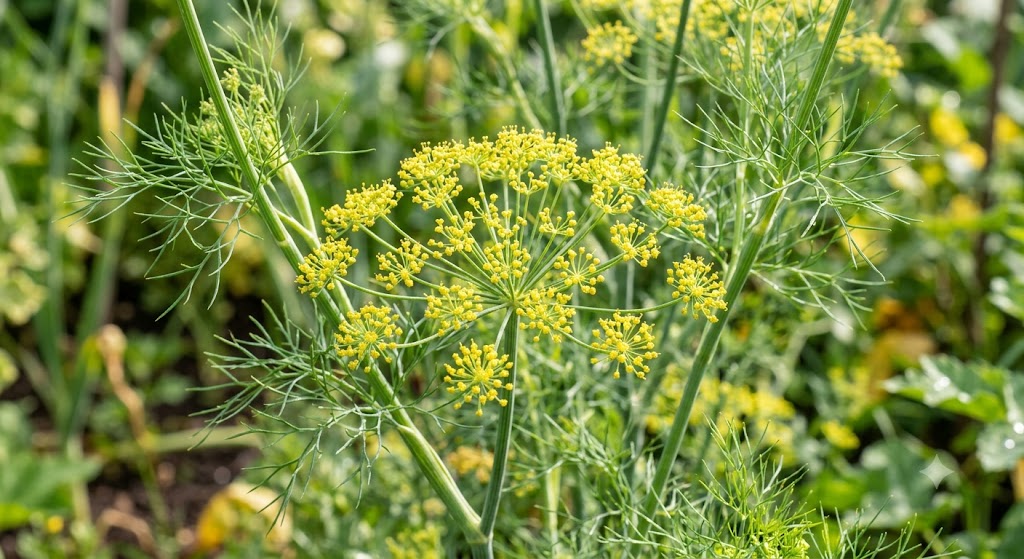
Fennel’s flat-topped umbel flowers are exceptional for beneficial insects once they open in summer — one of the best plants in the herb garden for attracting parasitic wasps (braconid and ichneumonid species that parasitize aphids and caterpillar pests), hoverflies and syrphid flies that predate aphids as larvae, and ladybugs. This beneficial insect function is worth keeping in mind alongside the plant’s known difficulties as a companion, because siting fennel at the garden perimeter — isolated from sensitive vegetables — still puts its umbrella of beneficials within range of the crops they protect. In that configuration, fennel delivers genuine pest management value without its allelopathic compounds reaching vegetable root zones. For more on designing a full pollinator-friendly garden around these relationships, the bee garden guide covers the full annual-to-perennial plant palette.
The other significant insect relationship is with swallowtail butterflies. The black swallowtail (Papilio polyxenes) across eastern North America and the anise swallowtail (Papilio zelicaon) across the West both use fennel as a primary larval host plant — their caterpillars, strikingly banded in green and black, feed on fennel fronds and can cause significant defoliation on smaller plants. This relationship divides gardeners into two camps: those who consider it a problem and those who consider finding a swallowtail caterpillar on their fennel one of the highlights of the growing season. If you want to encourage both swallowtail species — among the most striking butterflies in North America — designate one or two plants as undisturbed habitat rather than a kitchen resource, and allow the caterpillars to feed undisturbed.
The Allelopathy Problem
Fennel releases allelopathic compounds — primarily trans-anethole and related volatile phenolic acids — through its root system into surrounding soil and as volatile aromatics from its foliage. These compounds have a documented suppressive effect on the germination and growth of a range of common vegetables. The effect is not theoretical or subtle in close proximity: tomatoes planted within 1 m of established fennel reliably show reduced vigour and yield, as do peppers, kohlrabi, and bush beans. Brassicas — broccoli, cabbage, kale — experience moderate suppression. The practical consequence is straightforward: fennel should not be planted within the vegetable garden at all. It belongs at the perimeter or in a dedicated herb bed positioned away from any vegetable growing area.
Plants largely unaffected by fennel’s allelopathy include most ornamental flowers, aromatic herbs from unrelated families (mint, sage, thyme, oregano, lavender), and most grasses. This means fennel integrates well into an herb border alongside Mediterranean herbs, into a pollinator or cottage garden, or along a boundary where ornamental plantings rather than vegetable crops are its neighbours. The allelopathic radius extends roughly 1 m from the crown in all directions through established root systems; volatile aromatics have a shorter effective range. Maintaining a 1.5–2 m buffer between fennel and any sensitive crop is the conservative and reliable approach.
Dill & Fennel: Cross-Pollination, Not Allelopathy
The instruction to keep fennel away from dill is nearly universal in companion planting guides, but the reason given is often imprecise. Fennel does not suppress dill through allelopathy — it doesn’t chemically inhibit dill’s growth the way it affects tomatoes. The actual problem is genetic: both plants are Apiaceae with nearly identical umbel flower structure, and they cross-pollinate readily through insect activity when grown in the same garden. The resulting seeds — from either plant — develop into hybrids with diminished, flat flavour that is neither properly fennel nor properly dill. If you save seeds from either crop, this cross ruins the next generation’s culinary quality entirely. Even without active seed saving, subsequent seasons of self-seeding from cross-pollinated parents produce plants that are noticeably blander.
The solutions are practical and proportionate to your goals. True seed-saving isolation requires 500 m (1,600 ft) or more between the two species — not achievable in most gardens. For most kitchen gardeners, the best approach is to grow one or the other rather than both, or to grow both without saving seeds from either. If growing both matters, site them as far apart as your garden allows and purchase fresh seeds each season. Caraway (Carum carvi) has the same cross-pollination relationship with fennel and should be similarly separated. The dill growing guide covers isolation from the dill side of this relationship.
| Plant | Relationship | Notes |
|---|---|---|
| Tomatoes | ✘ Avoid | Fennel allelopathy suppresses tomato root development and reduces yield. Minimum 1.5–2 m separation. |
| Peppers | ✘ Avoid | Sensitive to fennel allelopathy — stunted growth and reduced fruit set in close proximity. |
| Kohlrabi | ✘ Avoid | Among the most sensitive crops to fennel allelopathy. Do not plant within the vegetable bed at all. |
| Bush Beans | ✘ Avoid | Allelopathic suppression documented. Pole beans appear less sensitive, but maintaining separation remains wise. |
| Brassicas (Broccoli, Kale, Cabbage) | ⚠ Caution | Moderate suppression. Maintain at least 1 m separation. In small gardens, keep fennel well away from any dedicated brassica bed. |
| Dill | ✘ Avoid | Cross-pollination — resulting seeds become flavourless hybrids. Grow one or the other; if both, don’t save seeds from either. |
| Caraway | ✘ Avoid | Same cross-pollination issue as dill. Seed quality of both crops is compromised when grown together. |
| Lettuce | ✔ Generally OK | Less sensitive to fennel allelopathy than most vegetables. Usable near the outer edge of a fennel isolation zone. |
| Mint, Sage, Thyme | ✔ Good | Mediterranean aromatic herbs from unrelated families; no allelopathic conflict. Suitable companions in a dedicated herb border alongside fennel. |
| French Marigolds | ✔ Good | No allelopathic conflict. Marigolds’ nematode suppression complements fennel’s beneficial insect attraction at the garden perimeter. |
| Nasturtiums | ✔ OK with distance | No direct allelopathic conflict. Both attract beneficial insects. Keep fennel isolated from the vegetable area where nasturtiums operate as a trap crop. |
| Swallowtail Butterflies | ✔ Host Plant | Black swallowtail (eastern NA) and anise swallowtail (western NA) both use fennel as a primary larval host. Designate one plant as undisturbed habitat to support both species. |
Harvesting Fennel: Three Crops from One Plant
Harvesting Fronds
Frond harvest can begin once plants are 20–30 cm (8–12 in) tall — typically 50–70 days from direct sowing. The governing rule is never remove more than one-third of the plant’s total foliage in a single harvest: taking too much at once stresses the plant and slows regrowth significantly. Snip outer fronds at the stem with scissors rather than pulling or tearing, which preserves the branching structure and encourages more new growth from the base. Fronds are at their most aromatic in the weeks just before the plant begins forming flower buds — volatile compound concentration peaks before energy shifts toward reproduction. After flowering begins, fronds develop a slightly coarser texture and somewhat diminished aroma, though they remain usable throughout the season.
Fresh fennel fronds are genuinely versatile in a way that their dried equivalent is not. Drying causes a loss of roughly 50–60% of volatile aromatics — what remains is a fraction of the flavour in fresh fronds. Use them fresh wherever the anise character is the point: scattered over roasted fish or salmon, stirred into potato salad, blended into herb butters, folded into cucumber salads with yogurt, or used as a dill substitute in any recipe where fennel’s slightly sweeter note works. Fronds store adequately in the refrigerator for five to seven days, wrapped loosely in a damp paper towel inside a resealable bag.
Harvesting Seeds
Fennel seed harvest requires attention to timing: cut seed heads too early and the seeds won’t have developed their full aromatic compound profile; wait too long and they drop from the umbels before you collect them. The right moment is when individual seeds within the umbel cluster have turned from green to grey-brown but the seed heads are still holding most seeds firmly. Cut the entire seed head stem, leaving 20–30 cm (8–12 in) of stalk attached. Place the cut heads face-down over a large paper bag or spread brown paper beneath them and hang upside-down in a warm, dry location for one to two weeks. Seeds that have reached maturity release easily; any that remain attached at the end of two weeks can be rubbed free by hand.
Dried fennel seeds are one of the kitchen garden’s most versatile spices. In Italian cooking they define the flavour of pork sausage — fresh or dried seeds worked into ground pork before forming. In Indian cooking, fennel seed is one of the five spices in panch phoron, the Bengali five-spice blend used in lentils and vegetables. Seeds can be used whole, lightly toasted in a dry pan to intensify flavour, or ground. Toasted and cooled seeds steeped in hot water make a traditional digestive tea. Store dried seeds in a sealed glass jar away from light and heat; culinary quality holds well for two years.
Fennel Pollen: The Premium Harvest
Fennel pollen is the most underutilized product of a fennel plant and one of the most genuinely interesting culinary ingredients the kitchen gardener can produce. The pollen — a fine, bright yellow powder — is collected from umbels at the specific moment just before individual flowers fully open, when each tiny floret is still a tight yellow bud. At this stage, tapping or shaking the umbel releases the intensely perfumed pollen into whatever container is held beneath it. The flavour is categorically different from dried seeds: more floral, more citrusy, sweeter, and with a complexity that makes dried seed taste blunt by comparison. This ingredient sells for $25–50 per ounce from specialty food suppliers because harvesting it at commercial scale is genuinely labour-intensive. From your own garden, a single pass over a large plant takes five minutes and yields enough for multiple cooking sessions.
Harvest pollen in the early morning before heat disperses the volatile compounds. Hold a paper bag, bowl, or sheet of parchment under the umbel cluster and tap or shake the stems gently — the pollen releases immediately when flowers are at the right stage. Repeat over two to three days as different flowers in the cluster reach their moment. Spread the collected pollen on a flat paper sheet in a thin layer and allow to dry at room temperature for two to three days, then sieve through fine mesh to remove any debris. Store in a small sealed glass jar away from light. Use sparingly: a pinch dusted over sea bass, pork belly before roasting, fresh pasta with seafood, or burrata with olive oil transforms the dish with a flavour no other ingredient replicates exactly.
Saving Fennel Seeds
Herb fennel is open-pollinated and saves true — meaning seed from your plants will grow into plants identical to the parent — provided it is isolated from other Apiaceae family members that cross-pollinate freely. Dill and caraway are the primary concerns. If you grow any of these alongside fennel and the plants flower at the same time, cross-pollination is essentially guaranteed, and saved seeds will produce hybrid plants with diminished flavour. The practical minimum isolation distance for seed purity is 500 m (1,600 ft) — which rules out seed saving for most urban and suburban gardeners who also grow dill. The solution is to grow one or the other, or to accept that you’ll purchase fresh seeds each season if growing both.
When saving seed, allow the designated plants to mature fully without cutting back fronds or seed heads. Harvest entire seed heads in September or October when seeds have turned from green to grey-brown and are just beginning to firm up. Dry the cut heads upside-down in a paper bag in a warm, well-ventilated location for two weeks. Thresh the dried heads by shaking vigorously over a bowl; winnow by pouring seeds between two bowls in a light breeze to remove chaff. Store in labelled paper envelopes placed inside a sealed glass jar with a silica gel packet; keep in a cool, dark location. Germination viability holds well for two to three years; test germination in year three before sowing a full crop. Perennial plants in Zones 6 and warmer tend to produce more abundant seed than first-year plants, which may not set seed at all in short-season climates.
Common Fennel Problems & Fixes
| Problem | Likely Cause | Fix |
|---|---|---|
| Poor or patchy germination | Soil below 10°C (50°F), seeds sown too deep, or old seed lot | Wait until soil is genuinely warm. Sow no deeper than 6 mm (¼ in). Test germination from old lots: place 10 seeds on a damp paper towel for 10 days. |
| Seedlings leggy and pale | Insufficient light when started indoors | Move to a sunnier window or add a grow light. Indoor starts need 12–16 hours of strong light to produce sturdy seedlings. |
| No flowers or seeds in first season | Normal for first-year perennials in Zones 5–6; plant may need a second season to flower | Be patient. Annual-treated plants (Zones 3–4) sown in May reliably flower and set seed by September. Perennial plants often don’t flower until their second season. |
| Seeds not ripening before frost (Zones 2–3) | Season too short for full seed maturation | Start in biodegradable pots May 1 to add 3–4 weeks. Alternatively, focus harvest on fronds only; seed harvest is marginal at this latitude. |
| Aphid colonies on new growth | Common in summer, especially in humid climates; worse on plants stressed by heat or overwatering | Knock colonies off with a strong jet of water. Avoid insecticides — they kill the parasitic wasps that fennel attracts and that naturally suppress aphid populations. Most colonies self-limit once wasp populations build. |
| Caterpillars defoliating the plant | Black swallowtail or anise swallowtail larvae — expected host plant relationship | This is a feature. If you want to protect the plant, relocate caterpillars to a sacrificial fennel plant or wild carrot. Established fennel tolerates moderate defoliation and re-grows readily. |
| Yellowing leaves, wilting | Overwatering or poorly draining soil — taproot rot | Reduce watering frequency. Improve drainage by working in grit or raising the bed. Established fennel needs very little water; wet soil is the most common cultural failure. |
| Powdery mildew on fronds | Overcrowding, poor airflow, or humid conditions in late summer | Improve spacing to 45–60 cm (18–24 in). Remove heavily affected fronds. Mostly cosmetic — rarely kills the plant. Base watering rather than overhead reduces recurrence. |
| Perennial plant not re-sprouting in spring (Zone 6) | Crown winter-killed by hard frost without adequate mulch | Apply 15–20 cm (6–8 in) of straw mulch over the crown in late fall after the first hard frost. Wait until late April before concluding the plant is dead — perennial fennel is a late re-sprouter. |
| Neighbouring vegetables doing poorly | Fennel allelopathy — fennel too close to the vegetable bed | Increase separation to 1.5–2 m (5–6 ft) minimum. Move fennel to the garden perimeter away from vegetable root zones. Recovery of affected plants is usually complete by the following season. |
| Bland frond flavour | Over-fertilized soil (high nitrogen), or harvesting fronds after flowering has begun | Avoid high-nitrogen fertilizers. Harvest fronds in the weeks before flower buds form for peak flavour. Post-flowering fronds are still edible but noticeably less pungent. |
| Self-seeding out of control | Seed heads allowed to mature and drop (common in Zones 6–9) | Cut seed heads before seeds turn tan and drop, or cut the entire plant back to 10 cm after first frost. Allow only one or two designated plants to self-seed each year if you want natural regeneration. |
Frequently Asked Questions About Growing Fennel
Related Guides
The closest companion — and the main cross-pollination concern. Everything you need to know about growing dill alongside or instead of fennel.
Read the guide →Fennel’s umbel flowers are exceptional for parasitic wasps and native bees. Build the full pollinator garden around them.
Read the guide →The complete companion planting reference — which crops help each other, which ones to separate, and how much distance matters.
View the chart →Another Apiaceae herb with the same taproot sensitivity and companion planting rules — plus its own host plant relationship with swallowtails.
Read the guide →