

Last updated: July 7, 2026
Why Kale Is So Easy to Grow
Kale germinates in cold soil, shrugs off frosts that flatten tender greens, and produces from spring through late fall — and in mild regions, straight through winter. It grows just as happily in a Zone 3 prairie plot with a four-month season as in a Zone 8 coastal bed that rarely freezes. Getting kale to grow is rarely the problem. Growing it well comes down to three decisions: when to plant it, which variety suits your climate and kitchen, and how to work with the plant’s biology instead of against it.
One fact reshapes every one of those decisions, and most guides skip past it: kale is not one plant but two different species. Sort out which is which and the rest — flavour, cold and heat tolerance, and even how you save seed — falls into place. This guide covers the full arc: choosing a variety, climate-specific timing, sowing, care, pests, harvesting, overwintering, seed saving, and indoor sprouting.
Choosing a Kale Variety: The Two-Species Split
Kale splits into two botanical species, and knowing which one you’re holding predicts how the plant will behave. The Brassica napus group — the Russian and Siberian kales — descends partly from turnip stock; the leaves are flatter, more tender, milder, and the most cold-hardy of all kale. The Brassica oleracea group is a direct cabbage cousin: sturdier, curlier or strappier leaves that hold up to cooking, with the one heat-tolerant outlier (Portuguese Tronchuda) living here too. The table below sorts all seven varieties by species so you can match one to your climate and your plate.
🌿 Kale Variety Comparison
| Kale Seed Variety | Species | Leaf & Colour | Flavour | Cold / Heat Tolerance | Best Use |
|---|---|---|---|---|---|
| Red Russian | B. napus | Flat, oak-leaf lobed; grey-green with purple-red veins & stems | The mildest, sweetest kale raw | Very cold-hardy; bolts fastest in heat | Baby-leaf salads, smoothies, microgreens |
| White Russian | B. napus | Flat oak-leaf; clean white ribs in place of Red Russian’s purple | Very mild, tender | Extremely winter-hardy | Raw salads, overwintering crop |
| Dwarf Siberian | B. napus | Compact, frilly blue-green | Mild, tender — the gateway kale | Extra cold-hardy; notably pest-resistant | Small gardens, containers, fall & winter |
| Lacinato | B. oleracea | Long, strappy, pebbled dark blue-green (dinosaur kale) | Earthy, nutty, low bitterness | Cold-hardy; best heat tolerance among the curly/cabbage types | Ribollita, braises, massaged raw salads, chips |
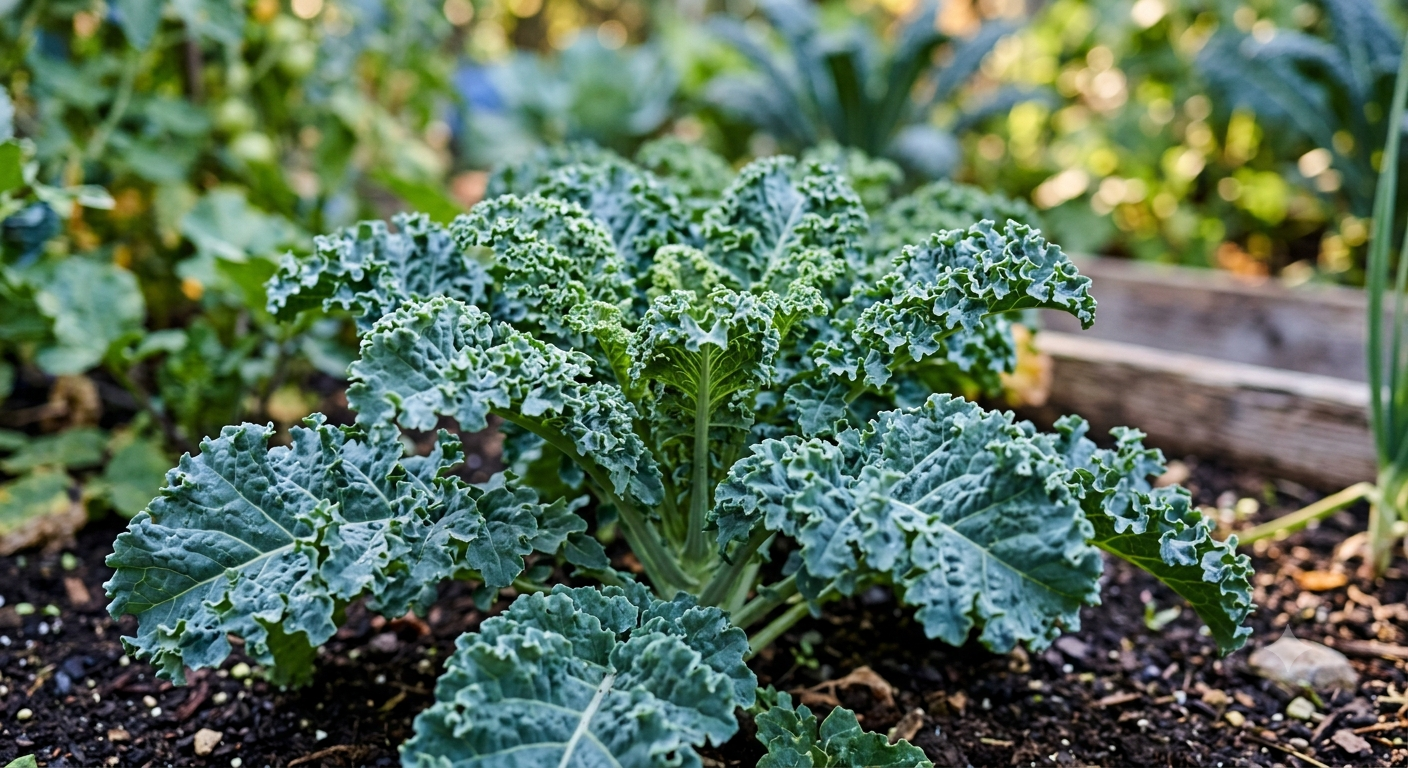
| Blue Curled Scotch | B. oleracea | Tightly ruffled, frilled blue-green (borecole) | Mild; sweetens hard after frost | Extremely cold-hardy | The classic kale chip; sautes, soups |
| Scarlet | B. oleracea | Tightly curled, deep burgundy-purple | Mild; sweetens after frost, colour deepens with cold | Cold-hardy | Edible ornamental beds, chips, high-antioxidant |
| Portuguese (Tronchuda) | B. oleracea var. costata | Broad, flat blue-green paddles; thick, crisp edible white ribs | Mild, cabbage-sweet | The heat-tolerant outlier — and still frost-tolerant | Caldo verde, braises, warm-climate & long-summer gardens |
The three Brassica napus kales — Red Russian, White Russian, and Dwarf Siberian — are the ones to reach for if you think you don’t like kale, or if your season is short and cold. Their flat, oak-leaf foliage is tender enough to eat raw straight off the plant, their flavour is gentle rather than sulphurous, and they carry the deepest cold-hardiness in the genus. Red Russian is the mildest and fastest to baby-leaf size; White Russian is its winter-hardy, white-ribbed twin; Dwarf Siberian stays compact and resists pests better than most, which makes it the standout for containers and tight beds.
The Brassica oleracea kales are built for the kitchen’s cooking side. Lacinato’s flat, pebbled leaves massage into salads and hold their shape in soups and braises; Blue Curled Scotch’s tight ruffles trap seasoning and crisp evenly into the definitive kale chip; Scarlet brings the same curly structure in a deep burgundy that intensifies with cold, earning its place in ornamental beds as readily as on the plate. Portuguese Tronchuda is the exception that proves the rule — an oleracea kale bred around thick, sweet ribs that keeps producing through heat that sends every other variety to seed, which makes it the one to plant where summers run long and hot.
Preparing Soil for Kale
Kale is a heavy nitrogen feeder, and it tells you plainly when it’s underfed — the lowest leaves pale and yellow first. Before planting, work 5–8 cm (2–3 in) of compost into the top 30 cm (12 in) of soil. Kale roots run 45–60 cm (18–24 in) deep, so compacted or heavy clay ground holds it back; loosen it thoroughly, or switch to a raised bed where drainage is poor. Aim for a pH of 6.0–7.5, and if clubroot has ever been a problem, push it toward the top of that range — a pH above 7.2 suppresses the disease. In the naturally acidic soils of the Pacific Northwest and Atlantic Canada, a light lime application the season before planting pays off.
As a brassica, kale also draws on magnesium and calcium. If a previous brassica crop in the bed showed interveinal yellowing — yellow between still-green veins — work a handful of Epsom salt per square metre into the soil for magnesium. For calcium, which prevents the marginal leaf scorch called tip burn during heat spikes, mix crushed eggshells or bone meal into the planting area. Consistent moisture does the rest: calcium moves through the plant in water, so erratic watering undoes good soil prep. For the full indoor-start routine, the complete guide to starting seeds indoors covers timing, lighting, and hardening off in depth.
How to Grow Kale from Seed
Direct Sowing Kale vs. Transplanting
Kale can be direct-sown outdoors or set out as transplants, and both work well — the choice comes down to your season length. Give it a site with at least 6 hours of direct sun. Direct sowing is simplest once the soil is workable: kale germinates at soil temperatures as low as 4°C (40°F), though it sprouts fastest at 18–24°C (65–75°F) — expect 10–14 days in cold spring ground and as little as 5–7 days in warm summer soil for a fall crop. Sow kale seeds 1 cm (¼ in) deep, spacing 8–10 cm (3–4 in) apart in rows 45 cm (18 in) apart, then thin to 30–45 cm (12–18 in) between plants once seedlings reach 8 cm (3 in) tall. Crowded kale is stressed kale, and stressed brassicas pull in more aphids, so thinning is not optional.
Transplants are the better route where the season is short or spring soil stays cold — they give you a head start and a more even stand. Whichever method you use, prioritize the fall crop: kale grown to mature in cooling weather is sweeter and less bitter than anything harvested in summer heat.
Starting Kale Seeds Indoors
Start kale seeds indoors 4–6 weeks before your target transplant date to gain about three weeks on a short season. Sow into cells, keep them warm to germinate, then grow the seedlings on somewhere bright and cool so they stay stocky rather than leggy. Harden off over 7–10 days before planting out. Set transplants slightly deeper than they grew in the cell — like tomatoes, kale roots along a buried stem and anchors more firmly — and water them in with a dilute liquid feed to ease transplant shock. In hot, bright weather, shade new transplants for the first 3–5 days.
Growing Kale in Containers
Kale grows well in containers as long as the pot suits its deep roots. Use one at least 30 cm (12 in) wide and deep — a shallow pot produces a stunted plant — with one plant per 30 cm pot or three in a 60 cm (24 in) planter, in quality mix amended with compost. Container kale dries out far faster than ground-grown plants, so check moisture daily in warm weather and feed every 2–3 weeks, since frequent watering flushes nutrients out the drainage holes. In hot regions, give containers morning sun with afternoon shade for better flavour and less bolting — and the pot’s mobility lets you move plants to a sheltered spot for overwintering.
Growing Kale by Climate & Region
Where you garden changes how you grow kale more than any other single factor. Find the box that matches your region for the specific challenge it presents and the adjustment that solves it.
🥶 Cold / Short-Season Climates
Where: AB, MB, SK; ND, MN, northern MI & WI; the Mountain West above 1,500 m.
The challenge: The season is short, and repeated hard freezes at transplant time can stall young plants that would sail through a single frost.
The fix: Start indoors 6–8 weeks before last frost, harden off over 10–14 days, and transplant only once overnight lows reliably clear −5°C (23°F). For the sweet fall crop, direct-sow about 65 days before your first fall frost — often late July in Zone 3. Row cover adds 2–4 weeks at season’s end, and the napus types (Red Russian, White Russian, Dwarf Siberian) give the deepest cold-hardiness.
💧 Humid / High-Pest Climates
Where: Southeast US, Gulf Coast, Mid-Atlantic, Southern Ontario, Pacific Northwest.
The challenge: Warm, damp conditions build heavy aphid and cabbage-worm pressure and favour downy mildew on crowded, wet foliage.
The fix: Install row cover at transplant, before cabbage butterflies appear, and keep it on through peak flight. Water at the base, never overhead. Across the Deep South, grow kale as a September-to-February cool-season crop; region-wide, fall is the stronger, cleaner season than spring.
☀️ Arid / Heat-Stress Climates
Where: Southwest US, Southern Plains, Texas, Low Desert (AZ, NV, Southern CA), BC Interior.
The challenge: Sustained heat above 27°C (80°F) triggers bolting and turns leaves tough and bitter.
The fix: In the low desert, grow kale as a winter crop — plant October through January, harvest through March. Elsewhere, plant in early spring and again in late summer, and stretch 40% shade cloth over any warm-weather planting. Choose Portuguese Tronchuda, the one kale bred to hold in heat.
When to Plant Kale by Zone
Searching for when to plant kale in Alberta, Ontario, Texas, or the Pacific Northwest? The tables below give spring and fall windows across the zones, with the varieties and adjustments that suit each band. For a whole-garden view, the North American planting calendar sets kale alongside every other crop.
📅 Kale Planting Calendar — Zones 3–6 (Cold & Transitional)
| Zone / Region | Spring Direct Sow | Indoor Start | Fall Direct Sow | Recommended Varieties | Key Adjustment |
|---|---|---|---|---|---|
| Zones 3–4 AB, MB, SK; ND, MN, northern MI; Mountain West (high elevation) | Late April–mid May (soil above 4°C/40°F) | Early March (6–8 wks before transplant) | Late June–mid July (~65 days before first frost) | Red Russian, White Russian, Dwarf Siberian, Blue Curled Scotch | Fall beats spring here — sow late June for a Sept–Oct peak, and row-cover to push past first frost. |
| Zones 5–6 Southern ON, QC, NS; NY, MI, OH, PA, NE, IA, CO Front Range | Mid March–April (soil above 4°C/40°F) | Late Jan–February (6–8 wks before last frost) | Late July–mid August | Lacinato, Blue Curled Scotch, Scarlet, Red Russian | Spring crops often bolt by July; plan the August-sown fall crop as your main harvest — fall leaves are always sweeter. |
📅 Kale Planting Calendar — Zones 7–11 (Warm & Hot)
| Zone / Region | Primary Window | Second Window | Avoid | Recommended Varieties | Key Adjustment |
|---|---|---|---|---|---|
| Zones 7–8 VA, NC, TN, KY; OR, WA & BC coast; Mid-Atlantic | Sept–Oct transplant; harvest Nov–Feb | Feb–March spring crop before heat | July–Aug (heat; flea-beetle peak) | Red & White Russian (overwinter), Lacinato, Tronchuda | Russian types left in the ground resume growth in late Feb before bolting — 2–3 extra weeks of harvest. |
| Zones 9–10 CA (Central Valley/South), TX, AZ, NM, FL, Gulf Coast | Oct–Jan transplant; harvest Nov–March | None in hot-summer areas | April–Sept (bolts, turns bitter) | Portuguese Tronchuda (heat), Lacinato | Treat kale as a winter annual: start in Sept in shade, transplant in Oct once days drop below 30°C (86°F). |
| Zone 11 Hawaii, extreme South FL, Puerto Rico | Nov–Feb at elevation only | — | Summer & low-elevation year-round | Portuguese Tronchuda, Lacinato | At sea level heat defeats kale year-round; above 300 m, winter crops succeed. |
Watering & Feeding Kale
Watering Kale
Kale wants steady moisture — 2.5–4 cm (1–1.5 in) of water per week from rain or irrigation. Water stress causes two separate problems: early-season drought stunts growth and pushes plants to bolt, while mid-season drought concentrates the glucosinolates that make leaves taste bitter. Deep, consistent watering keeps kale mild and productive; shallow, frequent sips build weak surface roots. Water at the base rather than overhead, since wet foliage in humid weather invites fungal disease.
The two failure modes look alike until you check the soil. Underwatered kale droops and its leaf margins curl upward and crisp; overwatered kale in poorly drained ground goes pale and limp, with lower leaves yellowing and dropping. Dry and crumbly versus waterlogged and compacted tells them apart in seconds.
Feeding Kale
Side-dress with compost or a balanced fertilizer every 4–6 weeks through the season — kale rewards nitrogen with dramatically more leaf. There’s one timing caveat: heavy nitrogen in the last six weeks before your first hard frost forces soft, cold-tender growth, so ease off and let the plant harden naturally heading into cold. A handful of wood ash scratched in during late summer adds potassium, which sharpens both cold-hardiness and flavour.
Kale Pests & Diseases
Kale’s pests are predictable, and prevention beats treatment nearly every time. The broader organic approach lives in the organic pest control guide; the kale-specific problems and fixes are below.
🐛 Kale Pest & Problem Solver
| Problem | Likely Cause | Fix |
|---|---|---|
| Ragged holes; leaves eaten toward the midrib | Cabbage worms or cabbage loopers (velvety green caterpillars) | Hand-pick caterpillars and greenish eggs from both leaf surfaces; spray Bt (Bacillus thuringiensis); fit floating row cover before white butterflies appear. |
| Tiny scattered shot-holes across leaves | Flea beetles (worst in warm, dry spells on young plants) | Row cover at planting; diatomaceous earth around the base; keep soil consistently moist, as dry conditions worsen pressure. Established plants outgrow cosmetic damage. |
| Sticky residue; curled, distorted new growth | Aphids (grey-green cabbage aphids cluster in growing tips) | Blast off with a strong water spray; follow with insecticidal soap; invite ladybugs and lacewings with companion flowers. Avoid excess nitrogen — soft growth draws them in. |
| Slime trails; irregular edge holes overnight | Slugs and snails | Iron-phosphate bait; copper tape on containers; pull mulch back from stems to dry the surface. |
| Pale patches up top, grey fuzz underneath | Downy mildew (cool, wet, crowded foliage) | Improve spacing and airflow; water at the base only; remove affected leaves; thin crowded plants. Worst in humid fall weather. |
| Brown, scorched leaf margins in heat | Tip burn from calcium deficiency or heat stress | Water consistently so calcium can move; work crushed eggshells or bone meal into the soil; shade during heat spikes. |
| Lower leaves yellow evenly and drop | Nitrogen shortage or waterlogged roots | Side-dress with compost or blood meal for a hungry plant; if soil is soggy, improve drainage and ease off watering. |
| Sudden central stalk; leaves turn tough & very bitter | Bolting, triggered by heat and long days | Harvest heavily right away; cutting the flower stalk buys a week or two. Shift to fall planting and grow Tronchuda where summers are hot. |
The single most effective long-term defence is crop rotation. Keep kale and every other brassica — broccoli, cabbage, cauliflower, Brussels sprouts, collards — out of the same bed for at least three years. Rotation breaks the cycle of clubroot, a soil-borne disease whose spores persist for 20 years or more once established. If clubroot has appeared, raise the bed’s pH above 7.2 and soil-test before replanting any brassica there.
Companion Planting for Kale
Good kale companions do two jobs: they mask the brassica scent that guides egg-laying cabbage butterflies in, and they draw the predators that clear aphids out. The full cross-crop reference is the vegetable companion planting chart; the kale-specific pairings are below.
🌱 Kale Companion Planting
| Companion Seeds | Relationship | Why It Works |
|---|---|---|
| Dill | ✔ Good | Umbel flowers feed the parasitic wasps that prey on cabbage worms. Let a plant or two flower at the bed edge. |
| Nasturtium | ✔ Trap crop | Aphids strongly prefer nasturtiums — ring the kale with them to pull infestations off the crop. |
| Marigold | ✔ Good | Suppress soil nematodes and pull in hoverflies and ladybugs. French marigolds are the most effective for nematode control. |
| Onions & Garlic | ✔ Good | Allium sulfur compounds mask the brassica scent that draws cabbage moths. Interplant freely between kale rows. |
| Sage | ✔ Good | Strong aromatic oils confuse egg-laying moths; sage shares kale’s cool-season, well-drained preferences. |
| Chamomile | ✔ Good | Draws hoverflies and beneficial wasps, and is long credited with improving the vigour of nearby brassicas. |
| Beets | ✔ Good | Share the cool season, sit low, and don’t compete heavily for nitrogen — efficient use of the space between kale plants. |
| Bush Beans | ✔ Good (spring) | Legumes fix nitrogen from the air, feeding the heavy-feeding kale beside them without crowding the ground. |
| Mint | ⚠ Useful, contain it | Its scent deters cabbage moths and flea beetles, but mint spreads aggressively — keep it in a sunken pot beside the bed, not loose in it. |
| Broccoli, Cabbage & Cauliflower | ⚠ Avoid grouping | All brassicas share the same pests and diseases; planting them together concentrates aphid, cabbage-worm, and clubroot pressure. Grow them, but in separate beds, and rotate the whole family. |
| Tomatoes | ✘ Poor | Heavy feeders that compete directly with kale and are widely reported to inhibit brassicas nearby. Keep them apart. |
| Strawberries | ✘ Poor | Brassicas are reported to suppress strawberry growth and fruiting; give each its own bed. |
Harvesting Kale
When & How to Harvest Kale
Kale is a cut-and-come-again crop, so you harvest leaves, not whole plants. Take the largest outer leaves first, working around the plant, and always leave at least 4–6 inner leaves so it keeps producing — stripping it bare or cutting the central growing point stalls regrowth for weeks. Harvest in the morning, when leaves are firm and cool; midday-picked leaves wilt fast and don’t rebound. Baby kale at 5–8 cm (2–3 in) is ready as early as 25–30 days from sowing; mature cooking leaves run 15–25 cm (6–10 in), and the larger they get the tougher the central rib, which strips out easily before cooking.
⏱ Kale Harvest Timing Guide
| Stage | Leaf Size | Best Use | Notes |
|---|---|---|---|
| Baby kale | 5–8 cm (2–3 in) | Salads, smoothies, sandwiches | Ready 25–30 days from direct sow; mildest flavour |
| Young mature | 10–15 cm (4–6 in) | Salads, stir-fries, wraps | Tender ribs; good raw or briefly cooked |
| Full mature | 20–30 cm (8–12 in) | Soups, braises, chips, sauteed | Strip the central rib; best after first frost |
| ✅ Post-frost peak | Any size | Any use; sweetest of the year | Harvest after 2–3 light frosts for peak sweetness |
| ❌ Too late (bolted) | Any; plant flowering | Pick remaining leaves at once | Leaves turn tough and very bitter once flowering starts |
Why Frost Makes Kale Sweeter
The frost-sweetening of kale is biochemistry, not folklore. When temperatures drop below about 4°C (39°F), kale acclimates to cold by converting stored starches into simple sugars, which lower the freezing point inside its cells and, conveniently, taste sweet. The same shift trims some of the harsher glucosinolates. The result is leaves that are measurably milder and sweeter than the same plant picked in warm weather — the reason the fall crop is worth prioritizing everywhere.
Two or three light frosts down to about −5°C (23°F) give the best flavour. A hard freeze below −10°C (14°F) on unprotected plants turns leaves to mush as they thaw, so in cold regions drape row cover or an old sheet over the plants through hard nights — it extends the harvest by weeks while still letting the cold cycling that improves flavour do its work.
Storing Fresh Kale
Fresh kale keeps 5–7 days refrigerated — wrap unwashed leaves in a damp towel in a loose bag, and don’t wash before storing, since surface moisture speeds decay. To freeze, blanch leaves for 2 minutes, plunge into ice water, drain well, and freeze flat on a tray before bagging; blanched kale holds up to 12 months with little nutrient loss. To dehydrate, dry at 52°C (125°F) for 4–6 hours until brittle for chips or crumbled seasoning that stores for months in a sealed jar.
Overwintering Kale and Saving Kale Seeds
Overwintering Kale in Zones 6–9
Kale planted in late summer overwinters in the ground across much of the Pacific Northwest, Mid-Atlantic, and Southern US with little protection. The napus Russian types are the hardiest — they take temperatures down to about −10°C (14°F) under straw mulch or row cover. In Zone 7 and warmer, kale left through winter slows to near-dormancy, then surges with fresh growth in late winter, weeks before anything new can be planted — giving you February and early-March harvests when the rest of the garden is bare.
To set it up: in late fall, cut the plant back to about 15 cm (6 in), mulch heavily with straw around the base, and add row cover if lows below −8°C (18°F) are coming, pulling it off on warm days to prevent fungal problems. The plant will look rough by spring but usually recovers — then bolts as days lengthen, so harvest hard before the flowers open.
Saving Kale Seeds
All seven varieties here are open-pollinated, so seed saved from them grows true to type — provided you manage crossing. Let one or two plants bolt and flower fully; the yellow flowers are edible and loved by bees. Seed pods (siliques) form along the stalk and turn brown and papery about 8–10 weeks after flowering. Cut whole stalks before the pods shatter, dry them upside down in a paper bag, then thresh by rubbing between your hands and winnow off the chaff. Stored cool, dry, and dark, kale seeds stay viable for 3–4 years.
Cross-pollination is where the two-species split matters most. Kale outcrosses readily by bees, but only within its own species. A Brassica oleracea kale (Lacinato, Blue Curled Scotch, Scarlet, Tronchuda) will cross with any other oleracea in bloom nearby — cabbage, broccoli, cauliflower, kohlrabi, Brussels sprouts — while a Brassica napus kale (Red Russian, White Russian, Dwarf Siberian) crosses only with other napus: rutabaga, rapeseed, and some turnips. The two groups do not cross with each other, so you can safely save seed from one oleracea and one napus kale in the same season. To keep any single variety pure, isolate flowering plants by at least 300 m from others in its species, or cage and hand-pollinate. The complete seed-saving guide covers isolation and viability testing in depth.
Growing Kale Sprouts & Microgreens Indoors
Kale sprouts are among the most nutrient-dense things you can grow on a countertop. Sprouting concentrates the glucosinolate compounds behind kale’s reputation — the sulforaphane precursors — at levels many times those in mature leaves, and they’re ready in 5–7 days with no soil, light, or garden space. The flavour is mild and gently peppery, far softer than mature kale, and folds straight into smoothies, grain bowls, and salads.
For cold-climate gardeners facing a long winter gap between outdoor harvests, indoor kale is the practical bridge. Sprouts grow in a jar with a twice-daily rinse; microgreens go a step further, sown thickly on a shallow tray of mix and cut with scissors at 2–5 cm (1–2 in) tall around 8–12 days. The full methods are in the microgreens guide and the complete sprouting guide.
🥗 Garden Kale vs. Kale Sprouts at a Glance
🌿 Garden-Grown Kale
50–70 days to first harvest
Needs outdoor space & full sun
Season-limited (spring / fall)
Best cooked: soups, braises, chips
Rich in vitamins K, C, A & calcium
🌱 Kale Sprouts (Indoors)
5–7 days to harvest
Countertop — no space or light needed
Year-round production
Best raw: salads, smoothies, bowls
Far higher sulforaphane per gram than mature leaves
Both start from the same seed — organic green kale seeds for sprouting & microgreens, paired with a sprouting jar kit for the jar method.
Using Kale in the Kitchen
Kale’s bitterness reputation is really a question of variety, maturity, and preparation. Young leaves and post-frost mature leaves are mild enough to eat raw; the bitterness lives in mature mid-summer leaves left too long on a heat-stressed plant. Choosing a napus type like Red Russian for raw use sidesteps most of it before you even reach the kitchen.
For raw mature kale, massaging is the single most effective fix. Strip the leaves from the rib, tear them up, add a little olive oil and a pinch of salt, and massage firmly for 2–3 minutes until the leaves soften and deepen in colour. That physically breaks down tough cell walls, turning squeaky and chewy into silky, and massaged kale actually improves over 24–48 hours in the fridge — ideal for meal prep. For cooking, kale’s sturdiness is the asset: unlike spinach it holds structure in soups and braises, softening and mellowing over 10–15 minutes. Blue Curled Scotch and Scarlet crisp into the best chips, tossed lightly in oil and roasted at 150°C (300°F) for 20–25 minutes; Lacinato’s flat leaf is the one for wraps.
🌍 A Short History of Kale
Kale is one of the oldest cultivated greens in the Western world, and it reached North American gardens the same way most of its vegetables did — carried across the Atlantic by European settlers.
🌍 Eastern Mediterranean & Europe: The True Origin
Kale has no North American Indigenous history — it descends from wild cabbage native to the coasts of the eastern Mediterranean and Asia Minor, cultivated for well over 2,000 years. Greek and Roman growers ate loose-leafed, non-heading kales long before the tight cabbage head was bred. Curly kale spread through the gardens of medieval and early-modern Europe as a hardy peasant staple, while the Russian and Siberian Brassica napus kales developed later along the cold northern rim of Europe and Asia — which is exactly why they carry the deepest cold-hardiness today.
🇺🇸 Kale in the United States
European colonists brought kale to the US by the 1600s, and it settled in as a hardy garden green and a Southern cooking staple alongside collards. Its modern surge is well documented: US kale acreage roughly doubled between the 2007 and 2012 USDA Censuses of Agriculture as the health-food movement took hold. California and Georgia lead commercial production, and kale now appears in supermarkets, farmers markets, and home gardens coast to coast — a crop that went from overlooked to ubiquitous in barely a decade.
🇨🇦 Kale in Canada
Kale is tailor-made for the Canadian garden. Its tolerance of hard frost makes it one of the few greens that reliably produces late into a Prairie or Ontario fall, and overwinters on the coast. Market gardeners across British Columbia, Ontario, and Quebec grow it heavily, and Statistics Canada tracks kale within the rising national appetite for leafy greens. For much of the country, a fall kale crop that only sweetens as the frosts arrive is the most dependable fresh vegetable of the late season.
Kale Growing FAQ
When is the best time to plant kale?
What is the best kale variety for cold climates?
What is the best kale variety for hot climates?
Why is kale two different species, and does it matter?
How much sun does kale need?
How often should I water kale?
Why is my kale bitter, and how do I fix it?
How do I stop kale from bolting?
Does kale survive frost and snow?
How do I deal with cabbage worms on kale?
What is eating my kale overnight, leaving tiny holes?
Can I grow kale in containers?
How do I harvest kale so it keeps producing?
What is the difference between curly, Lacinato, and Russian kale?
How long does kale keep after harvest?
Is raw or cooked kale more nutritious?
Is kale safe during pregnancy or for people watching oxalates?
Is kale safe for dogs, cats, and other pets?
Can I save seeds from my kale plants?
Can I grow kale indoors in winter?
Related Growing Guides
Kale’s closest Brassica oleracea relative — shared pests, shared crop-rotation rules.
Another cool-season brassica with nearly identical timing and pest management.
The trickier brassica cousin — head timing, blanching, and the same clubroot cautions.
A cold-tolerant leafy green with similar season timing but different spacing and soil needs.
A heat-tolerant, cut-and-come-again green that carries the harvest when kale bolts.
Grow kale microgreens indoors year-round, alongside a dozen other fast tray crops.
The complete jar-sprouting method — kale sprouts ready in five to seven days.
Kale is a headliner — paired with other cold-hardy crops for year-round planning.


Kale is one of our favourite vegetables, we didn’t know how easy it is to grow and harvest. I love that you can cut some leaves off for stir fries, curries, smoothies, etc. and the kale keeps growing. To think that the first few years we tried to give it away, because I didn’t realize how versatile and nutritious it was!
Glad you discovered how great kale is! It really is so easy to grow kale, and it’s nutritious to eat.