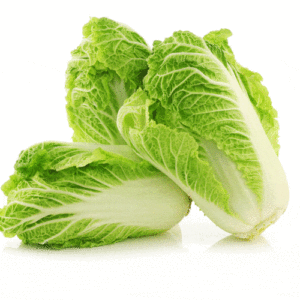
Copenhagen Market — The All-Purpose Garden Cabbage
🌍 Where It Grows Best
🇨🇦 Canada: Zones 3–9 — a dependable main-season cabbage across the Prairies, Ontario, Quebec & the Maritimes. 🇺🇸 US: Zones 3–10 — spring & fall crop in the North; fall & winter crop across the South & West Coast. Best for: All-purpose fresh use, short-term storage & sauerkraut.
Copenhagen Market is the cabbage that built a thousand market gardens. Introduced from Denmark around 1909, it became the standard round green cabbage for growers on both sides of the Atlantic — and it’s easy to see why. It produces firm, uniform, ball-shaped heads of 3–4 pounds on a short, compact stem, and it does so with remarkable evenness: a bed of Copenhagen Market tends to mature all at once, which is exactly what you want when you’re harvesting for the kitchen, the cellar, or a big batch of sauerkraut.
At roughly 63–72 days from transplant it sits in the sweet spot between the quick fresh-eating types and the long-season storage giants — early enough for a reliable spring crop, dependable enough for a fall planting. The heads are sweet and fine-grained, with little waste thanks to the short core, and the compact frame means you can grow it at standard 45 cm (18 in) spacing without crowding. It’s an excellent all-purpose choice for a gardener who wants one solid, versatile cabbage rather than several specialists.
🌱 Sowing & Growing Copenhagen Market
For a spring crop, start seeds indoors 6–8 weeks before your last frost, sowing ¼ inch (6 mm) deep at 18–24°C (65–75°F); seedlings emerge in 5–10 days. Harden off and transplant out 2–4 weeks before last frost. For a fall crop — often the sweeter of the two, as heads mature into cooling weather — direct-sow or transplant in early-to-mid summer, counting back the days-to-maturity from your first frost. Space plants about 45 cm (18 in) apart in rows 60–75 cm (24–30 in) apart; the short stem lets it sit at standard spacing without crowding. Our complete guide to growing cabbage from seed lays out the full split-season plan.
Copenhagen Market is a heavy feeder that does best in fertile, well-drained soil with a pH near 7.0 — keeping the pH up is the most reliable way to suppress clubroot. Work compost into the bed before planting, keep moisture even to prevent splitting, and rotate brassicas on a three-year cycle. Interplant the herbs and flowers in our vegetable companion planting chart to keep cabbage moths and aphids in check naturally.
🎯 Why It’s the Reliable All-Rounder
🎯 Uniform Maturity
Heads ripen evenly — ideal for one big harvest or a single preserving session.
🍳 Truly All-Purpose
Sweet and fine-grained — equally good fresh, cooked, or short-term stored.
🥬 Kraut-Friendly
Firm heads with a short core mean dense, clean cabbage and little waste for ferments.
🌿 Soil, Care & Watering
Aim for about 4 cm (1.5 in) of water per week and keep it steady — uneven moisture is the main cause of split heads in a fast-firming variety like this one. Mulch with 5–8 cm (2–3 in) of organic matter to buffer soil moisture and temperature. Feed a balanced fertilizer at transplant, side-dress with compost around the four-week mark, then ease off nitrogen as heads firm so they stay dense rather than loose. Because the crop ripens uniformly, watch maturing heads closely and harvest promptly once they’re solid to avoid splitting.
✂️ Harvesting & Storing
Harvest when heads feel firm and solid throughout — usually 63–72 days from transplant. Cut at the base, leaving a couple of wrapper leaves for protection. Whole heads keep several weeks to a couple of months in the fridge or a cold room near 0°C (32°F); for crisp sauerkraut, shred and ferment soon after cutting while the cabbage is at its densest. Leave the rooted stump in the ground and you’ll often get small secondary heads for a bonus harvest a few weeks later.
🌱 Saving Seeds from Copenhagen Market
An open-pollinated Danish heirloom from around 1909, Copenhagen Market produces seed that grows true to type. Cabbage is biennial, so overwinter a plant and let it flower the following spring to set seed. It cross-pollinates by insects with any flowering Brassica oleracea, so isolate from broccoli, kale, cauliflower and kohlrabi for pure seed. See our complete seed-saving guide for the full biennial process.
❓ Copenhagen Market Cabbage FAQ
How long does Copenhagen Market take to mature?
Roughly 63–72 days from transplant — an early-to-mid season cabbage. Add 6–8 weeks if you’re starting indoors from seed.
What makes it good for sauerkraut?
Firm, fine-grained heads with a short core mean lots of clean, dense cabbage to shred and very little waste — ideal for crisp, reliable ferments. Storage types like Danish Ballhead are the other classic kraut choice.
Do the heads mature all at the same time?
Largely, yes — uniform maturity is one of Copenhagen Market’s signature traits, which is why market growers favoured it. That makes it convenient for a single big harvest or preserving session.
Can I grow it in both spring and fall?
Yes. Its mid-range timing suits a spring transplant and a fall crop equally well. Fall-grown heads maturing into cool weather are especially sweet — see the split-season strategy in our cabbage guide.
How far apart should I space plants?
About 45 cm (18 in) apart in rows 60–75 cm (24–30 in) apart. The compact stem lets it sit at standard spacing without crowding its neighbours.
Is it an heirloom?
Yes — an open-pollinated Danish heirloom from around 1909. Seed saved from it grows true to type; isolate from other flowering brassicas as covered in our seed-saving guide.
How does it compare to Early Jersey Wakefield?
Early Jersey Wakefield is faster (~63 days) with pointed, fresh-eating heads, while Copenhagen Market is a round, slightly later, more all-purpose cabbage that handles short storage and kraut better. Many gardeners grow both for a longer harvest window.
How do I prevent clubroot and head splitting?
Keep soil pH near 7.0 (lime if needed) to suppress clubroot, rotate brassicas on a three-year cycle, and maintain even moisture with mulch to prevent splitting. Full detail in our growing guide.
🥬 The All-Purpose Garden Cabbage
Firm, uniform, sweet heirloom heads — equally at home fresh, stored, or fermented.
As an Amazon Associate, I earn from qualifying purchases — at no extra cost to you.