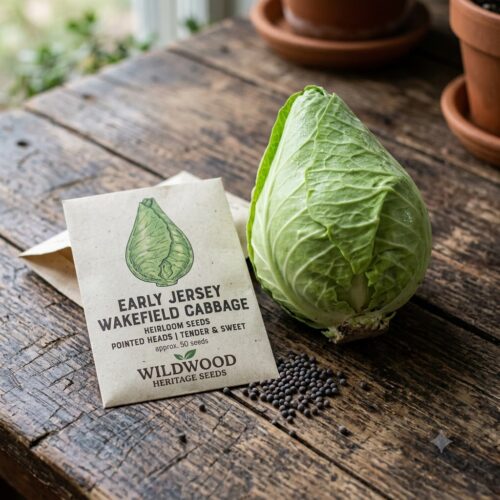
Early Jersey Wakefield — The Earliest Cabbage of the Season
🌍 Where It Grows Best
🇨🇦 Canada: Zones 3–9 — an outstanding early spring crop where the cool window is short, from the Prairies to Ontario, Quebec & the Maritimes. 🇺🇸 US: Zones 3–10 — spring crop in the North; fall & overwinter crop across the South & West Coast. Best for: A fast first harvest, fresh eating, slaws & small-space gardens.
Early Jersey Wakefield is one of the oldest cabbages still grown in North America — an heirloom tracing back to the 1840s, when seed brought from Wakefield in England was popularized by market growers in New Jersey. Nearly two centuries later it’s still a favourite for one simple reason: it’s fast. At around 63 days from transplant it’s among the first cabbages of the season, forming compact, pointed (conical) heads of 2–3 pounds with a sweet, tender heart that’s at its best eaten fresh in slaws and salads.
The pointed shape isn’t just good looks — it lets you plant Wakefield closer together than round storage types, which makes it a smart choice for raised beds and small gardens where space is tight. It’s also notably cold-hardy and reasonably bolt-resistant for such an early variety, so it transplants out well ahead of summer heat to catch the cool spring window. In mild-winter regions it doubles as a fall and overwintering crop.
🌱 Sowing & Growing Early Jersey Wakefield
Start seeds indoors 6–8 weeks before your last frost, sowing ¼ inch (6 mm) deep at 18–24°C (65–75°F); seedlings appear in 5–10 days. Harden off over a week or two, then transplant out 2–4 weeks before your last frost — Wakefield is frost-hardy and young plants take a light freeze in stride. Because the heads stay compact and pointed, you can space plants tighter than round cabbages: 30–38 cm (12–15 in) apart works well, versus the 45–60 cm round storage types demand. Our complete guide to growing cabbage from seed covers indoor starting, hardening off and timing in detail.
Give it fertile soil with a pH near 7.0 to suppress clubroot, and keep moisture steady so the fast-developing heads don’t split. The most effective pest defence on tender early heads is a floating row cover installed at transplant — it blocks cabbage moths before they lay eggs. Interplant aromatic herbs and flowers from our vegetable companion planting chart to reinforce that protection.
⚡ Why Gardeners Love Wakefield
⚡ Fast — ~63 Days
Among the earliest cabbages you can grow — fresh heads in late spring.
📐 Space-Saving
Pointed heads allow tight 30–38 cm spacing — ideal for raised beds & small plots.
🥗 Sweet & Tender
A fine, sweet heart that’s best fresh — slaws, salads & quick sautés.
🌿 Soil, Care & Watering
Wakefield grows fast, so it appreciates a fertile, compost-rich bed and consistent moisture — about 4 cm (1.5 in) of water per week. Apply a balanced fertilizer at transplant to fuel quick leafy growth, then keep watering even as heads form to prevent splitting. A light mulch conserves moisture and keeps spring soil temperatures stable. Because the crop matures quickly, the pest window is short — a few weeks of row cover after transplant usually carries it through.
✂️ Harvesting & Using
Cut Wakefield as soon as the pointed heads feel firm — don’t wait for them to bulk up like a storage cabbage, as early types hold less long and can split if left standing. Slice at the base with a sharp knife; if you leave the rooted stump and a few outer leaves, it often throws a cluster of small secondary heads for a bonus cutting. These early heads are higher in moisture and best eaten within a week or two: shred raw for slaw, wilt into stir-fries, or braise gently. For long keeping, grow a dense storage type like Danish Ballhead alongside it.
🌱 Saving Seeds from Early Jersey Wakefield
This is a true open-pollinated heirloom dating to the 1840s, so saved seed grows true to type. Like all cabbage it’s biennial, flowering in its second year — overwinter a plant and let it flower the following spring. It cross-pollinates by insects with other flowering Brassica oleracea, so isolate from broccoli, kale, cauliflower and kohlrabi for pure seed. Our complete seed-saving guide explains the biennial cycle.
❓ Early Jersey Wakefield FAQ
How fast does Early Jersey Wakefield mature?
About 63 days from transplant — one of the earliest cabbages you can grow. Starting seed indoors 6–8 weeks ahead, you can be cutting heads in late spring.
Why are the heads pointed instead of round?
It’s a conical (sometimes called “sugarloaf”) type. The pointed shape packs a tender, sweet heart and lets you space plants more closely than round cabbages — handy in small beds.
Can I plant it close together?
Yes — because the heads stay compact, 30–38 cm (12–15 in) spacing works well, tighter than the 45–60 cm round storage types need. See spacing detail in our cabbage guide.
Is it good for storage or best eaten fresh?
Best fresh. Early types have a higher moisture content than dense storage cabbages, so enjoy Wakefield in slaws, salads and quick cooking rather than long root-cellar keeping. For storage, choose Danish Ballhead.
Will it bolt in spring?
It’s more bolt-resistant than most early cabbages, but any cabbage can bolt if young plants sit through a prolonged cold snap and then warm quickly. Harden off properly and transplant on schedule to minimise the risk.
Is this a true heirloom?
Yes — open-pollinated and dating to the 1840s, so you can save true-to-type seed. Isolate from other flowering brassicas; our seed-saving guide explains the biennial seed cycle.
Can I grow Wakefield in containers?
Yes — its compact size suits a pot at least 30 cm (12 in) wide and deep, one plant per container, in full sun. Water consistently, since containers dry out faster and drought stress can trigger bolting or splitting in such a fast crop.
How do I keep cabbage worms off the young heads?
Floating row cover at transplant is the most effective method, plus aromatic companion herbs. If worms appear, Bt is an organic control. The full playbook is in our companion planting chart and growing guide.
🥬 Grow the Earliest Cabbage of the Season
Sweet, tender, fast-maturing heirloom heads — a North American garden classic since the 1840s.
As an Amazon Associate, I earn from qualifying purchases — at no extra cost to you.