

Published: June 24, 2026
If you’ve ever stared at a seed catalogue trying to decide between a Brandywine and a Big Boy tomato, you’ve wandered into one of gardening’s most misunderstood debates. The terms heirloom, open-pollinated, and hybrid appear on nearly every seed packet — yet most guides use them interchangeably when they shouldn’t, and one misconception circulates so persistently it deserves its own section: hybrid seeds are not GMO. The two are entirely different technologies, and confusing them leads to bad purchasing decisions in both directions.
These seed types differ in ways that genuinely affect flavor, yield, disease resistance, seed saving potential, and how your garden performs in your specific climate. This guide covers the full picture: what each term actually means, where each type genuinely outperforms the other, and a crop-by-crop breakdown covering tomatoes, peppers, squash, beans, cucumbers, lettuce, and corn.
What Makes a Seed Heirloom, Open-Pollinated, or Hybrid?
Open-Pollinated Seeds: The Foundation
Open-pollinated (OP) seeds are produced by natural pollination — wind, insects, birds, or direct contact between plants of the same variety. The defining property is genetic stability: grow an OP variety, collect its seeds, and plant them next season, and the offspring will closely resemble the parent plant in all the traits that matter — size, colour, flavour, days to maturity, and disease tendencies. Plant breeders call this “coming true to type.”
Before hybrid technology arrived in the early twentieth century, every garden crop was open-pollinated. Farmers selected the best-performing plants each autumn, saved their seeds, and replanted the following spring. Over generations, that selection adapted varieties to local conditions — shorter seasons in northern plains, heavier clay soils in the Midwest, higher humidity along the Gulf Coast. Every heirloom variety in a seed catalogue today is the living result of that centuries-long process.
Heirloom Seeds: A Subset of Open-Pollinated
All heirloom seeds are open-pollinated, but not all open-pollinated seeds are heirlooms. An heirloom is an OP variety with documented history of at least 50 years — placing the cutoff roughly at 1975 or earlier. Many well-known heirlooms are considerably older: Cherokee Purple tomato traces to the late 1880s, Mortgage Lifter was developed in the 1930s, and Brandywine has documented history back to the mid-1800s. A newer OP variety introduced in 2005 may be excellent and true-breeding, but it is not an heirloom.
The word “heirloom” carries cultural weight beyond its botanical meaning. Seed Savers Exchange defines heirlooms based on age and open-pollinated status rather than geographic origin or family lineage. When you grow a Brandywine tomato, you’re growing essentially the same plant Pennsylvania gardeners grew in the 1880s. The genetic diversity heirloom varieties represent — hundreds of regionally adapted selections that commercial breeding has largely set aside — also has real value as food security and a resource for future plant breeders.
Hybrid Seeds (F1): Controlled Cross-Pollination
A hybrid seed — labeled F1 on the packet, meaning “first filial generation” — is produced by deliberately crossing two genetically distinct, stabilized parent lines. This is not genetic engineering and it is not new: F1 hybrid plant breeding has been practiced since the early 1900s. The crossing is done by hand or controlled pollination in isolation, ensuring every seed in the batch descends from those two specific parent lines. The result is a phenomenon called hybrid vigor, or heterosis: first-generation offspring frequently outperform both parents in yield, growth rate, and uniformity.
The trade-off is generational. Hybrid vigor does not transfer to the next generation. Seeds collected from F1 plants — called F2 — will not resemble the parent. The traits combined in the F1 cross separate and recombine unpredictably, producing a highly variable population. This is why seed companies re-cross parent lines every production cycle, why hybrid seeds cost more per packet, and why saving seed from hybrid varieties is not practical for most home gardeners.
The Real Differences That Matter to Home Gardeners
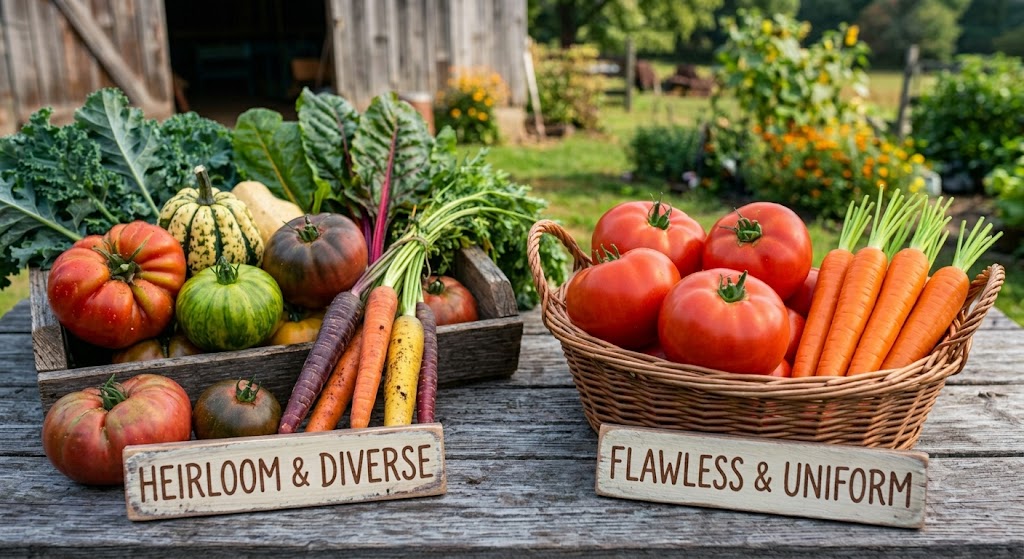
Neither heirlooms nor hybrids win across every trait — choosing well means understanding where each type genuinely performs better.
| Trait | Heirloom / Open-Pollinated | Hybrid (F1) |
|---|---|---|
| Flavor | Often complex and variety-specific; most pronounced in tomatoes and some melons | Typically milder; often optimized for shelf life over taste |
| Yield | Moderate and crop-dependent | Usually higher; hybrid vigor reliably produces more fruit per plant |
| Disease Resistance | Variable; many large-fruited tomatoes are prone to blight in humid climates | Often superior; breeders stack multiple resistances into a single F1 variety |
| Uniformity | Some natural variation in size, colour, and ripening time within the variety | Extremely uniform; useful for succession planting and planning |
| Days to Maturity | Varies widely; many large-fruited types are mid- to late-season | Often faster; a real advantage in short-season climates |
| Seed Saving | ✅ Yes — saves true to type; the primary practical advantage over hybrids | ✗ No — F2 offspring segregate unpredictably |
| Seed Cost | Usually lower per packet; simpler to produce at scale | Higher; parent lines must be re-crossed every production cycle |
| Variety Diversity | Enormous — hundreds of regionally adapted varieties per crop | Significant, but skewed toward commercial priorities |
| Climate Adaptation | Can improve in your specific soil and climate through selective seed saving | Does not adapt; purchase new seed every season |
| GMO? | No — conventional plant selection only | No — F1 hybridization is conventional plant breeding; addressed in full below |
Flavor: Where Heirlooms Have a Documented Advantage
The flavor case for heirlooms is real, and most pronounced in tomatoes. Commercial tomato breeding from the 1960s onward optimized for shelf life, firmness, and resistance to mechanical harvesting — priorities that work directly against flavor. Researchers identified that a gene variant selected for uniform ripening in commercial and hybrid tomatoes simultaneously suppresses sugar and lycopene production. Heirloom varieties like Brandywine, Cherokee Purple, and Black Krim were never subjected to that selection pressure — a significant part of why the flavor gap between a garden-grown heirloom and a grocery store tomato can be so striking.
This advantage does not carry equally across all crops. Heirloom lettuces and beans are typically as flavorful as hybrid equivalents. With squash, cucumbers, and peppers, flavor differences are considerably less dramatic. The flavor argument is strongest where commercial breeding specifically traded taste for shelf stability — tomatoes first, and to a lesser degree some melons and sweet peppers.
Yield and Disease Resistance: Where Hybrids Genuinely Earn Their Price
In replicated trials comparing OP and hybrid versions of the same crops, hybrids consistently produce more fruit per plant — with advantages of 20–40% in sweet corn and cucumbers. Disease resistance stacking is the other genuine advantage: tomato hybrids carry multi-resistance codes like VFNT — protection against Verticillium wilt, Fusarium wilt, nematodes, and Tobacco Mosaic Virus — that no 19th-century heirloom variety possesses. In humid climates across the Southeast, Mid-Atlantic, and Southern Ontario where Fusarium wilt, early blight, and late blight are common season-enders, a well-chosen disease-resistant hybrid can mean the difference between a full harvest and a failed season.
Seed Saving: Where the Lines Diverge Most
How Open-Pollinated Seeds Save True
With any OP or heirloom variety, you collect ripe seeds at the end of the season, dry them thoroughly, store them in a cool dark location, and replant the following spring. The resulting plants will be genetically nearly identical to the parent — same flavour, same growth habit, same disease tendencies. Select seeds each season from your strongest, most productive plants, and your variety gradually adapts to your specific microclimate and soil. This is how heirloom varieties were developed, and it remains a powerful tool for any home gardener who wants seed independence. With F1 hybrids, the F2 offspring will not resemble the parent — traits from the two original parent lines segregate unpredictably. If seed saving is a priority, open-pollinated varieties are the straightforward choice.
Cross-Pollination Risk by Crop Family
Cross-pollination between varieties of the same species produces seeds that don’t come true to type — a common source of mystery when squash or cucumbers look completely different the year after you save seed. The risk varies enormously by crop.
| Crop | Cross-Pollination Risk | Isolation for Pure Seed | Notes |
|---|---|---|---|
| Tomatoes | Very Low | 3–10 m (10–33 ft) | Largely self-pollinating; bees occasionally cross potato-leaved types |
| Beans & Peas | Very Low | 3–6 m (10–20 ft) | Self-pollinate before flowers open; easiest crops to save in mixed gardens |
| Lettuce | Very Low | 3–6 m (10–20 ft) | Self-pollinating; only crosses when bolting plants attract insects to open flowers |
| Peppers | Moderate to High | 150–500 m (500–1,600 ft) | Sweet and hot varieties cross freely; affects next year’s plants, not this season’s fruit |
| Squash (C. pepo) | High within species | 400–800 m (¼–½ mile) | Zucchini, acorn, delicata, and many pumpkins cross freely; C. moschata (Butternut) does not cross with C. pepo |
| Cucumbers | High | 500+ m (1,600+ ft) | Cross readily between varieties; hand-pollination with bagged flowers is practical for home saving |
| Corn | Very High | 800 m–1.6 km (½–1 mile) | Wind-pollinated; pollen travels far — the most difficult garden crop to save in isolation |
| Brassicas | Very High | 1 km (½+ mile) | Broccoli, cabbage, kale, and Brussels sprouts all cross within B. oleracea; biennial — won’t set seed until year two in most climates |
Before replanting stored heirloom seed, a quick germination test removes the guesswork. Place 10 seeds on a damp paper towel, fold and bag it, keep at 18–24°C (65–75°F), and check after the expected window for that crop — 7–10 days for tomatoes, 3–5 days for beans, 10–14 days for peppers. Eight or more out of ten means excellent viability; five to seven, plant more densely; below four, replace the lot. F1 hybrid seeds from purchased packets almost always test at 90%+ germination in their first season, but their vigor declines more predictably with storage than well-selected open-pollinated seed does.
Climate Realities: Where Each Type Actually Performs
The heirloom vs. hybrid debate often plays out as if climate is irrelevant. It is not. Where you garden determines which type delivers on its promises — and in some climates, defaulting to heirlooms actively sets gardeners up for frustration.
The challenge: Recommending Brandywine (85–90 days) in a 90-day frost-free window guarantees plants that never fully ripen. This is the clearest case where early-maturing hybrid tomatoes (60–70 days) are a legitimate, practical choice — not a compromise. Their maturity advantage is climate-specific and real.
The open-pollinated path: Short-season OP varieties — Stupice (60 days), Glacier (55 days), Sub-Arctic Plenty (45 days) — deliver heirloom flavor inside a realistic time window. Start transplants 6–8 weeks indoors and use black plastic mulch to push the season forward.
The challenge: Late blight (Phytophthora infestans) and Fusarium wilt can destroy heirloom tomato plantings before fruit fully ripens — particularly in wet summers across the Southeast and during mid-July humidity surges in the Great Lakes region. VFNT disease-resistant hybrid tomatoes allow reliable harvests where unprotected heirlooms regularly fail.
The open-pollinated path: Choose late-blight-tolerant heirlooms (Matt’s Wild Cherry, Aunt Ruby’s German Green, Amish Paste), plant in full sun with excellent airflow, stake aggressively, and apply preventive copper sprays before symptoms appear.
The challenge: Many hybrid tomatoes were bred under cooler greenhouse conditions and set fruit poorly when daytime temperatures consistently exceed 35°C (95°F). Disease resistances built into those hybrids become largely irrelevant when heat and water stress are the defining threats.
Heirlooms genuinely win here: Drought-adapted selections — Amish Paste, Mortgage Lifter, traditional Southwestern dry-farmed types — have proven deeper root systems and heat tolerance that commercial hybrids often lack. Traditional heirloom dry beans from the Southwest outperform hybrid snap bean varieties dramatically in low-water conditions.
Crop-by-Crop Breakdown: Flavor, Yield, Seed Saving & the GMO Truth
The table below covers the seven crops where the heirloom vs. hybrid question comes up most often. Heirloom picks link to product pages on seed-bank.ca where available; the hybrid column notes when a hybrid is the genuinely better choice and links to Amazon.
As an Amazon Associate, I earn from qualifying purchases — at no extra cost to you.
| Crop | Top Heirloom / OP Pick | When to Consider a Hybrid | Key Factor |
|---|---|---|---|
| Tomatoes | Brandywine (flavor) · Amish Paste (sauce) · Cherokee Purple (complexity) | Humid climates with heavy blight; short seasons needing sub-70-day maturity. Look for VFNT codes. Shop on Amazon → | Climate decides: flavor favors heirlooms, disease pressure and season length favor hybrids |
| Peppers | California Wonder · Jalapeño · Cayenne | Short-season climates needing fruit set by late August; some hybrids mature 10–14 days earlier. Shop on Amazon → | Flavor differences are minor; season length matters most |
| Squash & Zucchini | Waltham Butternut · Table Queen Acorn · Delicata | Small gardens needing max yield per plant; PMR hybrid zucchini in humid climates. Shop on Amazon → | Yield per plant and mildew resistance in humid conditions |
| Beans | Dragon Tongue, Kentucky Wonder, Provider — browse our bean seeds collection | Rarely necessary. OP beans match hybrid performance in most home gardens. Shop on Amazon → | Beans are the clearest case where heirlooms lose nothing vs. hybrids |
| Cucumbers | Marketmore, Lemon, Straight Eight — browse our cucumber seeds collection | Powdery mildew in humid climates; disease-resistant hybrids extend the season meaningfully. Shop on Amazon → | Disease pressure tips the balance toward hybrids in humid regions |
| Lettuce | Buttercrunch · Parris Island Romaine · Red Leaf | Heat-resistant hybrid lettuce for summer production when OP varieties bolt quickly. Shop on Amazon → | Lettuce is an ideal heirloom crop — easy to save, excellent flavor, enormous variety selection |
| Sweet Corn | Golden Bantam, Bloody Butcher — browse our corn seeds collection | Hybrid vigor is most dramatic in corn — hybrids typically outyield OP varieties by 30–50%. Shop on Amazon → | Seed saving corn requires large isolation distances most home gardens can’t provide |
Are Hybrid Seeds GMO? No — and Here’s Why the Confusion Persists
This question deserves its own section because the confusion between hybrid and GMO seeds is the single most common misunderstanding in home seed buying. Gardeners who believe hybrids are GMO avoid excellent disease-resistant and short-season varieties without cause. And no commercial garden seed in North America — heirloom or hybrid — is GMO.
What Genetic Modification Actually Is
Genetic modification (GM) means inserting genetic material from one organism into the DNA of another in a laboratory using recombinant DNA technology. The most well-known agricultural example is Roundup Ready crops: genes from a soil bacterium were inserted into corn, soybean, canola, and cotton DNA to confer resistance to the herbicide glyphosate. This process requires sophisticated laboratory equipment, years of regulatory testing, and approval from USDA, EPA, and FDA. The commercially approved GMO crops in North America are a short list: field corn, soybeans, cotton, canola, alfalfa, and sugar beets — commodity crops grown by commercial producers, not available through garden seed companies.
What Hybrid Breeding Actually Is
F1 hybrid seeds are produced by crossing two genetically distinct parent plants through conventional pollination — hands, bees, or controlled field isolation. The resulting seeds are a natural genetic combination of two existing plant varieties. No genes are inserted from other species, no laboratory procedures are involved, and no regulatory approvals beyond standard plant variety development are required. F1 hybridization is mechanically no different from what happens in nature when a bee transfers pollen from one plant to another — except it’s done intentionally with carefully selected parent lines. The confusion between hybrid and GMO likely arises because both technologies are associated with large commercial seed companies. But the underlying technologies are completely different.
What “Non-GMO” Labels on Seed Packets Actually Mean
You’ll frequently see “Non-GMO” or the Non-GMO Project butterfly label on heirloom seed packets — and almost never on hybrid packets. This creates a false implication. The Non-GMO label verifies what was already true by default: these garden seeds have not been genetically engineered. Hybrid seeds without the label are equally non-GMO; the label is a marketing differentiator, not a safety warning about alternatives. No approved GMO tomatoes, peppers, cucumbers, squash, lettuce, or beans are commercially available to home gardeners.
Which Should You Grow? A Goal-Based Decision Framework
The right answer depends on what you’re optimizing for. Here’s a clear framework by priority.
Grow heirloom open-pollinated varieties, particularly for tomatoes and sweet peppers where the flavor advantage is most documented. Start with Brandywine, Black Krim, or Cherokee Purple. For crops where flavor differences are minor (beans, cucumbers, squash), the heirloom vs. hybrid distinction matters far less.
Choose open-pollinated varieties across the board. Start with the easiest crops: beans, peas, and lettuce carry very low cross-pollination risk. Add tomatoes once you’re comfortable. Leave squash, cucumbers, corn, and peppers for when you have the space for proper isolation distances.
Use targeted hybrid choices for specific problem crops. Short growing season (Canada Zones 2–4, US Upper Midwest): early-maturing hybrid tomatoes under 70 days are a legitimate choice. Humid climate with annual blight: VFNT disease-resistant hybrid tomatoes provide the reliability that large-fruited heirlooms cannot. Use OP beans, lettuce, and herbs everywhere — they don’t benefit meaningfully from hybrids.
Hybrid zucchini and cucumbers produce more per plant than heritage equivalents — meaningful when you only have room for two or three plants. Hybrid sweet corn outyields OP varieties most reliably. For everything else in a compact garden — tomatoes, beans, lettuce, herbs — variety selection and growing skill matter far more than seed type.
The most practical approach for most North American gardeners is a deliberate mix: heirloom and open-pollinated varieties where flavor or seed saving is the point, targeted hybrid choices where season length or disease pressure creates real production challenges. You don’t have to pick a side — the goal is to grow food successfully in the conditions you actually have.
Common Misconceptions — Cleared Up
| Misconception | What’s Actually True |
|---|---|
| Hybrid seeds are genetically modified (GMO) | Completely false. F1 hybridization is conventional cross-pollination between two parent varieties. GMO involves laboratory gene transfer from unrelated organisms. No approved GMO garden seeds exist for most vegetable categories in North America. |
| You can’t save seeds from open-pollinated plants | The opposite is true. Seed saving is the primary advantage of OP and heirloom varieties — saving true to type is exactly what “open-pollinated” means. |
| Heirloom tomatoes always taste better than hybrids | Often true for tomatoes, where commercial breeding prioritized shelf life over flavor. Not universally true across all crops — heirloom and hybrid beans, cucumbers, and squash are often indistinguishable in taste. |
| Organic seeds are the same as heirloom or non-GMO seeds | No. Organic certification describes how the parent plants were grown (without synthetic inputs), not the variety type. Organic seeds can be heirloom, OP, or F1 hybrid. |
| Hybrid seeds produce sterile plants | Hybrid plants are generally fertile and produce viable seeds — those seeds just don’t grow into plants resembling the parent. “Non-true-breeding” is accurate; “sterile” is not. |
| You’re legally required to buy new hybrid seeds each season | No legal requirement exists for home gardeners. Patent restrictions apply to commercial seed production, not personal garden use. |
| Heirloom varieties are harder to grow | Not inherently. The perception often stems from growing large-fruited heirloom tomatoes where disease-resistant hybrids perform better — a matching problem, not a trait of heirlooms in general. |
| The “Non-GMO” label means the unlabeled alternative might be GMO | No. Virtually all commercial garden seeds — heirloom, OP, and hybrid — are non-GMO. The label is a marketing differentiator. Hybrid seeds without the label are equally non-GMO. |


