
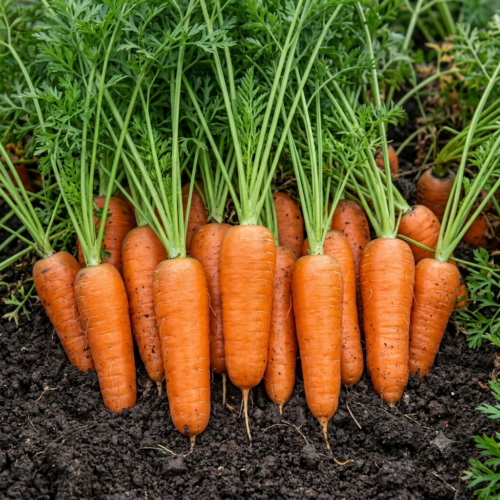
Kuroda — The Sweet Japanese Carrot Bred to Take the Heat
Kuroda is the carrot to grow where summers are hot and the soil is less than perfect. Bred in Japan as a Chantenay-type, it produces thick, broad-shouldered roots that taper to a blunt tip — a shape that sizes up in heavier, shallower ground where long, slender carrots fork and stall. The flavour is the payoff: Kuroda is one of the sweetest, most tender carrots you can grow, loaded with beta-carotene and crisp right through with no woody core.
Where most carrots sulk in warm weather, Kuroda holds its quality through heat that would turn other varieties bitter or bolt-prone, which is why it is a staple across the southern US, warm-climate gardens, and anywhere spring turns hot fast. This open-pollinated strain (often sold as Shin Kuroda or New Kuroda) grows 15–20 cm (6–8 in) roots that are as good juiced as they are roasted or eaten raw from the row.
🇨🇦 Canada: Zones 3–9. A dependable, very sweet carrot across Ontario, Quebec, BC, and the Prairies, and a smart pick where summer heat arrives early. Direct sow 2–4 weeks before last frost, and sow again in midsummer for a fall crop that finishes in cooling soil.
🇺🇸 US: Zones 3–11 — and one of the best carrots for hot regions. Its heat tolerance makes it a standout across the Southeast, Gulf Coast, Texas, and the Southwest, where cool-season types struggle. Grow spring and fall in the North; fall through winter in the South and low desert.
How to Grow Kuroda Carrot Seeds
Direct sow Kuroda carrot seeds where they will grow — like all carrots, the taproot forks if transplanted or disturbed. Sow 6 mm (¼ in) deep in loose soil from 2–4 weeks before your last frost, and keep sowing into warm weather, since Kuroda’s heat tolerance lets it germinate and grow when other carrots refuse. Its blunt, Chantenay-type root means you only need to loosen the bed to about 25 cm (10 in), and it copes with heavier ground better than long types.
Germination takes 10–18 days; keep the surface constantly moist, as a dry crust is the usual cause of a thin stand. Thin seedlings to 5 cm (2 in) apart once they reach 5 cm tall. Keep nitrogen modest and water evenly at about 2–3 cm (1 in) per week — steady moisture in warm weather is what keeps Kuroda sweet and crisp rather than fibrous.
Harvesting & Storing Kuroda Carrots
Kuroda carrots are ready 70–80 days after sowing, when the shoulders reach 4–5 cm (1½–2 in) across — this is a stout, thick-shouldered carrot, not a slender one. Pull a test root to judge size; Kuroda is sweet at maturity and does not need frost to develop flavour, which is part of what makes it so useful in warm regions where a light frost never comes.
Store Kuroda like any main-crop carrot: trim the tops, leave the roots unwashed, and pack in damp sand at 0–4°C (32–40°F) with high humidity, where they hold two to four months. In mild-winter areas, leave the roots in the ground under mulch and pull them as needed through the cool season.
Cooking with & Juicing Kuroda Carrots
Kuroda’s high sugar and beta-carotene make it a first-choice juicing carrot — the sweet, tender flesh yields a rich, bright juice with none of the bitterness of a tough storage carrot. Run the roots through a juicer raw, alone or with apple, ginger, and beet, for a naturally sweet blend. The same qualities make it excellent grated raw into salads and slaws.
Cooked, Kuroda holds its sweetness and tender texture beautifully. Roast it to caramelise the sugars, glaze it, or add it to soups, stews, and stir-fries where its flavour carries. Because the roots are thick and coreless, they cut into clean, even pieces and cook without the woody centre that plagues over-mature carrots of other types.
Saving Kuroda Carrot Seeds
This open-pollinated Kuroda strain grows true from saved seed, unlike the F1 hybrid Kurodas also on the market, whose seed would scatter into a mix. Carrots are biennial: overwinter your best, sweetest, thickest-shouldered roots — under mulch in mild regions, or lifted into damp sand where the ground freezes — replant in spring, and let them flower and set seed the second summer. Cut the dried umbels, finish drying indoors, and rub out the seed, viable about three years.
Check that your seed stock is the open-pollinated strain before saving, since a hybrid Kuroda will not come true. Carrots cross with every other carrot variety and with wild Queen Anne’s lace of the same species, so isolate a seed crop by at least 800 m (½ mile), or cage and hand-pollinate. Sprout-test ten seeds on a damp paper towel before sowing — seven or more sprouts means the lot is viable.
Match the carrot to your soil and climate — compare Kuroda with Nantes, Chantenay, and colour types.
Complete sowing, thinning, pest, and harvest detail for growing carrots from seed in any North American zone.


