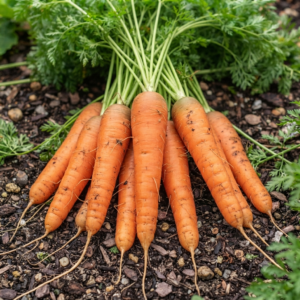
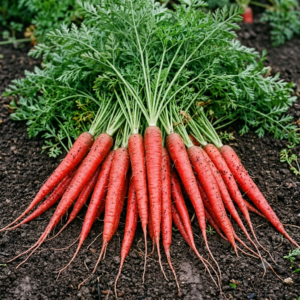
Nantes Carrots — Sweet, Nearly Coreless Roots
🌍 Where Nantes Carrots Grow Best
🇨🇦 Canada: Zones 3–9. Direct sow 2–4 weeks before last frost. In the Prairies and short-season gardens, the 65–70 day maturity makes Nantes one of the most reliable carrot types. Sow succession crops every 3 weeks through midsummer for a continuous harvest.
🇺🇸 US: Zones 3–10. Grows in all regions; ideal in the North and Pacific Northwest. In the South and Southwest, grow as a fall and winter crop — summer heat produces tough, bitter roots.
Best for: Fresh eating, snacking, juicing, freezing, farmers market growing, and children’s gardens.
Nantes is the carrot type that changed how gardeners think about growing their own. Developed in the Loire Valley of France in the 19th century and named for the coastal city of Nantes, this variety set the standard for what a garden carrot should be: cylindrical rather than tapered, blunt-tipped, almost coreless, and extraordinarily sweet. Where many varieties prioritize size or storage, Nantes prioritizes flavour — and on that metric it remains unsurpassed among commonly available types.
The Nantes type is also remarkably practical for home gardens. Its cylindrical shape performs well in a wider range of soil depths than tapered Danvers or long Imperator types — roots that hit a stone or compacted subsoil won’t fork and twist as dramatically. The crisp, fine-grained flesh holds its texture through both raw use and cooking, and the thin edible skin means no peeling is required for fresh eating.
How to Grow Nantes Carrot Seeds
Nantes carrot seeds are direct-sown only — they do not transplant. Sow directly into the garden 2–4 weeks before your last frost date into soil loosened to at least 25–30 cm (10–12 inches) deep and free of stones and large clumps. This soil preparation step is the most important factor in carrot growing: shallow, compacted, or rocky soil produces forked, stunted roots regardless of seed quality.
Carrot seed is small and slow to germinate — 10–21 days in cool soil. Sow thinly in rows or wide bands, barely covering seeds with fine soil or vermiculite (no more than 5 mm / ¼ inch deep). Keep the seedbed consistently moist through the full germination period — the single most common cause of carrot germination failure is the soil surface drying out before emergence. Laying a board or burlap over the seedbed and checking daily until emergence is an old reliable technique. Thin seedlings to 5–8 cm (2–3 inches) apart once they reach 5 cm tall — crowded carrots produce small, forked roots. Thinnings are edible baby carrots.
Sow succession plantings every 3 weeks from early spring through midsummer for a continuous harvest. A final succession sown in mid-to-late July can be left in the ground through fall — roots sweetened by cold soil after the first frost are among the best garden vegetables of the entire season. In the Pacific Northwest and mild coastal climates, roots left in the ground overwinter and can be harvested through winter.
🥕 Nantes vs. Other Carrot Types
Nantes
Cylindrical, blunt tip, nearly coreless. Best fresh flavour. 15–18 cm long. Tender skin. Home garden favourite.
Danvers
Broad-shouldered, tapered tip. Tolerates heavy clay soils better. Good storage root. Slightly less sweet.
Imperator
Long, thin, tapered. Commercial grocery standard. Needs deep, loose soil. Excellent storage.
Chantenay
Short, wide, tapered. Best for clay and shallow soils. Dense, good for cooking and canning.
Harvesting & Storing Nantes Carrots
Nantes carrots are ready to harvest at 65–70 days. Check by gently pulling one test root — a mature Nantes should be 15–18 cm (6–7 inches) long and cylindrical with a blunt tip. Roots left in the ground past maturity become woody and lose sweetness; harvest when they’re at peak size rather than waiting. Loosen roots with a garden fork before pulling to avoid breaking tops in heavy soil. For the sweetest flavour, harvest in the cool of morning.
Carrots stored with tops removed in perforated bags in the refrigerator keep 3–4 weeks. For root cellar storage, layer in barely damp sand or sawdust — roots keep 4–6 months at 0–2°C (32–36°F) with high humidity. Alternatively, leave carrots in the ground until needed in fall and early winter — mulch with 15–20 cm (6–8 inches) of straw after the first frost to insulate the soil and extend in-ground storage.
Saving Nantes Carrot Seeds
Nantes carrot seeds are worth saving because the variety is open-pollinated, but carrots are biennials — seed saving is a two-year project. Plants build an edible root the first season and only bolt, flower, and set seed in their second summer after a cold winter (vernalization). In Zones 6 and warmer, leave a few of the best-shaped roots in the ground under heavy mulch; in colder zones, lift them, store in damp sand near 0–2°C (32–36°F), and replant in spring. Once the second-year flower umbels dry and turn brown, rub the seed free and winnow away the chaff.
Because Nantes is open-pollinated rather than a hybrid, saved seed grows true to type — but carrots cross readily with every other carrot variety flowering nearby and with wild Queen Anne’s Lace, so isolate a seed crop by roughly 800 m (½ mile) for pure Nantes seed. Cross-pollination affects only the seed you save, never the roots you harvest this year. Test stored seed each season with a damp paper-towel germination check; carrot seed stays viable about 3 years, with germination dropping noticeably after that.
Compare more carrot varieties
Why won’t my Nantes carrot seeds germinate?
The most common reason is the soil surface drying out before emergence — carrot seeds are tiny and the seedlings are fragile, so they need consistently moist conditions for the full 10–21 day germination period. Water gently twice daily in dry weather, or cover the seedbed with burlap or a board and check daily. Also check for seed buried too deep (more than 5 mm stops light-sensitive germination), soil below 7°C (45°F), or old seed with poor viability.
Why are my Nantes carrots forked or misshapen?
Forking and twisting is almost always caused by soil obstacles — stones, clods, or compacted subsoil deflect the growing root tip. The fix is soil preparation: loosen soil to 30 cm (12 inches) deep, remove all stones and break up clods, and work in compost to improve structure. Fresh manure added just before sowing also causes forking — always use well-composted organic matter. In heavy clay, the shorter cylindrical Nantes root performs better than a long Imperator but worse than a stubby Chantenay.
When should I plant Nantes carrots?
Direct sow 2–4 weeks before your last spring frost — Nantes seed tolerates light frost and germinates in cool soil. In the northern US and Canada that’s roughly late March to early May depending on zone; the BC and Pacific Northwest coast can start February to March; the US South and Southwest grow Nantes as a fall-through-winter crop sown September to November. Sow every 3 weeks through midsummer for succession harvests, with a final July sowing for a fall crop that sweetens in cold soil.
Why do Nantes carrots taste sweeter after frost?
Cold soil below about 10°C (50°F) triggers carrots to convert stored starches into sugars — a cold-stress response that lowers the freezing point of the root’s cells. Fall-harvested Nantes that have felt cool nights measure noticeably higher in sugar than summer-pulled roots. This is the strongest argument for sowing a fall crop: the eating quality is simply better.
Can I grow Nantes carrots in containers?
Yes — Nantes is one of the best carrot types for containers because its cylindrical roots don’t need extreme depth. Use a container at least 30 cm (12 inches) deep with a light, loose potting mix and good drainage. Avoid heavy garden soil in pots — it compacts and restricts root development. Water consistently: containers dry out faster than beds, and uneven moisture causes cracking and split roots.
How far apart should I thin Nantes carrots?
Thin Nantes seedlings to 5–8 cm (2–3 inches) apart once they reach about 5 cm tall. Crowded roots compete and stay small, twisted, or forked, so thinning is not optional for full-size carrots. Thin in two passes — an early pass to 2–3 cm, then a second once you can eat the thinnings as baby carrots. Snip crowded seedlings at the soil line rather than pulling, to avoid disturbing the roots you’re keeping.
Are carrot tops edible?
Yes — Nantes tops are edible, though slightly bitter and best used in small quantities. Use young, tender tops in salads, chimichurri-style sauces, or pestos where their mild bitterness adds complexity, or in soups and stocks in place of parsley. Use large amounts cooked rather than raw, and compost any yellowing or tough tops.
How long do harvested Nantes carrots store?
Freshly harvested Nantes with tops removed store 3–4 weeks in the refrigerator in perforated bags. For longer storage, pack them in barely damp sand or sawdust in a cool cellar at 0–2°C (32–36°F) with high humidity — they keep 4–6 months. Alternatively, leave roots in the ground through fall and early winter under straw mulch and harvest as needed. Nantes can also be blanched and frozen for up to 12 months.
How long do Nantes carrot seeds stay viable?
Nantes carrot seeds stay viable about 3 years when kept cool, dark, and dry, with germination dropping noticeably after that. Store packets in an airtight jar with a desiccant in the fridge to extend life. Before sowing older seed, run a damp paper-towel test: fold 10 seeds into a moist towel, keep it warm, and count sprouts after 14 days — 7 or more means the seed is still worth sowing at normal density.
Nantes vs Chantenay — which should I grow?
Grow Nantes for the best fresh-eating flavour in loose, well-worked soil — it’s sweeter and more tender than most types. Choose
Royal Chantenay carrot seeds instead when your soil is heavy clay or shallow, or when you want a dense root for juicing, canning, and long storage. Many gardeners grow both: Nantes for the table and Chantenay for the root cellar.
The Sweetest Carrot You Can Grow from Seed
Heirloom Nantes carrot seeds — non-GMO and open-pollinated, for the tender, nearly coreless roots that set the garden standard.
As an Amazon Associate, I earn from qualifying purchases — at no extra cost to you.
Buy Nantes Carrot Seeds on Amazon →