🌾 Kamut Khorasan Wheatgrass Seeds
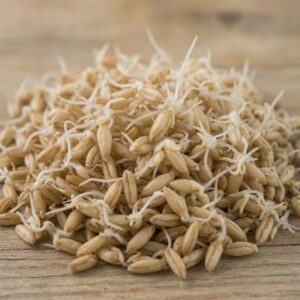
Khorasan wheat is the ancient grain most people search for by its trademark, Kamut®. Triticum turgidum ssp. turanicum is a tetraploid wheat carried out of the Fertile Crescent, and the berry is unmistakable in the hand — the Saskatchewan Ministry of Agriculture describes the kernels as roughly twice the size of spring wheat, with a distinctive hump along the back. That size is not a curiosity. It changes how the seed behaves in a jar and in a tray, and it is why this grain wants the long end of the soaking window rather than the short one.
The grass it produces is the reason most growers switch. Where hard red spring wheat juices sharp and aggressively green, this one comes up sweet, buttery and notably mild — the easiest of the tray grains to drink without a chaser. The trademark is worth understanding too: Kamut® may only be marketed under that name when the crop is grown on certified organic farms under production contract, and the brand guarantees the wheat is never modified or hybridised. Kamut and khorasan are the same wheat. One name is the brand, the other is the botanical variety, and Mumm’s sells this seed under the branded name.
🇺🇸 US: Same indoor tray crop in every state, every season, no garden needed. Field production is centred on Montana and the northern Great Plains, which is where the branded grain originates.
Best for: A milder daily juice shot, sprouted wheat berries, and anyone who has tried standard wheatgrass and found it too harsh to keep up.
🌱 How to Grow Khorasan Wheatgrass Seeds
Khorasan wheatgrass seeds go from dry berry to cut grass in about two weeks: roughly a day and a half in the jar, then 8–12 days in the tray. The one adjustment this grain asks for over standard wheat is time in water — a kernel twice the size takes longer to imbibe fully, and a short soak is the most common reason a Kamut tray comes up patchy.
- Treat the seeds before soaking with 3% hydrogen peroxide at 60°C (140°F), held for five minutes and swirled once a minute, then rinsed thoroughly under cool running water.
- Soak the seeds in about four times their volume of cool water for 12–24 hours. Take the long end of that window on this grain — the large kernel is slower to hydrate than common wheat.
- Drain the soak water off completely, then rinse and drain in the jar 2–3 times a day, keeping it propped mouth-down at an angle so nothing pools at the bottom.
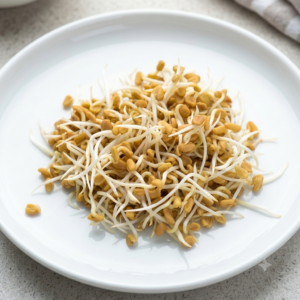
- Plant at first tails, roughly 24 hours after the soak, when most berries show a white tail 2–3 mm long. Longer tails tangle and tear as you spread them.
- Spread the sprouted berries in a dense single layer over 2–3 cm (1 in) of moist potting mix or coco coir, seeds touching but never stacked, and press gently into the surface.
- Cover completely to block all light for the blackout phase, 3–4 days, misting morning and evening. Resist peeking — a tray that dries out mid-blackout comes up uneven.
- Uncover around day 5 and give it bright indirect light, or an LED bar 10–15 cm (4–6 in) above the canopy for 16–18 hours a day. Switch to bottom-watering from this point.
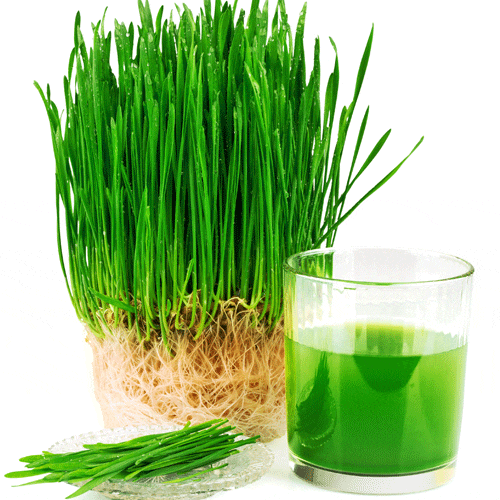
- Cut at 18–25 cm (7–10 in), taking the blades 2–3 cm (1 in) above the seed layer rather than down at the mat, so no ungerminated seed reaches the juicer.
Expect this grain to sit at the slower end of that 8–12 day window and to give a slightly thinner stand than hard red spring wheat — the same weight of seed spreads across fewer, bigger kernels, so a tray simply holds less of them. That is bench observation rather than a published figure: no university or agency publishes a per-grain tray timing for any wheatgrass, and the only vendor number for this seed is Mumm’s own, which gives 10–12 days. A second cut usually follows 5–7 days after the first, visibly thinner and milder, because the seed’s stored reserves are largely spent by then.
🧃 Juicing Kamut Khorasan Wheatgrass
Kamut khorasan wheatgrass juice is taken as a concentrated shot, 30–60 ml (1–2 oz) pressed fresh and drunk the same day. A masticating or manual wheatgrass juicer crushes the fibre and extracts properly; a centrifugal machine spins past the blades and returns almost nothing. The flavour is the whole point of choosing this grain — sweet and buttery where the standard tray grasses run sharp and bitter, mild enough that most people take it neat rather than burying it in apple and lemon.
One claim about this grain is worth stating carefully, because seed catalogues get it backwards. USDA composition data for khorasan puts the dry grain at 81 µg of selenium and 3.7 mg of zinc per 100 g, against 71 µg and 2.8 mg for hard red spring wheat — a genuine mineral advantage. Protein runs the other way: 14.5 g against 15.4 g, so the Prairie bread wheat wins that one outright. And all of those figures describe the berry, not the ten-day grass, which is a different tissue at a different stage with a composition nobody has measured side by side. Grow this variety for the taste, which is real and immediate, rather than for a nutrition claim borrowed from the grain.
🌿 Sprouting Kamut Wheat Berries
Khorasan wheatgrass seeds are just as good stopped early and eaten whole, and sprouted Kamut berries are ready in 2–3 days with no tray, soil or light involved. Treat and soak exactly as above, then rinse and drain 2–3 times a day — every six hours if you plan to eat them raw. Stop when the white tail is about the length of the berry itself, before any true leaf appears.
Sprouted Kamut is the sweetest and chewiest of the sprouted grains, with a nutty finish the mature berry never shows. The sweetness is the germinating seed mobilising its starch reserves, which is also why the window closes: leave the jar two days too long and the texture turns gluey. Fold the berries into salads and grain bowls, stir them through bread dough, or scatter them over yogurt. Being a true wheat, the berries contain gluten and are not suitable for anyone with coeliac disease.
🌾 Saving Khorasan Wheatgrass Seeds
Saving Khorasan wheatgrass seeds means growing the plant out as a field crop, because a tray of grass is cut long before it ever flowers. Sown outdoors, the crop needs about 100 days to mature — roughly a week longer than spring wheat — and each head carries 25 to 35 kernels. Let the heads dry down on the plant until the kernels are hard, thresh by rubbing the heads between your palms over a bowl, winnow the chaff off in a light breeze, then dry the grain further indoors before it goes into storage in a cool, dark, airtight container.
Khorasan is an open-pollinated wheat and self-pollinates, so seed saved from a clean stand comes true to type without isolation cages or hand work. The one neighbour worth keeping distance from is durum, which shares this wheat’s tetraploid ploidy level and is the realistic crossing risk — common bread wheat, being hexaploid, is not. Test viability before committing a full tray to an old batch: soak 100 seeds overnight, keep them damp, and count tails at 48 hours, where anything over 90% is excellent and anything under 80% is worth replacing rather than fighting. Note that saved seed cannot legally be sold as Kamut® — the trademark applies only to grain grown under contract with the brand holder.
How to grow wheatgrass at home →