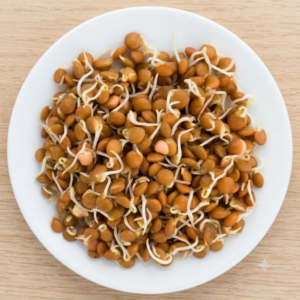
Hulless barley (Hordeum vulgare var. nudum) is one of the oldest cultivated grains on earth, and this organic seed is grown for one job above all: fast, clean sprouting. The “hulless” trait is what makes it work — where standard barley clings to a tough hull that has to be milled off and won’t germinate reliably, hulless barley sheds its hull at threshing, leaving the living bran and germ intact. Drop it in a jar and it wakes up quickly, ready to eat as a sweet, chewy short sprout in just a couple of days.
That same intact germ makes this a genuine multi-use grain. Beyond the sprouting jar it grows into livestock fodder in under a week, into a mild barley grass for juicing, and into a fast cool-season cover crop out in the garden. One bag on the shelf covers the kitchen counter and the soil alike, and stores for a year or more if kept cool and dry.
🌍 Where Organic Hulless Barley Grows Best
🇨🇦 Canada: As a sprout, fodder, or grass, hulless barley grows indoors year-round in jars and trays — zone and season are irrelevant, and room temperature (18–22°C / 65–72°F) is all it needs. As an outdoor cover crop it suits cool Canadian springs and short-season Prairie regions, sown in early spring or late summer. 🇺🇸 US: The same indoor crop works in any state, any season, on a countertop. Outdoors it grows as a fast cool-season cover across the northern and transitional US, sown in spring or fall and turned under before it sets seed. Best for: quick sprouts, winter livestock fodder, mild barley grass, and fast soil-building cover.
Soak Seeds
6–12 hours
Sprout Ready
2–3 days
Fodder Mat
6–8 days
Grass Harvest
9–12 days
🌿 Sprouting Hulless Barley Seeds
Hulless barley seeds are best as a quick short sprout, sweet and chewy and ready to eat in just 2–3 days. Only hulless barley sprouts reliably — pearl barley has been polished to remove the germ and will never grow. Sprouted barley adds a mild, nutty bite to breads, salads, and grain bowls, and sprouting makes the grain easier to digest.
Rinse 1/4 cup of hulless barley seeds, pick out any debris, and place them in a wide-mouth quart jar with a sprouting lid.
Cover with cool water and soak 6–12 hours, then drain well through the lid.
Invert the jar at an angle on a rack or in a bowl so it drains fully and air can circulate.
Rinse and drain with cool water twice a day, keeping the seeds moist but never sitting in water.
Harvest once short tails appear, usually in 2–3 days; give a final rinse and refrigerate to store.
🐄 Growing Hulless Barley Seeds for Fodder
Hulless barley seeds sprout into fresh livestock fodder in under a week, turning about 1 lb of dry seed into roughly 7 lb of green feed in 6–8 days. Barley is the preferred fodder grain because it sprouts fast and cleanly where oats tend to mold. Soak the seed 8–12 hours, spread it about 1–1.5 cm deep in a shallow tray with drainage, and rinse two to three times a day until roots knit into a mat and green blades reach 10–15 cm (4–6 in). Feed the whole mat — roots, seed, and greens — to chickens, goats, and rabbits as a fresh supplement alongside their usual hay and minerals. Sprouting also lifts the grain’s protein and digestibility, so animals get more nutrition from less feed, which is what makes a rolling tray system pay for its seed through the winter.
🌱 Growing Barley Grass from Hulless Barley Seeds
Hulless barley seeds also grow into barley grass — the young grass juiced for its mild, sweet, chlorophyll-rich flavour, harvested at 12–15 cm (5–6 in) in about 9–12 days. Soak the seed 8–10 hours, spread it over 2–3 cm of potting mix in a shallow tray, and rinse lightly twice a day at room temperature, keeping trays out of direct sun until the grass greens up. Cut with scissors just above the soil before a second blade forms, at peak nutrition.
🌱 Barley Grass
Milder and slightly sweeter, easier to drink straight, harvest 9–12 days. The gentler choice for anyone new to green juicing.
🌾 Wheatgrass
Stronger, earthier, and more intense, with slightly higher juice yield, harvest 7–10 days. Favoured by experienced juicers taking shots.
Mumm’s grows this hulless variety mainly as a short sprouting seed rather than a dedicated grass seed, so expect good but not maximum grass yield — for heavy daily juicing, a grass-specific cereal performs a little better. As a mild everyday green, though, home-grown barley grass is hard to beat.
🌾 Growing Hulless Barley Seeds as a Cover Crop
Hulless barley seeds double as one of the fastest cover crops a grower can sow, germinating quickly to shield bare soil, smother weeds, and scavenge leftover nitrogen before it leaches away. Broadcast it over a worked bed in early spring for a fast green cover to turn under before planting, or in late summer for a winter cover in milder zones, then cut or dig it in at flowering — before it sets seed — to leave behind loose, weed-free, enriched soil. Because barley is a grass and fixes no nitrogen, many growers pair it with a legume for the best of both.
Is hulless barley better for sprouts or for barley grass?
Hulless barley is grown mainly as a short sprouting seed — Mumm’s sells it as a quick sprout ready in 2–3 days, not as a dedicated grass seed. It still grows perfectly good barley grass if you want to juice it, but for heavy daily grass juicing a grass-specific cereal yields a bit more. For sprouts, fodder, and mild everyday grass, this seed does all three well.
What is the difference between hulless and regular barley?
Regular (hulled or covered) barley has a tough hull that clings to the grain and needs mechanical dehulling — and it won’t germinate reliably because the hull is damaged during processing. Hulless barley has a loose hull that separates cleanly at harvest, leaving the bran and germ intact, so it sprouts evenly and grows dependably. That’s why hulless is the right choice for sprouting, fodder, and grass.
Can I sprout pearl barley?
No — pearl barley has been polished to remove the hull, bran, and germ, so the living embryo is gone and it cannot sprout. Only whole hulless barley with an intact germ will grow in a jar or tray.
How long does hulless barley take to sprout?
Soak the seed 6–12 hours, then rinse twice a day and it’s ready to eat as a short sprout in 2–3 days. Keep the seeds moist but well-drained — standing water is what causes the sour smell and mold that spoil a batch.
How much fodder does hulless barley produce?
About 1 lb of dry barley seed yields roughly 7 lb of fresh fodder in 6–8 days. Sprouting also raises the grain’s protein and digestibility, so chickens, goats, and rabbits get more nutrition from less feed — the reason a rolling tray system cuts winter feed costs.
How do I grow barley grass from these seeds?
Soak the seed 8–10 hours, spread it over 2–3 cm of potting mix in a shallow tray, and rinse lightly twice a day at room temperature. Cut the grass at 12–15 cm (5–6 in), around 9–12 days, before a second blade forms. The method is identical to wheatgrass — the wheatgrass growing guide covers trays, lights, and juicers in full.
Is barley grass gluten-free?
The young grass, harvested before the grain forms, contains no gluten proteins — gluten only develops in the mature seed. Certified barley grass juice powder tests gluten-free. People with celiac disease should still be cautious about cross-contamination during growing and harvesting, and consult their healthcare provider first.
Can I use hulless barley as a cover crop?
Yes — barley is among the fastest cover crops available, controlling erosion, smothering weeds, and scavenging nitrogen. Broadcast it in early spring or late summer and terminate it at flowering, before it sets seed. The full field method is in the how to grow barley guide.
What can I make with sprouted barley?
Sprouted hulless barley is sweet and chewy — good stirred into breads, salads, and grain bowls, or blended into smoothies. Many people also simmer the whole grain for barley water, then blend the softened barley into breads. Sprouting makes the grain more digestible and boosts its available nutrients.
How do I store hulless barley seed?
Stored cool and dry, hulless barley seed sprouts well for about a year. Keep it in an airtight container away from light and pests; refrigerating extends its germination life, and freezing keeps it viable longer still. Well-dried barley seed can stay good for several years.
🌾 One Organic Seed — Sprouts, Fodder, Grass & Cover
Certified organic hulless barley from Mumm’s, family-grown on the Canadian prairies. Sprouts in 2–3 days and stores for a year on the shelf.
💸 Code: SEEDBANK — 10% off at Mumm’s
As a Mumm’s Sprouting Seeds affiliate, I earn a commission — at no extra cost to you.