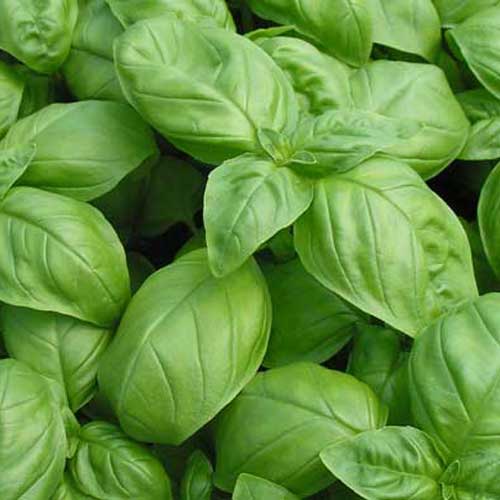
Genovese Basil — The Large-Leaf Italian Pesto Basil
Genovese basil is the cultivar traditional Pesto alla Genovese is named for — a large-leaf Ocimum basilicum selected in the Liguria region of Italy for its deep, sweet-spicy aroma and heavy leaf production. The rounded, cupped leaves reach up to 2 in (5 cm) across and carry a richer, more perfumed flavour than plain sweet basil, with clove and anise notes that hold up in cooked sauces where lighter basils fade.
What sets this variety apart in the garden is its bolt resistance. Genovese holds in leaf for weeks longer than sweet basil before flowering, so a single spring sowing keeps producing kitchen-ready leaves deep into summer — the trait that makes it the standard choice for growers who cook with basil in volume.
🇺🇸 United States: Thrives everywhere from the Gulf Coast and Southwest, where it produces from late spring through fall, to the Upper Midwest and New England, where it’s transplanted after the last frost for a July–September harvest. In the low desert (AZ, NV), it performs best in spring and fall, easing off in peak summer heat.
🇨🇦 Canada: Grown coast to coast as a summer annual. In Zones 2–5 (Prairies, Northern Ontario, Quebec, Atlantic Canada) start indoors 6–8 weeks early and transplant once nights stay above 10°C (50°F); in the milder BC coast and Southern Ontario it produces reliably from June through first frost.
🌍 Direct sow seeds: After frost, soil 18°C+ (65°F+)
📏 Sow depth: 6 mm (¼ in) · Spacing: 25–30 cm (10–12 in)
🌡️ Germination: 5–10 days at 21–27°C (70–80°F)
☀️ Light: Full sun, 6–8 hours minimum
✂️ Pinch at: 4–6 leaf sets to force bushy growth
How to Grow Genovese Basil Seeds
Genovese basil seeds germinate in 5–10 days when soil is held at 21–27°C (70–80°F). Sow 6 mm (¼ in) deep and keep the surface consistently moist — cool, wet soil below 18°C (65°F) causes the seed to rot rather than sprout, which is the single most common reason indoor sowings fail.
Start indoors 6–8 weeks before your last frost, or direct sow once soil has warmed and nights hold above 10°C (50°F). Space plants 25–30 cm (10–12 in) apart in full sun. The key to a heavy harvest is pinching: once a plant has 4–6 sets of true leaves, pinch out the growing tip, and keep pinching any flower buds the moment they appear. Flowering turns leaves bitter and signals the plant to stop producing, so removing buds early keeps it in leaf for months. Water deeply at the base — never overhead — because Genovese’s large leaf surface is prone to downy mildew when kept wet.
Harvesting & Storing Genovese Basil
Harvest Genovese basil by cutting whole stems just above a leaf node rather than stripping individual leaves — the plant branches from the cut and regrows faster, giving far more volume over the season. Begin once plants reach 15–20 cm (6–8 in) tall and never take more than a third at once. Morning cutting, before the day’s heat drives off the aromatic oils, gives the most fragrant leaves.
Fresh basil bruises and blackens in the fridge, so store cut stems like flowers — in a glass of water on the counter, loosely covered, where they hold for several days. For longer storage, blanch leaves 2 seconds, blend with olive oil, and freeze in cubes; the oil locks in colour and flavour far better than drying, which strips most of basil’s volatile aroma.
Cooking with Genovese Basil
Genovese basil is the only basil a traditional Ligurian pesto calls for, and its high oil content and bold flavour are why. Beyond pesto, the large leaves make it the workhorse of Italian cooking — torn over a Caprese of buffalo mozzarella and ripe tomato, stirred into pasta al pomodoro off the heat, layered on pizza in the last minutes of baking, or blended into a brilliant-green finishing oil.
Add Genovese basil at the very end of cooking. Its aroma comes from heat-volatile compounds that dissipate within minutes of hitting a hot pan, so leaves torn in off the heat keep the fragrance that leaves added early lose entirely. To make basil oil, blanch a handful of leaves 10 seconds, shock in ice water, then blend with good olive oil and strain — the blanching deactivates the enzymes that otherwise turn raw basil oil black within hours.
Saving Genovese Basil Seeds
Let a few flower stems fully develop and dry on the plant at the end of the season. Once the calyxes turn brown and brittle, cut the stems and rub them over a fine sieve to release the small black seeds, then winnow off the chaff. Stored in a paper envelope somewhere cool and dry, Genovese basil seeds stay viable for 4–5 years.
Genovese is open-pollinated, so seeds saved from an isolated plant grow true to type. Basil readily cross-pollinates between cultivars, though — plant Genovese near Thai, cinnamon, or purple basil and the saved seed may produce variable offspring. Keep varieties 45 m (150 ft) apart, or save from only one cultivar per season, to keep the strain pure. To test old seed, roll ten seeds in a damp paper towel for a week; if six or more sprout, the batch is still worth sowing.