Principe Borghese Tomato — Italy’s Classic Sun-Drying Tomato
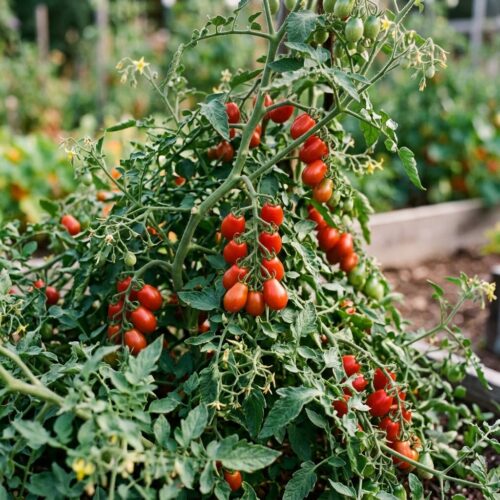
Principe Borghese (Solanum lycopersicum ‘Principe Borghese’) is the tomato Italian cooks have hung on the fence to dry for over a century. Small, red, and plum-shaped at 30–60 g (1–2 oz), it grows in heavy grape-like clusters of a dozen or more and is prized for one thing above all: dense, low-juice flesh with few seeds that dries fast and keeps its rich, concentrated flavour. It is the traditional variety behind homemade sun-dried tomatoes, and the same firm fruit makes an intense winter sauce once rehydrated.
This is a compact, semi-determinate heirloom — smaller and bushier than a sprawling beefsteak — that sets its enormous crop over a relatively short window at roughly 75 days from transplant. That early, concentrated harvest makes it a strong choice for cooler and shorter-season gardens as well as hot ones. One useful quirk: the ripe fruit does not drop readily from the stem, so whole branches or even whole plants can be pulled and hung to dry indoors. Give it full sun, steady moisture until fruit set, and a cage for the fruit-laden clusters, and a couple of plants will fill a dehydrator.
🇺🇸 US: Annual in all zones. The dry heat of the Southwest and California is ideal for true sun-drying; in the humid Southeast and Midwest, a dehydrator or low oven does the same job when open-air drying is unreliable.
Best for: sun-drying, dehydrating, concentrated sauce, and winter pantry storage.
🌱 How to Grow Principe Borghese Tomato Seeds
Start Principe Borghese tomato seeds indoors 6–8 weeks before your last frost date, sown 6 mm (¼ in) deep and held at 21–27°C (70–80°F), where they germinate in 5–10 days. Give the seedlings strong light straight away so they stay stocky, pot up at the first true leaves, harden off over 7–10 days, and transplant after the last frost with nights above 10°C (50°F). Set them deep, up to the top leaves, to build the root mass a heavy-clustering plant needs.
Space plants 45–60 cm (18–24 in) apart in full sun. Though semi-determinate and compact, the branches carry so many fruit that a cage or short stake keeps clusters off the ground and the fruit clean. Ease back on watering slightly once fruit begins ripening — the drier you keep the plant, the less juice in the fruit and the better it dries. That said, keep moisture steady enough through fruit set to avoid blossom end rot; work a calcium source such as bone meal or crushed eggshells into the hole, and go easy on high-nitrogen feed. Because the crop ripens in a concentrated window, expect to harvest whole clusters at once at peak season.
☀️ Sun-Drying & Preserving Principe Borghese Tomatoes
Drying is what this tomato was bred for, and the method is simple. Halve the small fruit lengthwise, lay the halves cut-side up on racks, and dry until leathery: in a dehydrator at 57–63°C (135–145°F) for 6–12 hours, in a low oven at 90–95°C (200°F) for a few hours, or in the open sun over several dry days in a hot, low-humidity climate. Because the flesh is dense and low in juice, Principe Borghese dries far faster and more evenly than a watery slicer and rarely spoils partway through.
A traditional shortcut plays to the variety’s habit of holding fruit on the stem: pull whole ripe-laden branches, or the entire plant at season’s end, and hang them upside down in a warm, airy indoor spot to dry over one to two weeks. Once fully dry, store the tomatoes in airtight jars, or pack them in olive oil with herbs for the fridge. Beyond drying, the concentrated flesh also freezes and makes an intense, low-water sauce, so a glut never goes to waste.
🍝 Cooking with Principe Borghese Tomatoes
Principe Borghese cooks best in concentrated form. Rehydrated dried halves bring an intense, sweet-savoury depth to pasta, risotto, focaccia, and winter braises that fresh tomatoes can’t match, and the fresh fruit itself cooks down into a rich, low-water sauce with almost no reduction. Roast the halves with olive oil and garlic for a deep, jammy base you can freeze in batches.
Fresh, the small fruit is firm and pleasantly tangy rather than lush — better tossed whole into a roasting pan or a chunky salad than sliced for a sandwich. Many gardeners simply snack on the clusters straight off the vine. Its real strength, though, is the pantry: a handful of dried Principe Borghese revives a mid-winter meal in minutes.
🫙 Saving Principe Borghese Tomato Seeds
Principe Borghese tomato seeds are easy to save because the variety is open-pollinated and grows true to type, and each heavy cluster supplies plenty of fruit for seed. Use the fermentation method: scoop the seeds and gel into a jar, add a splash of water, and leave at room temperature for 2–3 days until a film forms on top. That fermentation dissolves the germination-inhibiting gel coat and cuts seed-borne disease. Pour off the floaters and pulp, rinse the heavy seeds that sank, and dry them on a plate or screen for 1–2 weeks until they snap rather than bend. Stored cool and dark, they stay viable for 4–5 years.
Keep the strain pure with two habits. Save only from open-pollinated Principe Borghese, never a hybrid, so the next generation reproduces the same small drying fruit. And while tomatoes cross only rarely, space different varieties 3–4.5 m (10–15 ft) apart or bag a few flower trusses with fine cloth when purity matters. Before storing a batch, sprout ten seeds on a damp paper towel — if seven or more germinate, the lot is good to keep.