
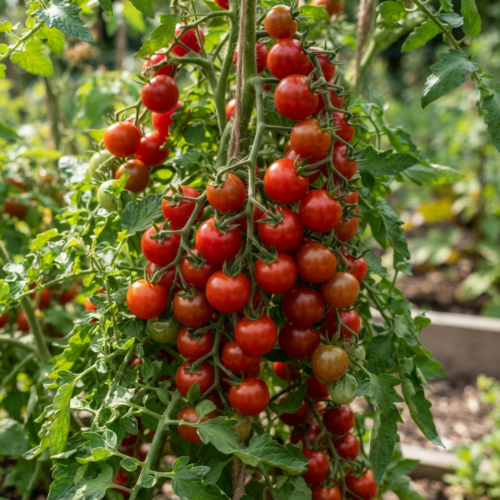
Gardener’s Delight Tomato — The Sugar Lump Cherry That Started It All
Gardener’s Delight (Solanum lycopersicum ‘Gardener’s Delight’) is the bright-red German heirloom that taught a generation of gardeners what a cherry tomato should taste like. Bred by Paul Tellhelm and introduced by the German firm Benary in 1950, it earned the nickname “Sugar Lump” for its sugary sweetness — but under that sweetness is the real, rounded flavour of a full-size heirloom, which is why it holds the UK Royal Horticultural Society’s Award of Garden Merit. The two-bite fruit runs a little larger than a standard cherry at ¾–1½ in, and hangs in long trusses of six to twelve.
This is a vigorous, reliable indeterminate that fruits on a tall vine until frost, and its standout trait is speed: at about 65 days from transplant it is one of the earliest tomatoes to ripen, often the first fruit off the plant while big slicers are still green. That earliness, paired with heavy yields and crack-resistant fruit, makes it a favourite for beginners and for short-season gardens alike. Give it full sun, steady moisture, and a sturdy support, and it produces sweet red clusters from early summer straight through to the first frost.
🇺🇸 US: Annual in all zones. Dependable and productive from the Upper Midwest and Northeast to the South; short-season northern gardeners value it for ripening early, and it keeps setting sweet trusses right through a long warm summer.
Best for: fresh snacking, salads, roasting, and early-season, high-yield harvests.
🌱 How to Grow Gardener’s Delight Tomato Seeds
Start Gardener’s Delight tomato seeds indoors 6–8 weeks before your last frost date, sown 6 mm (¼ in) deep and held at 21–27°C (70–80°F), where they germinate in 5–10 days. Give seedlings bright light straight away so they stay stocky, pot up at the first true leaves, harden off over 7–10 days, and transplant only after the last frost with nights above 10°C (50°F). Its early maturity means even a slightly late start still ripens fruit in good time.
Plant deep, up to the top leaves, so the buried stem roots out and feeds the long trusses. Space plants 45–60 cm (18–24 in) apart in full sun and cage or stake at planting time — this tall, vigorous indeterminate reaches 1.2–1.8 m (4–6 ft) and will sprawl without support. Water deeply and evenly and mulch to hold moisture; steady watering keeps the heavy trusses from splitting and heads off blossom end rot. Go easy on high-nitrogen fertilizer, which drives leaf over fruit, pinch the side shoots to one or two main stems for airflow and cleaner trusses, and top the growing tips about four weeks before your first frost so the vine finishes what it has set.
🍅 Harvesting & Storing Gardener’s Delight Tomatoes
Pick Gardener’s Delight when the fruit has coloured to a full bright red and gives slightly to gentle pressure — that is when the sugars peak. Because it ripens early and heavily, harvest every 2–3 days at the height of the season to keep the trusses coming and to catch fruit at its sweetest. The crack-resistant skin holds up well, but in a wet spell pick promptly so ripe fruit doesn’t sit through rain. Never refrigerate a ripe tomato — cold below 12°C (55°F) turns the flesh mealy and dulls the sweetness that makes this variety worth growing.
Gardener’s Delight is a snacking tomato first and keeps a few days at room temperature stem-side down, out of direct sun. For a glut, these sweet cherries roast and dry well: halved and slow-roasted at 120°C (250°F) they concentrate into intense, jammy bites worth freezing, and they dehydrate into sweet dried tomatoes. Whole fruit freezes fine on a tray for later cooking and sauces.
🍽️ Cooking with Gardener’s Delight Tomatoes
Gardener’s Delight is at its best raw, where the sugary-sweet flavour and firm, juicy bite carry a salad, a lunchbox, or a snacking bowl on their own. Whole or halved they brighten a green salad, a grain bowl, or a cheese board, and their reliable sweetness makes them the cherry most likely to convert a tomato skeptic straight off the vine.
In the kitchen the sweetness concentrates beautifully with heat. Roast whole with olive oil and garlic until they burst for a quick pasta sauce or bruschetta, blister them in a hot skillet to fold through pasta and grains, or halve them onto pizza and flatbreads. Because the flavour is sweet rather than acidic, a little Gardener’s Delight also balances a sharp dressing or a savoury skillet dish.
🫙 Saving Gardener’s Delight Tomato Seeds
Gardener’s Delight tomato seeds are rewarding to save because the variety is open-pollinated and grows largely true to type, and its heavy trusses give plenty of seed. Use the fermentation method: squeeze the seeds and gel into a jar, add a splash of water, and leave at room temperature for 2–3 days until a film forms on top. That fermentation dissolves the germination-inhibiting gel coat and cuts seed-borne disease. Pour off the floaters and pulp, rinse the heavy seeds that sank, and dry them on a plate or screen for 1–2 weeks until they snap rather than bend. Stored cool and dark, they stay viable for 4–5 years.
Two habits keep the line true. Save only from open-pollinated Gardener’s Delight, never a hybrid, so the sweet red fruit reproduces. And because tomatoes occasionally cross when varieties flower side by side, space different types 3–4.5 m (10–15 ft) apart or bag a few flower trusses with fine cloth if purity matters. Before storing a batch, sprout ten seeds on a damp paper towel — if seven or more germinate, the lot is good to keep.


