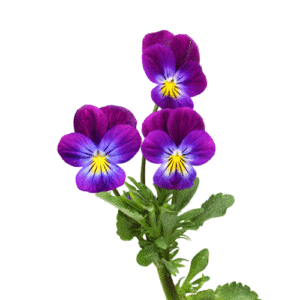
Type: Perennial Flower Botanical Name:Platycodon grandiflorus Plant Type: Perennial — Open-Pollinated Hardiness: Zones 3–9; extremely cold-hardy Height: 45–90cm (18–36 inches) Colours: Blue-violet (classic), white, pink Bloom Time: Midsummer to early fall Sow: Surface sow indoors 8–10 weeks before last frost; or direct sow in fall Light: Full Sun to Partial Shade Uses: Perennial borders, cut flowers, children’s gardens, medicinal, edible roots
As an Amazon Associate, I earn from qualifying purchases. I may earn a commission at no extra cost to you.
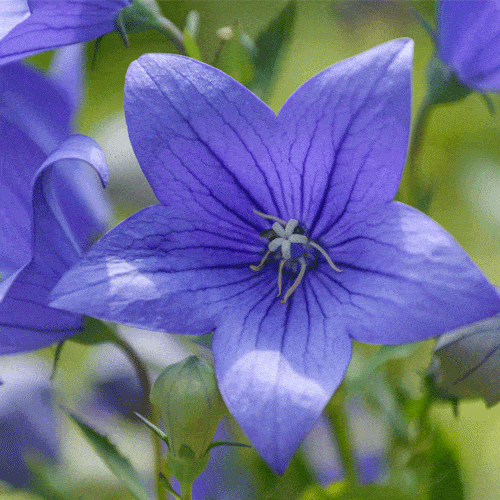
Balloon Flower (Platycodon grandiflorus) takes its name from one of the most charming features in the summer garden: the buds inflate into round, air-filled balloons before splitting open into beautiful star-shaped blue-violet (or white, or pink) flowers 5–8cm (2–3 inches) across. Children find this irresistible, and even experienced gardeners find themselves checking daily to catch the moment the “balloon” pops open. Native to East Asia — China, Japan, and Korea — where it’s been cultivated in medicine and cooking for centuries, Balloon Flower is a slow-starting but extraordinarily long-lived perennial that forms an increasingly robust clump over many years.
The patience required is upfront: Balloon Flower is slow to emerge in spring (one of the last perennials to show above ground — as late as May or June in Canadian gardens) and takes 2–3 years to reach its full flowering potential. But once established, a Balloon Flower clump is a fixture for decades. The plants live remarkably long for a garden perennial, with established specimens often remaining productive for 20+ years without division. In traditional East Asian medicine, the root is used as an expectorant and anti-inflammatory — it’s known as jie geng in Chinese medicine and doraji in Korean cuisine, where the roots are pickled and eaten as a vegetable. The roots and leaves are also edible in small quantities in Western culinary contexts.
🌍 Growing Zones & Climate Performance
🇨🇦 Canada: Perennial in Zones 3–9 — one of the hardiest ornamental perennials available. Extremely cold-tolerant and reliable across all provinces with adequate drainage. Slow to emerge in spring (don’t assume it’s dead — mark its location and wait until June before concluding otherwise). Hardy without protection across Prairie zones and northern gardens. 🇺🇸 US: Zones 3–9. Grows across all regions. In very hot, humid climates (Zone 8–9 Southeast), it may decline in summer heat and rebound in fall. Best for: Mixed perennial borders, cottage gardens, rock gardens, cut flowers, children’s gardens (for the balloon buds), low-maintenance permanent plantings.
🌱 How to Grow Balloon Flower from Seed
Balloon Flower seed is surface-sown — seeds need light for germination and should not be covered with soil. A brief cold stratification (2–3 weeks in the refrigerator on a moist paper towel) improves germination, though it’s not strictly required. Start indoors 8–10 weeks before last frost at 18–21°C (65–70°F); germination takes 14–21 days and can be uneven. Alternatively, direct sow outdoors in fall (seeds will stratify naturally and germinate in spring) or very early spring when the soil is still cold.
Once seedlings develop 2–3 true leaves, pot up individually and grow on in good light. Handle seedlings carefully — the roots are fleshy and don’t tolerate repeated disturbance. Transplant outdoors after last frost to a permanent location, spacing 30–45cm (12–18 inches) apart in full sun to light shade with well-drained soil (pH 5.5–7.0). Mark the planting location clearly — Balloon Flower is one of the last perennials to emerge in spring and bare soil in its spot can be alarming. First-year plants may produce a few flowers; full production begins in year 2–3. Do not move established plants — the fleshy taproot does not recover well from transplanting.
📋 Growing Quick Reference
Sow depth
Surface sow — needs light; do not cover
Germination
14–21 days at 18–21°C (65–70°F)
Start indoors
8–10 weeks before last frost
Spacing
30–45cm (12–18 inches)
Height
45–90cm (18–36 inches)
Bloom time
Midsummer through early fall
Spring emergence
Very late — often May–June; mark location
Lifespan
Decades — do not divide or move once established
❓ Balloon Flower FAQ
My balloon flower hasn’t emerged yet — is it dead?
Very likely not. Balloon Flower is one of the slowest perennials to emerge in spring — it’s common for established plants to show no signs of life until late May or even June in Canadian gardens, long after other perennials are actively growing. This is normal biology, not a problem. Mark the plant’s location in fall (a small stake or label) so you don’t disturb the area with a trowel while spring cleaning. Give it until mid-June before concluding it hasn’t survived.
How do I get more flowers?
Deadhead spent flowers promptly — remove the old blooms before the seed pod develops. This redirects the plant’s energy from seed production to new flower formation and significantly extends the bloom period. Balloon Flowers will continue producing new buds from the same stem for several weeks with regular deadheading. Cutting stems for a vase has the same effect. In the long term, established plants in their third year and beyond produce dramatically more flowers than young plants.
Can I divide balloon flower to make more plants?
Division is not recommended — the deep, fleshy taproot is easily damaged, and divided plants establish very slowly and often die. Balloon Flower is best propagated from seed or stem cuttings taken in summer. The better approach is simply to leave established plants in place and allow them to mature, seed themselves, or take basal cuttings in early summer before stems have fully hardened.
Are balloon flowers edible?
Yes — in Korean cuisine, the roots (doraji) are a traditional vegetable: peeled, soaked to remove bitterness, and then stir-fried, seasoned, or pickled. Young leaves can also be eaten in salads or as a cooked green. The roots need to be mature (3+ years old) to be worth harvesting for culinary use. The root is also used medicinally in traditional Chinese and Korean medicine for respiratory conditions.
Do balloon flowers attract pollinators?
Yes — the open, star-shaped blue flowers attract bumblebees, honeybees, and various butterfly species. They’re particularly valuable as a midsummer bloomer (July–September) when some earlier perennials have finished flowering. The flowers also make excellent cut flowers — cut stems when the balloons are just beginning to open, sear the stem ends briefly over a flame or in boiling water for 10 seconds to prevent sap loss, then place in water for a long vase life.
🪄 The Bud That Inflates Like a Balloon
Balloon Flower Seeds on Amazon — perennial to Zone 3, star-shaped blue blooms, decades of flowering. Ships to Canada and the US.