Organic Mung Bean Seeds for Sprouting & Cover Cropping
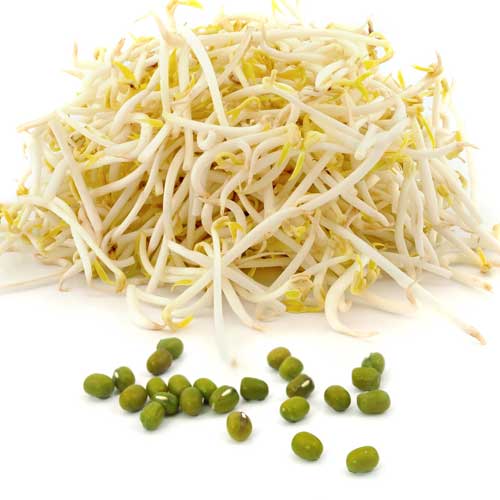
Mung bean sprouts (Vigna radiata) are the crisp, mild, juicy white sprout in pad thai, chow mein, spring rolls, and stir-fries across Asian kitchens — the most widely eaten sprout in the world. These organic, non-GMO seeds from Mumm’s are grown specifically for sprouting, with the high germination and vigour that give thick, tender sprouts from a jar and water alone. A single tablespoon of dry seed fills a jar with sprouts in a few days, fresher and cheaper than anything on a store shelf.
The same seed does double duty in the garden. Grown out to maturity, mung beans are a warm-season legume that fixes its own nitrogen and works beautifully as a fast cover crop or green manure — one packet, several genuinely different uses.
For sprouting, region is irrelevant — mung beans sprout indoors year-round across every province and state, needing only a warm room and clean water. Grocery-fresh sprouts on the counter in the dead of a Yukon or Manitoba winter are exactly the point.
United States: As a garden crop, mung beans thrive anywhere with a long, warm summer — the Southeast, Gulf Coast, Southern Plains, Texas, California valleys, and the Midwest all mature them easily. Northern states can grow them by starting after the soil warms and choosing a sunny, sheltered bed.
Canada: Mung beans mature outdoors in the warmest zones — Southern Ontario, the southern Prairies, and the BC Interior/Okanagan — where summers deliver 90-plus frost-free days. In cooler regions they still reward you as a summer cover crop or, most reliably, as an indoor sprout any month of the year.
🌿 Sprouting Mung Beans
Mung bean seeds sprout in 3–5 days at room temperature and need no soil and no light — just a jar, water, and a rinse twice a day. They are the ideal first sprout: forgiving, fast, and reliably productive, with a clean, neutral crunch that suits almost any dish.
Measure a small amount of seed — it multiplies dramatically — then soak, drain, and rinse on a simple rhythm until the shoots are ready.
- Measure 2–3 tablespoons of dry mung bean seeds into a clean wide-mouth jar — that small amount fills a 1-litre jar once sprouted.
- Cover with cool water and soak 8–12 hours (overnight is easiest); the beans roughly double as they take up water.
- Drain thoroughly, cap with a sprouting screen or mesh lid, and invert the jar at a 45° angle so air circulates and excess water runs off.
- Rinse and drain twice daily with cool water — thorough draining is what keeps the sprouts from souring.
- Keep the jar in the dark (a cupboard is perfect) — light turns mung sprouts green and bitter.
- Harvest at 2–5 cm (1–2 in), usually day 3–5. Give a final rinse, drain very well, and refrigerate.
For the long, pale, thick sprouts you see in restaurants, keep the jar in full darkness the entire time and rinse with slightly cooler water; a gentle weight on top encourages straighter growth. Use the fresh sprouts within a few days — a quick 60-second toss into a hot stir-fry, or straight onto noodles and salads raw.
🌱 Growing Mung Beans as a Cover Crop
Mung bean seeds double as a fast, warm-season cover crop and green manure. As a legume, mung beans host nitrogen-fixing bacteria in their root nodules and pull atmospheric nitrogen into the soil; their quick, leafy canopy also shades out weeds and shields bare ground from summer sun.
Broadcast seed at roughly 12–20 g per m² (about 4–6 lb per 1,000 sq ft) over cleared ground once the soil has warmed, rake in lightly, and water to establish. Turn the plants under just before flowering, when leaf nitrogen peaks and the stems are still soft enough to break down quickly — leaving a warm-season nitrogen boost for whatever follows.
🌾 How to Grow Mung Bean Seeds
Mung beans grow as a warm-season annual, maturing in 90–120 days from a direct sowing once the soil reaches 18°C (65°F). The bushy plants set slender pods you shell for dry beans — the very same beans you can then sprout, cook, or replant.
Direct sow after all danger of frost has passed and nights stay mild; mung beans resent cold, wet ground.
- Wait until the soil warms to 18°C (65°F) before sowing — frost-tender seed rots in cold, damp beds.
- Sow seeds 2–3 cm (1 in) deep, 8–10 cm (3–4 in) apart, in rows 45–60 cm (18–24 in) apart.
- Expect emergence in 7–10 days; keep the bed lightly moist until seedlings are up, then water only in dry spells.
- Skip nitrogen feeding — as a legume, mung beans make their own, so avoid high-nitrogen fertilizer that pushes leaves at the expense of pods.
- Mature pods are ready 90–120 days from sowing; harvest them once they turn brown and brittle.
- Shell the dry beans and store airtight — they sprout, replant, or cook like any dry pulse.
🌱 Saving Mung Bean Seeds
Saving mung bean seeds is straightforward because Vigna radiata is reliably self-pollinating and comes true to type. Leave a few of the healthiest plants unharvested and let their pods dry fully on the stem, then pick, shell, and finish drying the beans indoors before storing.
Mumm’s mung beans are open-pollinated rather than hybrid, so seed saved from them grows true to the parent. Because the flowers self-pollinate before they open, crossing between varieties is rare and a few metres of isolation is plenty in a home garden. Stored cool, dark, and dry, saved mung bean seeds stay viable for 4–5 years — test a batch by sprouting ten on a damp paper towel before a big sowing.